

Are you worried that shipping paperwork errors will cause delays? These simple mistakes can lead to big fines and hold-ups at the port, costing you time and money.
N.O.S. means "Not Otherwise Specified." It is a label for dangerous goods that do not have a specific name on the official lists. You must use it correctly by adding the primary hazardous technical name1 on the shipping documents to ensure safety and legal compliance.
Getting dangerous goods classifications right is a huge part of my job. I've seen how small errors can create massive problems for businesses. Many shippers see "N.O.S." and think it's an easy way out of detailed paperwork. But it's the opposite. It requires more attention, not less. Understanding how to handle N.O.S. shipments is not just about following rules. It is about keeping people safe and your cargo moving smoothly. Let's break down what you need to know.
What Goes Wrong Most Often?
Struggling with rejected shipments due to paperwork? An incorrect N.O.S. entry is a common reason. This mistake stops your cargo and can lead to inspections and penalties2.
The biggest mistake is failing to include the required technical name in parentheses after the N.O.S. description. Another common error is using N.O.S. as a lazy shortcut when a more specific shipping name3 actually exists on the dangerous goods list.

In my years in logistics, I've seen this happen too many times. A client once tried to ship a cleaning solution. They couldn't find "Cleaning Solution" on the dangerous goods list, so they just wrote "Corrosive Liquid, N.O.S." and hoped for the best. The shipment was immediately flagged and held by the carrier. The problem was they failed to specify what made it corrosive. The carrier and port authorities need to know if they are dealing with an acid or a base. This lack of detail creates a safety risk for everyone handling the container.
Vague or Missing Technical Names
The most frequent error is simply forgetting the technical name. The regulations are very clear: an N.O.S. entry is incomplete without it. For example, just writing "Flammable Liquid, N.O.S." is not enough. You must add the chemical that makes it flammable, like this: "Flammable Liquid, N.O.S. (contains Xylene and Acetone)."
Using N.O.S. as a Shortcut
Some shippers use N.O.S. to avoid doing the proper research. They think it’s a generic category for anything they can't immediately identify. This is a dangerous assumption. You must always check the official dangerous goods list first. If a specific name for your product exists, you must use it. Using N.O.S. when a specific entry is available is a compliance violation4.
Incorrect Classification
Another issue is choosing the wrong N.O.S. entry. A substance might have multiple hazards. For example, it could be both flammable and toxic. The shipper must determine the primary hazard and choose the N.O.S. entry that reflects it. Guessing the hazard class is not an option. It requires a careful review of the product's Safety Data Sheet (SDS)5.
| Common Mistake | Correct Approach |
|---|---|
[UN1993](https://www.dgm-boston.com/gallery/un-1993-flammable-liquid/)6, Flammable Liquid, N.O.S. |
UN1993, Flammable Liquid, N.O.S. (Ethanol) |
| Using N.O.S. for "Paint" | Finding the specific entry UN1263, Paint |
| Guessing the hazard class | Using the SDS to identify the primary hazard |
What Is N.O.S.7?
Confused by what N.O.S. actually means on a shipping document? It seems like a simple abbreviation, but its misuse can cause serious compliance issues for your business.
N.O.S. stands for "Not Otherwise Specified." It is a category used in dangerous goods regulations for a substance or mixture that is not explicitly listed by its specific name. It acts as a "catch-all" entry but requires additional information for safety.

Think of the dangerous goods list like a giant directory. It has thousands of specific names, from "Acetone" to "Zinc Peroxide." But new chemical mixtures are created all the time. Regulators at organizations like the United Nations, IATA (for air), and IMO (for sea) can't list every possible substance. The N.O.S. entry was created to close this gap. It provides a systematic way to classify and ship these unlisted materials safely. It’s not a loophole. It’s a tool designed to maintain safety standards for materials that don't fit neatly into a pre-existing box.
A "Catch-All" with Strict Rules
N.O.S. entries are designed to cover groups of substances that share the same type of hazard. For example, UN1993, Flammable Liquid, N.O.S. can be used for any liquid that meets the criteria for a Class 3 flammable liquid but isn't listed by a more specific name. However, this flexibility comes with a very important condition. You must declare what specific chemical(s) in the mixture create the hazard. This is the core principle of using N.O.S. correctly. It ensures that even without a specific name, the danger is clearly communicated.
The Purpose is to Close Gaps
The primary goal of N.O.S. is to ensure every dangerous good shipment is properly declared. Without it, shippers might be unable to legally transport newly developed products or complex mixtures. It ensures the classification system can adapt. But it was never intended to make the shipper's job easier. I often tell my clients that using an N.O.S. entry means you have more responsibility, not less. You are the one who must provide the specific details that emergency responders8 would need in case of a spill or accident.
The Core Requirement: What is the Technical Name?
You know you need a "technical name" for N.O.S. shipments, but what is it? Using the wrong name, like a brand name, is a common error that gets shipments rejected.
The technical name is the recognized chemical or microbiological name of the substance that makes the cargo dangerous. It cannot be a trade name. For mixtures, you must list up to two components that contribute most to the hazard.

I had a case with a company shipping an industrial adhesive. They listed the technical name as "SuperGrip 5000," which was the product's brand name. The shipment was stopped. The carrier rightly pointed out that "SuperGrip 5000" means nothing to a firefighter or a hazmat team. They need to know the actual chemical causing the hazard. After we helped them review their Safety Data Sheet (SDS), we found the primary hazardous ingredient was "Methyl Ethyl Ketone." Once we corrected the declaration to "Adhesives, N.O.S. (contains Methyl Ethyl Ketone)," the shipment was cleared.
Defining the "Technical Name"
The regulations are very specific about this. The technical name must be a name that is recognized in scientific and technical handbooks. It’s the true chemical name. For example, if you are shipping a cleaning product that is corrosive because it contains sodium hydroxide, then "Sodium Hydroxide" is the technical name. You cannot use generic terms like "caustic solution" or the product's marketing name.
How to Find the Right Name
The best and most reliable source for the technical name is the product's Safety Data Sheet (SDS). Specifically, Section 14, "Transport Information," will often provide the proper shipping name and any required technical names. If it's not there, you may need to look at Section 3, "Composition/information on ingredients," to identify the hazardous components.
Common Pitfalls with Technical Names
The biggest trap is using a name that is familiar to you but not technically correct. It's crucial to avoid this.
| Incorrect Name Type | Example | Correct Technical Name |
|---|---|---|
| Trade Name | PowerClean Degreaser | Isopropanol |
| Generic Description | Alcohol solution | Ethanol |
| Vague Term | Industrial Solvent | Toluene |
Always verify the name against the SDS. If you are shipping a mixture, identify the one or two chemicals that are most responsible for the hazard classification and list them.
Why Does It Matter?
Is taking a shortcut on N.O.S. paperwork really a big deal? Yes. A small documentation error can have huge consequences, affecting safety, your finances, and your company's reputation.
Correct N.O.S. documentation is critical for safety. It tells emergency responders what they are dealing with in an accident. It also ensures legal compliance, helping you avoid massive fines, shipping delays, and potential liability for damages.

Think about the worst-case scenario: a container leak in a port or on a ship. The first responders arrive on the scene and see a placard for "Corrosive Liquid, N.O.S." If the paperwork is incomplete, they have no idea what chemical is inside. Is it an acid that reacts violently with water? Is it a substance that releases toxic gas? The technical name gives them the information they need to respond safely and effectively. It protects their lives and minimizes environmental damage. This isn't just about red tape; it's about real-world safety.
Safety for Everyone
The technical name on the shipping documents is not for the shipper or the consignee. It is for the people in between. This includes the truck driver, the warehouse staff, the ship's crew, and the emergency services. Each of these people relies on your declaration to handle the cargo safely. An accurate declaration tells them what precautions to take, what other goods to keep separate, and how to react if something goes wrong. Providing the correct technical name is a fundamental part of your responsibility in the supply chain.
Avoiding Legal and Financial Trouble
Regulators do not take N.O.S. violations lightly. The penalties can be severe. Fines can run into thousands of dollars per day, per violation. Beyond fines, your cargo will be stopped, leading to customs holds9, storage fees, and missed delivery deadlines. This directly impacts your bottom line and your relationship with your customer. In the event of an accident, an incorrect declaration could even make your company legally liable for damages, injuries, or environmental cleanup costs. The financial risk is simply not worth the shortcut.
Maintaining Your Reputation
Your compliance record matters. Carriers, customs brokers, and government agencies all keep track of shippers. A history of incorrect declarations will flag you as a high-risk shipper. This can lead to more frequent inspections, higher insurance premiums, and even refusal by some carriers to transport your goods. A good reputation for compliance makes your entire logistics process10 smoother and more reliable.
How Can You Get It Right?
Ready to make sure your N.O.S. shipments are always compliant? The process is straightforward if you follow a few key steps. It's about being diligent, not taking shortcuts.
First, always check if a specific shipping name exists. If not, select the most appropriate N.O.S. entry. Then, use the Safety Data Sheet (SDS) to identify the correct technical name and add it to your documentation. When in doubt, ask an expert.
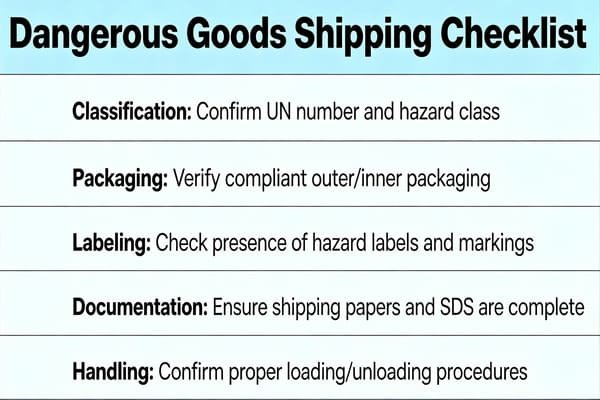
The key is to build a reliable process. I advise all my clients to create a simple checklist for their shipping department11. It removes guesswork and ensures consistency. This process should start long before the container is booked. It begins with product classification. The person responsible for shipping must have access to the SDS for every product and must be trained to read it. Making this a standard procedure is the single most effective way to prevent N.O.S. errors and ensure your cargo keeps moving without any issues.
A Step-by-Step Checklist
Here is a simple process to follow for every shipment that might be N.O.S.:
- Search the List First: Always start by searching the official Dangerous Goods list for your product's name. A specific entry must be used if one exists.
- Select the Best N.O.S. Entry: If no specific name is found, review the N.O.S. options. Choose the one that most accurately describes the primary hazard of your product (e.g., flammable, corrosive, toxic).
- Consult the SDS: Find the Safety Data Sheet (SDS) for your product. Go to Section 14 (Transport Information) and Section 3 (Composition) to identify the hazardous ingredients.
- Identify the Technical Name(s): From the SDS, determine the chemical name(s) responsible for the hazard. Remember to list up to two if it's a mixture.
- Document Correctly: Write the Proper Shipping Name exactly as required. For example:
UN 2924, Flammable liquid, corrosive, n.o.s. (Methanol, Potassium Hydroxide).
When to Ask for Help
There will be times when a product is complex or an SDS is unclear. You might have a new formula or a product with multiple, competing hazards. In these situations, do not guess. The risks are too high. This is the time to consult with a dangerous goods expert or a logistics partner like us at Deeplinker. We handle these classifications every day. A quick consultation can save you from weeks of delays and thousands of dollars in fines. It's a small investment to ensure your shipment is safe and compliant.
Conclusion
Properly using N.O.S. entries is not about extra paperwork. It is about ensuring safety and compliance. Always be precise, use the technical name, and never guess.
Discover the significance of using the correct hazardous technical name in shipping. ↩
Learn what can lead to inspections to avoid delays and fines. ↩
Finding the correct shipping name is essential for compliance and safety. ↩
Understanding the penalties can help you avoid costly mistakes in shipping. ↩
A comprehensive guide on interpreting SDS can prevent costly shipping errors. ↩
Understanding UN codes is essential for proper classification of hazardous materials. ↩
Understanding N.O.S. is crucial for compliance and safety in shipping dangerous goods. ↩
Understanding their needs can improve safety during incidents involving hazardous materials. ↩
Understanding customs holds can help you avoid delays and additional costs. ↩
Optimizing your logistics process can enhance efficiency and compliance. ↩
Implementing best practices can streamline processes and reduce errors in shipping. ↩