


Shipping lithium batteries feels complicated. A mistake can cause big delays and fines. This guide makes the rules simple, so you can ship your goods without any trouble.
SP188 is a special provision that lets you ship certain lithium batteries as non-dangerous goods if they meet strict criteria. PI965, PI966, and PI967 are IATA packing instructions for shipping lithium batteries by air as dangerous goods, depending on how they are packed.
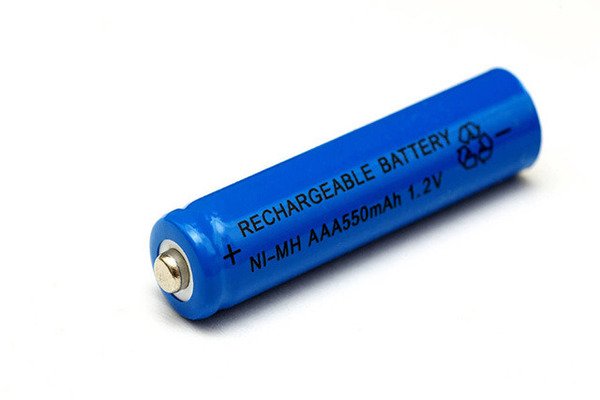
I talk to clients every day who are confused about shipping products with lithium batteries. They worry about getting it wrong. It's a valid concern because the rules are very specific. But once you understand the basic differences, it becomes much easier to manage. This guide will walk you through everything you need to know. Let's break it down so you can feel confident about your next shipment.
Can my cargo ship under SP188, and do I need a DG declaration for air shipment
Struggling to figure out if your battery shipment needs a dangerous goods declaration? The rules can be confusing and lead to costly mistakes. Let’s clear this up for you.
Your cargo can ship under SP1881 as non-dangerous goods if the batteries meet specific energy and packaging limits. If they don't, you must ship them by air under PI9652/966/967, which requires a Dangerous Goods (DG) declaration3.
Deciding if your cargo qualifies for SP188 is the first, most important step. It all comes down to the power of your batteries and how they are packed. I remember a new client shipping electronic skateboards. They assumed because the batteries were inside the product, they were safe. But the battery's watt-hour (Wh) rating was too high for SP188. Their shipment was stopped at the port, and we had to re-certify and re-pack everything as dangerous goods. This caused a two-week delay. To avoid this, you must check the specific energy limits.
Key Factors for SP188 Qualification
- Watt-hour (Wh) Rating4: For lithium-ion cells, the rating must be ≤ 20Wh. For batteries, it must be ≤ 100Wh.
- Lithium Content5: For lithium metal cells, the content must be ≤ 1g. For batteries, it must be ≤ 2g.
If your batteries are within these limits, you can likely use SP188. If they exceed these limits, you cannot. For air freight, this means you must follow the full IATA Dangerous Goods Regulations6s](https://www.iata.org/contentassets/05e6d8742b0047259bf3a700bc9d42b9/lithium-battery-guidance-document.pdf)%%%FOOTNOTE_REF_7%%%, which includes a formal DG declaration.
What is SP188
Confused by the term "SP188"? It sounds technical, but it’s a key rule that can save you time and money. Not knowing about it could mean you're overpaying for shipping.
SP188 is a “Special Provision” in transport regulations like IMDG Code for sea freight. It provides an exemption, allowing smaller lithium batteries that meet strict criteria to be shipped as general cargo, not as fully regulated Class 9 Dangerous Goods.
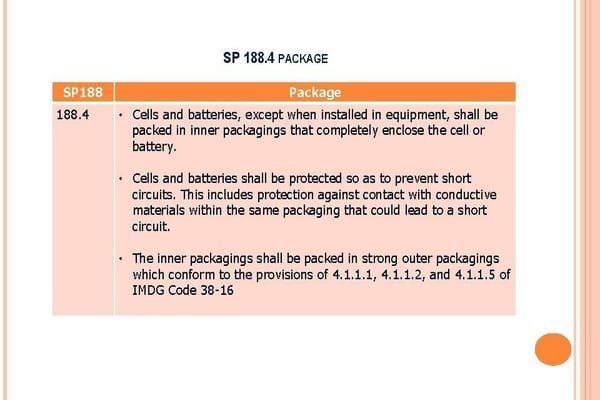
Think of SP188 as a special pass. If your batteries are small enough and pass certain safety tests, you get to use this pass. It simplifies the whole shipping process. The most critical test is the UN38.3 test8. Every lithium battery model must pass this series of tests to prove it can handle the stress of transport. This includes tests for altitude, thermal changes, vibration, and shock. When we handle a shipment, the first document we ask for is the UN38.3 test report, along with the Material Safety Data Sheet (MSDS)9. Without these, we can't even begin to classify the shipment. SP188 isn't a loophole; it's a standard that confirms a battery is low-risk and can be handled safely without the full dangerous goods procedure, as long as packaging and labeling rules are still followed.
What are PI965 / PI966 / PI967
Shipping batteries by air brings a new set of codes: PI965, PI96610, and PI96711. These codes look similar but mean very different things. Using the wrong one will get your shipment rejected.
PI965, PI966, and PI967 are IATA Packing Instructions for shipping lithium-ion batteries by air. They define how batteries must be packed based on whether they are shipped alone, with equipment, or inside equipment. Each has specific rules for labeling and quantity.
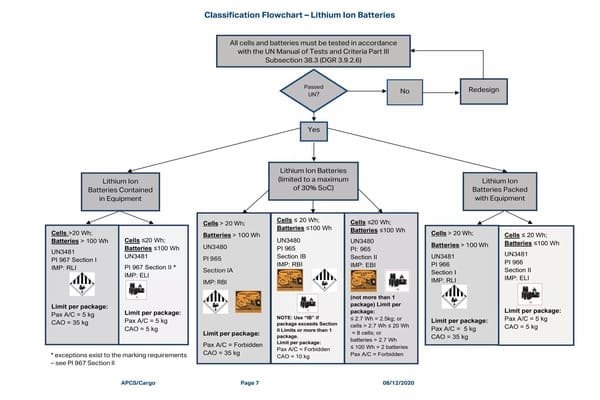
These packing instructions are the core of IATA's safety rules for batteries on planes. The risk level is different for each scenario, so the rules are different too. I once worked with a company shipping medical devices. They packed spare batteries in the same box as the device but didn't separate them properly. They used PI967 (contained in equipment) when they should have followed PI966 (packed with equipment). The airline rejected the cargo because the packaging didn't meet PI966 standards, which are stricter. We had to bring the shipment back to our warehouse to repack it correctly. It's a small detail, but for airlines, there is no room for error.
Here is a simple breakdown:
- PI965: For lithium-ion batteries packed by themselves. This is the most restrictive category.
- PI966: For lithium-ion batteries packed alongside the equipment they power.
- PI967: For lithium-ion batteries already installed inside the equipment they power.
SP188 vs PI965/966/967
You know the terms, but what's the real difference between them? Choosing the wrong one can lead to your shipment getting stuck. Let's make the difference clear and simple.
SP188 is an exemption that applies mainly to sea and road freight, letting you ship low-power batteries as non-dangerous goods. PI965/966/967 are mandatory IATA packing instructions for shipping batteries as dangerous goods by air freight.
The main difference is the mode of transport and the level of regulation. SP188 is your goal if you want to simplify logistics, especially for sea freight. It means less paperwork and lower costs. The PI codes are what you must follow for air freight, and they treat batteries as dangerous goods. A client shipping power banks wanted to send a large batch by air. Their individual batteries qualified for SP188 by sea, but for air, they had to be classified under PI965. This meant they needed special DG packaging, labels, and a Shipper's Declaration for Dangerous Goods. The cost was higher, but it was the only compliant way to ship by air. Understanding this distinction from the start saved them from trying to send something improperly and facing rejection by the airline.
| Feature | SP188 | PI965 / PI966 / PI967 |
|---|---|---|
| Primary Transport Mode | Sea (IMDG), Road (ADR) | Air (IATA) |
| Cargo Classification | Non-Dangerous Goods (if all conditions met) | Class 9 Dangerous Goods |
| Declaration Required | No formal DG Declaration | Shipper's Declaration for Dangerous Goods |
| Main Requirement | Battery Wh/lithium content below threshold | Follows specific IATA packing instructions |
| Use Case | Simplifies logistics for low-power batteries | Mandatory for all air shipments of lithium batteries |
Step-by-Step Decision Guide
Feeling overwhelmed by the choices? You need a clear path to follow. Let's create a simple checklist to help you decide how to ship your batteries every single time.
Follow a simple process: First, identify your battery type and power rating. Second, check how it’s packed. Third, choose your shipping method. This will tell you exactly which regulation—SP188 or a PI code—to use for your shipment.
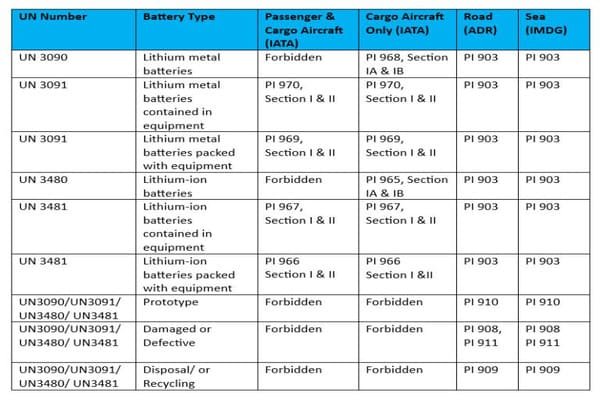
Making the right choice is about asking the right questions in the right order. Don't just guess. I always walk my clients through this process to ensure we have all the correct information before we even book a shipment. It avoids surprises later on. For example, a client was shipping drones with batteries contained inside. By following the steps, we quickly confirmed the battery was under 100Wh and they were shipping by sea. This made it a straightforward SP188 shipment. They just needed the right outer box markings. If they had chosen air freight, we would have gone down the PI967 path instead. A clear process removes doubt and ensures compliance.
Your 4-Step Checklist
- Get Your Documents: Start with the Material Safety Data Sheet (MSDS) and the UN38.3 test report for your battery. These documents contain all the technical details you need.
- Check the Power: Find the Watt-hour (Wh) rating for ion or lithium content for metal batteries. Is it under the SP188 limit (≤100Wh for batteries, ≤20Wh for cells)?
- Define Your Shipment: How are you packing the batteries? By themselves (PI965), with equipment (PI966), or in equipment (PI967)? How are you shipping? Sea, air, or road?
- Make the Call:
- Shipping by sea/road + battery is under the limit? You can likely use SP188.
- Shipping by air? You must use the correct PI code. The power rating will determine if you can use the more relaxed Section II or need the full Section I requirements.
Common Mistakes to Avoid
Knowing the rules is one thing, but avoiding common pitfalls is another. Many shippers make the same simple errors. A small mistake can cause big problems for your shipment.
The most common mistakes are miscalculating the battery's watt-hours, using incorrect packaging, forgetting the required marks and labels, and not having the UN38.3 test report ready. Any of these can lead to shipment rejection.
I've seen it all over the years. The most frustrating delays often come from the simplest mistakes. I remember one shipment of electric toothbrushes that was held up for a week. The supplier had put the lithium battery mark on the box, but it was too small and the wrong color. The carrier's inspector flagged it immediately. We had to have the entire shipment relabeled at the warehouse. It was an expensive lesson for my client over a five-cent sticker. These details matter. Double-checking your packaging and paperwork before the cargo leaves your factory is the best way to ensure a smooth journey. Never assume your supplier knows all the rules. Always verify everything yourself or with your logistics partner.
Top Mistakes to Watch For:
- No UN38.3 Report: This is non-negotiable. If you don't have this report, you cannot ship your batteries. Period.
- Bad Packaging: Using a weak outer box or not protecting batteries from short-circuiting is a frequent failure. The package must be strong enough to pass a 1.2-meter drop test.
- Incorrect Labeling: Forgetting the lithium battery mark, putting it in the wrong place, or not including a contact phone number are common errors.
- Hiding Batteries: Some shippers try to hide batteries in their cargo to avoid regulations. This is extremely dangerous, illegal, and can lead to huge fines and blacklisting.
Conclusion
Understanding SP188 and the PI codes is key to shipping batteries. SP188 simplifies sea freight for small batteries, while PI codes are mandatory for safe air transport.
Explore this link to understand how SP188 can simplify your shipping process and save you money. ↩
Learn about PI965 to ensure your lithium batteries are packed correctly for air transport. ↩
Understand when a DG declaration is necessary to avoid shipment delays and fines. ↩
Find out how watt-hour ratings affect your shipping options and compliance. ↩
Learn about lithium content limits to determine if your batteries qualify for non-dangerous shipping. ↩
Understand the IATA regulations to ensure compliance when shipping by air. ↩
Understand the regulations to ensure your shipments are compliant and safe. ↩
Explore the importance of the UN38.3 test in ensuring safe transport of lithium batteries. ↩
Learn why the MSDS is crucial for shipping lithium batteries safely and legally. ↩
Discover the specifics of PI966 to avoid costly mistakes when shipping batteries with equipment. ↩
Understand PI967 to ensure compliance when shipping batteries already installed in equipment. ↩