
Shipping fertilizers can be a confusing process. The rules seem to change, and costs can unexpectedly rise. Understanding the correct classification is key to smooth, cost-effective exports.
No, fertilizers are not automatically classified as dangerous goods for maritime export. The classification depends entirely on the fertilizer's specific chemical composition1 and properties. An official Material Safety Data Sheet (MSDS)2 is required to determine if it is hazardous or can be shipped as general cargo.
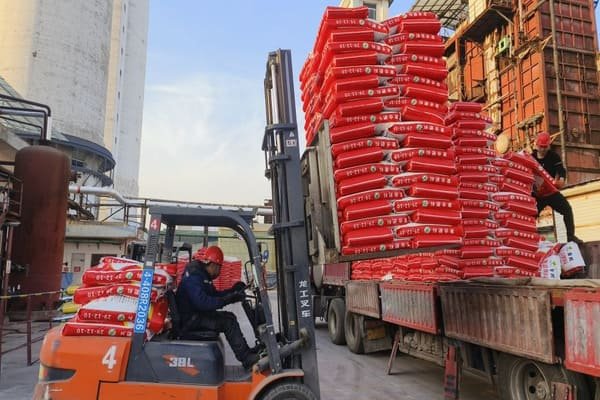
I remember a client who was completely stuck. They had a large order of fertilizer to ship, but two different shipping lines gave them opposite answers. One said it was general cargo3, the other insisted it was hazardous4. This confusion was costing them time and money every day. This experience is common, but it doesn't have to be your reality. Let's break down the process so you can ship your products with confidence and clarity. This article will guide you through the essential questions and provide clear answers.
Why Does Shipping fertilizer Cause So Many Headaches?
Are you trying to export fertilizer but getting conflicting information from carriers? These delays and unexpected costs can be incredibly frustrating. Let’s clear up the confusion right now.
The main headache is that "fertilizer" is a very broad term. Some types are completely harmless, but others contain chemicals that are considered hazardous for sea transport, like being oxidising5 or self-heating6. This variety creates uncertainty for both shippers and carriers.

I've seen this firsthand many times. The core of the problem lies in a few key areas. It's important to understand these points to see the full picture.
The Shipper's Responsibility
First, the responsibility for correctly declaring cargo lies with you, the shipper. The shipping line doesn't test your product. They rely on the information you provide. If you declare it incorrectly, even by mistake, you are liable for any fines, damages, or accidents that occur. This is a heavy burden, and it's why getting it right is so critical.
The Carrier's Caution
Second, shipping lines are extremely cautious. An incident involving improperly declared dangerous goods can be catastrophic, leading to fires, explosions, or environmental damage. Because of this high risk, they often have their own safety checks7. If your documentation is unclear or incomplete, they will always choose the safer option, which might mean treating your cargo as hazardous or refusing it altogether. They are protecting their crew, their vessel, and their business.
The Sheer Variety of Products
Finally, the word "fertilizer" covers a huge range of chemical products. A simple urea fertilizer is very different from an ammonium nitrate8-based fertilizer. The latter can be a powerful oxidising agent, which means it can make other materials burn more intensely. Because of this, regulations like the International Maritime Dangerous Goods (IMDG) Code9 have very specific rules for certain fertilizer types.
Are All Fertilizers Automatically Considered Dangerous Goods for Shipping?
Do you assume all fertilizers are hazardous, leading to higher shipping costs? This common mistake can make your products uncompetitive. In fact, many fertilizers can be shipped as general cargo.
No, not at all. Many common fertilizers, like urea or potassium sulphate, are typically non-hazardous and ship as general cargo. The classification depends entirely on the chemical ingredients and their concentrations, which must be verified through an official Material Safety Data Sheet (MSDS)2.
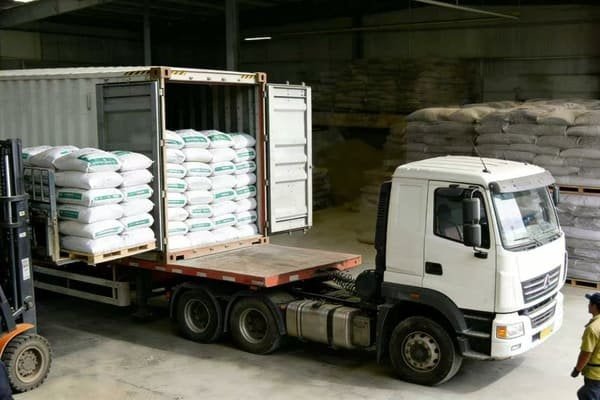
It's a simple but crucial point: you cannot guess. The chemical makeup is everything. A small change in formula can be the difference between a simple shipment and a complex, expensive one.
It's All in the Chemistry
The hazardous properties of a fertilizer come from its ingredients. For example, ammonium nitrate is a key component to watch. In certain concentrations, it is classified as an oxidising substance (Class 5.1) because it can release oxygen and intensify a fire. Other fertilizers might have corrosive properties or other hazards. On the other hand, many fertilizers are chemically stable and pose no such risks during transport.
The Power of the MSDS
The single most important document is the Material Safety Data Sheet (MSDS), which you get from the manufacturer. This document details the product's chemical properties10 and hazards. Specifically, Section 14 of the MSDS is for "Transport Information." If this section lists a UN Number11, a Proper Shipping Name, and a Hazard Class, your product is a dangerous good. If it states "Not regulated for transport," it's general cargo.
Here is a simple table to show the difference:
| Fertilizer Type | Common Classification | Why? |
|---|---|---|
| Urea | General Cargo | Chemically stable, not an oxidiser. |
| Potassium Sulphate | General Cargo | Stable salt, poses no transport hazard. |
| Ammonium Nitrate (high N%) | Dangerous Good (Class 5.1) | Strong oxidising properties. |
| Ammonium Sulphate | Usually General Cargo | Less reactive than ammonium nitrate. |
As you can see, you can't just look at the word "fertilizer." You have to know exactly what's inside.
How Are Fertilizers Actually Classified as Dangerous Goods for Sea Transport?
Do you see codes like "Class 5.1" and UN numbers but have no idea what they mean? Misunderstanding these classifications can lead to rejected shipments and major delays. Let's decode them.
Fertilizers are classified as dangerous goods according to the International Maritime Dangerous Goods (IMDG) Code. The most common classes are Class 5.1 (Oxidising Substances) and Class 9 (Miscellaneous Dangerous Goods). Each classification has a specific UN Number identifying the exact substance.
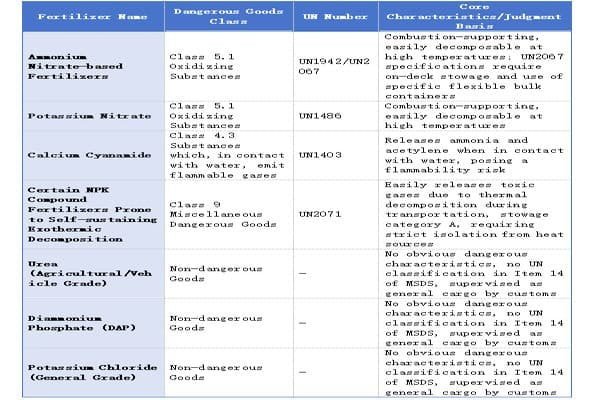
When a fertilizer is deemed hazardous, it isn't just a generic label. It's assigned to a specific class based on the primary danger it presents. I always tell my clients to think of these classes as "hazard families."
Class 5.1: Oxidising Substances
This is the most common class for hazardous fertilizers. An oxidising substance is one that can cause or contribute to the combustion of other materials, usually by yielding oxygen. It makes fires start more easily and burn more fiercely.
- Key Ingredient: Ammonium Nitrate is the usual suspect here.
- Example: UN 2067, AMMONIUM NITRATE BASED FERTILIZER. This is a specific entry in the IMDG code for fertilizers that meet certain criteria to be classified as oxidisers.
Class 9: Miscellaneous Dangerous Goods
This class is a catch-all for substances that present a danger during transport but don't fit into any of the other 8 classes. For fertilizers, this often applies to ammonium nitrate mixtures that are considered hazardous but don't meet the strict criteria for Class 5.1.
- Example: UN 2071, AMMONIUM NITRATE BASED FERTILIZER. This is for formulations that have hazardous properties (like self-sustaining decomposition) but are not considered primary oxidisers.
Here’s a table summarising the main classifications you'll encounter:
| UN Number | Proper Shipping Name | Class | Main Hazard |
|---|---|---|---|
| UN 1942 | AMMONIUM NITRATE | 5.1 | Oxidiser |
| UN 2067 | AMMONIUM NITRATE BASED FERTILIZER | 5.1 | Oxidiser |
| UN 2071 | AMMONIUM NITRATE BASED FERTILIZER | 9 | Miscellaneous (e.g., can decompose) |
Understanding these specific codes is vital. When you book your shipment, you must provide this exact information. It tells the carrier exactly what they are handling and how to stow it safely on the vessel.
What Are the Practical Steps to Check if My Fertilizer is a Dangerous Good?
You need to ship your fertilizer but are not sure where to even begin checking its status. Guessing is not an option and can lead to serious legal and financial trouble.
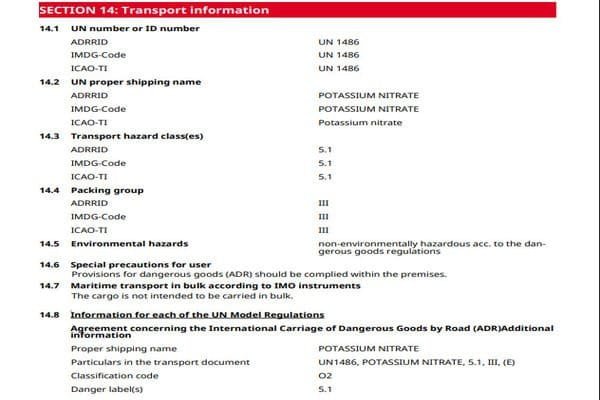
First, you must obtain the product's Material Safety Data Sheet (MSDS) from the manufacturer. Go directly to Section 14, "Transport Information." If it lists a UN number and a hazard class12, it is a dangerous good. If not, it is likely general cargo.
I guide my clients through a simple, foolproof process. Following these steps removes all guesswork and ensures you are compliant every single time.
Step 1: Obtain the Correct MSDS
This is the non-negotiable starting point. You must get the MSDS from the factory or supplier that produced the fertilizer. Make sure it is recent and that it matches the exact product you are shipping. An old or generic MSDS is not acceptable and will be rejected by the shipping line.
Step 2: Analyze Section 14
Once you have the MSDS, ignore everything else for a moment and go straight to Section 14: Transport Information. This section is specifically for logistics. You are looking for four key pieces of information:
- UN Number: A four-digit number (e.g., UN 2067).
- Proper Shipping Name: The official name used for transport (e.g., AMMONIUM NITRATE BASED FERTILIZER).
- Hazard Class: The class number (e.g., 5.1 or 9).
- Packing Group: A Roman numeral (I, II, or III) indicating the degree of danger.
If you see this information, your product is a dangerous good. It's that simple.
Step 3: What If It's Not a DG?
If Section 14 is blank or explicitly states "Not regulated for transport" or "Not dangerous goods," then you can proceed as if it's general cargo. However, carriers will still ask for proof. You will need to provide them with the MSDS and often a formal "Letter of Non-Hazardous Transport" from the manufacturer, which is a simple statement confirming the product is safe for transport.
Step 4: When in Doubt, Ask
If the MSDS is ambiguous, or if you have any doubts, do not guess. I always tell my clients, "When in doubt, ask." You can consult with a logistics professional like me, a freight forwarder with DG experience, or a chemical safety expert. A short conversation can save you from a massive headache later on.
What's the Real Difference in Exporting General vs. Hazardous Fertilizers?
You want to understand the actual, real-world impact of a dangerous goods classification. The extra paperwork, costs, and procedures can seem overwhelming. Let's compare the two processes directly.
The difference is huge. Hazardous fertilizers require special DG-certified packaging, container placards, a Dangerous Goods Declaration13, and are restricted to specific vessels and stowage locations. All of this adds significant cost, complexity, and requires much longer lead times for booking.
I've managed both types of shipments for years, and the difference is like night and day. Thinking about it in two distinct paths helps clarify just how much a DG classification changes things.
The General Cargo Path (The Easy Way)
When your fertilizer is confirmed as non-hazardous, the process is straightforward.
- Documentation: You need a standard set of shipping documents: Commercial Invoice, Packing List, and Bill of Lading instructions. You will also need to provide the MSDS to prove it is non-hazardous.
- Packaging: Your packaging just needs to be strong enough for export. Standard woven polypropylene (PP) bags are usually fine.
- Booking & Shipping: You can book space on almost any vessel going to your destination. The booking process is fast, and your container can be loaded almost anywhere on the ship.
- Cost: You pay the standard ocean freight rate. There are no extra surcharges related to the product's nature.
The Hazardous Goods Path (The Complex Way)
If your fertilizer is a dangerous good, the process becomes much more involved and expensive.
| Aspect | General Cargo Process | Hazardous Goods Process |
|---|---|---|
| Documentation | Standard documents + MSDS. | Standard docs + Dangerous Goods Declaration (DGD) + MSDS. |
| Packaging | Standard export-worthy bags. | UN-approved packaging with specific markings and labels. |
| Container | Standard container. | Container must be placarded with the correct hazard class diamonds. |
| Booking | Fast and flexible. | Requires DG approval from the carrier's central team, which takes time. |
| Vessel Choice | Any vessel. | Restricted to vessels certified to carry that specific DG class. |
| Stowage | Flexible. | Restricted to specific locations on the ship, away from heat sources or other reactive cargoes. |
| Cost | Standard freight. | Standard freight + DG Surcharge + higher local handling fees. |
As you can see, a DG classification adds layers of regulation, cost, and complexity at every single step of the process.
Conclusion
Classifying fertilizers for export is not about guessing. It depends on the specific chemical composition1. Always rely on the MSDS and expert assessment to ensure safe, compliant, and cost-effective shipping.
Explore how chemical composition determines shipping classifications and safety. ↩
Understanding the MSDS is crucial for safe shipping practices and compliance with regulations. ↩
Explore the definition of general cargo to understand shipping classifications better. ↩
Learn about the criteria that classify substances as hazardous to ensure safe transport. ↩
Discover the risks associated with oxidising substances to ensure safe shipping practices. ↩
Learn about self-heating materials to ensure safe transport and handling. ↩
Learn about necessary safety checks to prevent accidents during transport. ↩
Understand the specific hazards of ammonium nitrate to ensure safe handling and transport. ↩
Gain insights into the IMDG Code to navigate shipping regulations effectively. ↩
Understanding chemical properties is key to ensuring compliance in shipping. ↩
Understanding UN Numbers is essential for proper classification and safe transport. ↩
Discover the significance of hazard classes for safe and compliant shipping. ↩
Learn about the importance of a Dangerous Goods Declaration for compliance in shipping. ↩