
The Panama Canal Authority is introducing new capacity and booking measures as below-average rainfall continues to affect water availability across the Canal watershed.
The changes are important for companies moving cargo between Asia and the US East Coast, the Gulf Coast, the Caribbean and Europe. However, they do not mean that the Canal is closing or that every vessel will immediately face major delays.
Two official notices—Advisories A-29-2026 and A-31-2026—need to be considered together.
The first reduces the number of available transit slots. The second determines how a large share of the Neopanamax capacity will be allocated among different vessel segments.
For shippers, the practical impact will depend on the type of vessel carrying their cargo, whether the carrier has secured a reservation and whether water conditions deteriorate further.
Why Is the Panama Canal Tightening Capacity?
The Panama Canal depends heavily on freshwater.1
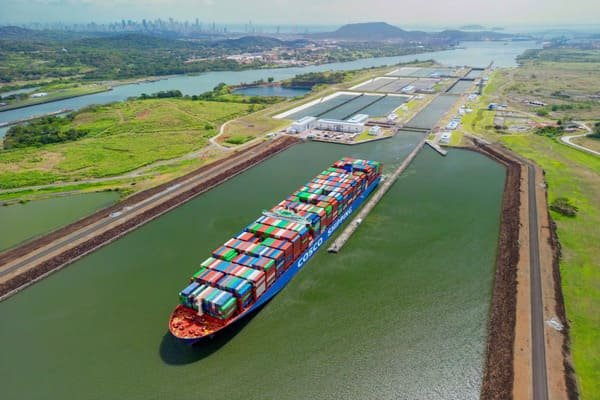
Ships passing through the Canal are raised and lowered through a system of locks. Each transit requires water2, making rainfall, reservoir levels and watershed inflows essential to the Canal’s operating capacity.
According to Panama Canal Authority Advisory A-29-2026, cumulative rainfall across the Canal watershed between May and August was 34% below the historical average.
Watershed inflows were even weaker, at 44% below the historical average for the same period.
The Authority also warned that the anticipated 2026–2027 El Niño event could further reduce rainfall and runoff3 during the remainder of the wet season. This raises concerns about water availability during Panama’s 2027 dry season, which normally runs from January to April4.
The latest measures are therefore preventive. Their purpose is to preserve water while maintaining predictable Canal operations for as long as possible.
What Changes Under Advisory A-29-2026?
Advisory A-29-2026 reduces the number of daily booking slots available through both lock systems.
For booking dates beginning September 4, 2026:
- Neopanamax Locks will offer 9 daily slots.
- Panamax Locks will offer 25 daily slots.
- Total daily booking availability will be 34 slots.
For booking dates beginning September 15, 2026:
- Neopanamax Locks will continue to offer 9 daily slots.
- Panamax Locks will fall to 23 daily slots.
- Total daily booking availability will decline to 32 slots.
The Panama Canal Authority has emphasized that a confirmed reservation is the only mechanism that guarantees a transit date5.
This distinction matters. A vessel with a confirmed reservation may experience a relatively controlled passage, while an unreserved vessel could face a longer and less predictable wait.
What Does Advisory A-31-2026 Change?
Advisory A-31-2026 does not reverse the capacity limits established under A-29. Instead, it modifies the way Neopanamax booking slots are distributed.
The revised rules apply to booking dates beginning September 13, 2026.
The Neopanamax Locks will offer 63 booking slots per week, equivalent to the 9 daily slots established under A-29.
These weekly slots will be allocated as follows:
| Vessel segment | Weekly slots | Slots per booking date | Maximum per customer per week |
|---|---|---|---|
| Full container vessels | 36 | 5 | 7 |
| LPG carriers | 21 | 3 | 3 |
| LNG carriers | 3 | Not applicable | 1 |
| Vehicle carriers, RoRo, bulkers and other vessels | 3 | Not applicable | 1 |
| Total | 63 |
The new rules also allow customers to obtain more than one slot for the same booking date and to secure slots across two or more consecutive booking dates.
This is a meaningful change for large operators managing regular vessel schedules. It gives carriers greater flexibility to maintain consecutive services and reduces some of the limitations created by the previous competition rules.
Container Shipping Receives Stronger Protection
Of the 63 weekly Neopanamax slots, 36 are allocated to full container vessels.
This gives container shipping the largest share of the available Neopanamax capacity.6 LPG carriers receive the second-largest allocation, with 21 weekly slots.
As a result, the immediate impact on scheduled container services may be more manageable than the headline “Panama Canal restrictions” suggests.
Major liner operators generally plan their rotations and Canal reservations in advance. The ability to secure multiple slots on the same date or across consecutive dates may also help carriers maintain weekly service patterns.
However, stronger booking protection does not eliminate every risk.
Container shippers could still be affected by:
- Vessels arriving outside their reserved transit window
- Further reductions in Canal capacity
- Changes to maximum authorized draft
- Service rotation adjustments
- Blank sailings or skipped port calls
- Equipment imbalances
- Delays spreading from other congested ports
The most relevant question for a shipper is therefore not simply whether the Panama Canal is restricted. It is whether the specific vessel carrying the cargo has a confirmed transit reservation.
Which Trades Are Most Exposed?
Asia to the US East Coast
The Asia–US East Coast trade is one of the main container shipping markets exposed to Panama Canal conditions.
Many services from China, Vietnam and other Asian origins use the Canal to reach ports such as:
- New York and New Jersey
- Savannah
- Charleston
- Norfolk
- Miami
- Houston
If transit availability becomes tighter, carriers may adjust schedules or consider alternative routings.
Possible alternatives include routing cargo through US West Coast ports and using rail or truck transportation inland.7 Some services may also use the Suez Canal8, depending on origin, destination and security conditions.
These alternatives can reduce dependence on Panama, but they introduce different costs and operational risks.
LPG and LNG Shipping
LPG carriers receive 21 of the 63 weekly Neopanamax slots, giving the segment a relatively substantial allocation.
LNG carriers, however, receive only three weekly slots under the published distribution.
Energy carriers are particularly sensitive to Canal delays because of their high daily charter costs and the commercial importance of delivery windows.9 If ships cannot obtain suitable reservations, they may need to wait or take a much longer route.
Vehicle Carriers, RoRo and Bulk Shipping
Vehicle carriers, RoRo vessels, bulkers and other ship types share only three weekly Neopanamax slots.
These segments may therefore face greater competition for reserved capacity than full container vessels and LPG carriers.
Irregular or spot-market vessels can be especially vulnerable because they may not have the same long-term scheduling options as major liner operators.
Will Ocean Freight Rates Increase?
The new restrictions may support freight rates, but they do not automatically mean a sharp increase.
Several factors will determine the outcome:
- The number of vessels seeking passage
- The percentage of vessels with confirmed reservations
- Future rainfall and reservoir levels
- Additional draft or capacity restrictions
- Cargo demand on Asia–US routes
- Capacity deployed by container carriers
- Conditions at Asian and US ports
If carriers maintain their reservations and overall demand remains balanced, the direct impact on container freight rates could be limited.
If Canal restrictions coincide with strong cargo demand, Asian port congestion or additional route disruption, effective vessel capacity could tighten more significantly.
Ships would still exist, but delays, reduced loading capacity or longer voyages would make fewer vessels available to maintain scheduled services10. That is the type of situation that can place upward pressure on spot rates and surcharges.
What Should Shippers Do?
Companies with cargo moving through the Panama Canal should focus on shipment-level visibility rather than reacting only to market headlines.
Confirm the Routing
Ask whether the booked service passes through the Panama Canal, Suez Canal or a US West Coast gateway.
Services with the same origin and destination may use different routes.
Verify the Vessel’s Transit Status
Where possible, confirm whether the operating vessel has secured a Panama Canal reservation.
A confirmed booking provides greater schedule certainty, although it cannot eliminate delays elsewhere in the voyage.
Allow Additional Lead Time
Time-sensitive shipments should include a reasonable buffer for Canal waiting, schedule adjustments and missed connections.
Compare Alternative Gateways
For US-bound cargo, compare an all-water service to the East Coast with a West Coast service connected by rail or truck.
The comparison should include:
- Total transit time
- Ocean freight
- Inland transportation
- Port congestion
- Rail capacity
- Demurrage and detention exposure
- Delivery-date reliability
Monitor Draft Restrictions
Maximum authorized draft affects how much cargo a vessel can carry.
Further draft reductions could force some vessels to reduce their load, even if the number of transit slots remains unchanged.
Review Surcharges and Quote Validity
Freight quotations should be checked for Canal-related surcharges, peak-season charges, fuel adjustments and short validity periods.
What Logistics Providers Should Monitor
Freight forwarders and supply chain teams should track more than the published daily slot count.
The most useful indicators include:
- Actual vessel waiting times
- Daily booked and unreserved transits
- Gatun Lake water levels
- Rainfall and watershed inflows
- Maximum authorized draft
- Carrier service changes
- Blank sailings and port omissions
- Asia–US East Coast and West Coast rate spreads
- US intermodal rail conditions
Actual waiting time is especially important.
A reduction in booking slots does not necessarily create immediate congestion if vessel arrivals also decline or carriers reserve capacity successfully. Conversely, waiting times can rise quickly if arrivals exceed available capacity.
Outlook
The latest Panama Canal measures introduce an additional layer of uncertainty for global shipping, but their impact will vary considerably by vessel type.
Container shipping has received a relatively strong allocation under the revised Neopanamax booking system. This should help major liner operators preserve regular services, provided they secure reservations and arrive within the required windows.
LNG carriers, vehicle carriers, RoRo vessels, bulkers and other ship types may face tighter access to reserved Neopanamax capacity.
The larger risk is what happens next.
If rainfall remains weak and the Canal Authority introduces further slot or draft reductions, pressure on shipping schedules and effective capacity could increase. The effect would be more significant if combined with congestion at major Asian ports or strong seasonal cargo demand.
For shippers, the best response is not to assume that every Panama-routed shipment will be delayed. It is to confirm the actual service, vessel reservation and available alternatives before cargo departs.
In a volatile shipping market, accurate routing information and early contingency planning remain more valuable than reacting to headlines alone.
Official Sources
- Panama Canal Authority Advisory A-29-2026
- Panama Canal Authority Advisory A-31-2026, issued August 28, 2026
This article is provided for general shipping and logistics information. Canal capacity, draft limits and carrier schedules may change. Shippers should confirm current conditions with the Panama Canal Authority, their carrier or logistics provider before making routing decisions.
"From Cross-fillings to Long-Term Solutions: How the Panama Canal ...", https://pancanal.com/en/how-the-panama-canal-is-addressing-the-issue-of-water-head-on/. An institutional or encyclopedia source should document that Panama Canal lock operations rely on freshwater stored in the Canal watershed and reservoirs. Evidence role: definition; source type: institution. Supports: The Panama Canal depends heavily on freshwater.. ↩
"Panama Canal locks - Wikipedia", https://en.wikipedia.org/wiki/Panama_Canal_locks. A technical source should explain that each lockage uses water to raise and lower vessels, supporting the claim that Canal transits consume or release freshwater as part of normal operations. Evidence role: mechanism; source type: education. Supports: Each Panama Canal transit requires water through the lock system.. Scope note: The source may describe lock mechanics generally rather than quantify water use for the specific restrictions discussed in the article. ↩
"El Niño: A Historical Perspective", https://www.ncei.noaa.gov/access/monitoring/dyk/el-nino. A meteorological or climate source should state that El Niño conditions are associated with reduced rainfall or altered hydrology in Panama or Central America, supporting the stated risk to rainfall and runoff. Evidence role: expert_consensus; source type: government. Supports: An El Niño event could further reduce rainfall and runoff affecting the Panama Canal watershed.. Scope note: Such evidence would support the climatic mechanism generally and may not directly predict the exact 2026–2027 event outcome. ↩
"Climate Change Knowledge Portal - World Bank", https://climateknowledgeportal.worldbank.org/. A climatological source should identify Panama’s typical dry season as occurring mainly from January through April, providing seasonal context for the Canal water-risk discussion. Evidence role: definition; source type: government. Supports: Panama’s dry season normally runs from January to April.. Scope note: Seasonal timing can vary by region within Panama and from year to year. ↩
"Panama Canal Adopts Additional Measures to Address Reduced ...", https://pancanal.com/en/panama-canal-adopts-additional-measures-to-address-reduced-precipitation-in-the-canal-watershed/. A Panama Canal Authority source should state that booked or reserved transits provide a guaranteed transit date under the Canal booking system, supporting the operational distinction between reserved and unreserved vessels. Evidence role: general_support; source type: institution. Supports: A confirmed Panama Canal reservation is the mechanism that guarantees a vessel’s transit date.. Scope note: The guarantee is subject to Canal rules, vessel compliance, and operational exceptions stated by the Authority. ↩
"Advisory to Shipping - Autoridad del Canal de Panamá", https://pancanal.com/en/maritime-services/advisory-to-shipping/. The relevant Panama Canal Authority advisory should show the weekly Neopanamax slot allocation by vessel segment, supporting that full container vessels receive the largest listed allocation. Evidence role: case_reference; source type: institution. Supports: Full container vessels receive the largest share of the available Neopanamax booking slots under the revised allocation.. Scope note: This support applies to the specific advisory period and allocation table, not to all Panama Canal operating periods. ↩
"The Panama Canal Widening and Implications for Gulf and Atlantic ...", https://www.fhwa.dot.gov/Planning/freight_planning/talking_freight/oct2109transcript.cfm. A transportation or logistics source should describe U.S. West Coast port entry followed by inland rail or truck movement as an alternative routing option for Asia-origin cargo destined for inland or eastern U.S. markets. Evidence role: general_support; source type: government. Supports: Asia-origin cargo can be routed through U.S. West Coast ports and moved inland by rail or truck as an alternative to all-water Panama Canal services.. Scope note: The source would establish the routing option generally, while cost and reliability depend on market conditions and shipment specifics. ↩
"Review of Maritime Transport 2024 | UN Trade and ...", https://unctad.org/publication/review-maritime-transport-2024. A maritime transport source should document that Asia–U.S. East Coast container services may be routed via the Suez Canal as well as via the Panama Canal, supporting Suez as a possible alternative routing corridor. Evidence role: general_support; source type: institution. Supports: Some Asia–U.S. East Coast container services may use the Suez Canal instead of the Panama Canal.. Scope note: The applicability of the Suez route depends on port pairs, carrier networks, canal conditions, and security risks. ↩
"LNG vessel charter rates peak in 2018 due to declining employability of ...", https://www.facebook.com/groups/1999525733609624/posts/2208086919420170/. A shipping economics or energy transport source should show that LNG and LPG carriers have substantial daily charter or operating costs and time-sensitive delivery obligations, supporting their sensitivity to Canal delays. Evidence role: mechanism; source type: paper. Supports: Energy carriers are especially sensitive to Canal delays because high vessel costs and delivery windows magnify delay impacts.. Scope note: The source may support cost sensitivity generally rather than quantify the financial impact of a specific Panama Canal delay. ↩
"Review of Maritime Transport 2025: Staying the course in ...", https://unctad.org/publication/review-maritime-transport-2025. A maritime economics source should explain that longer voyage times increase round-trip duration and absorb vessel capacity, supporting the claim that delays or rerouting reduce effective service capacity. Evidence role: mechanism; source type: paper. Supports: Longer voyages or delays reduce effective vessel availability for scheduled shipping services.. Scope note: The source would support the capacity mechanism generally; the size of the rate effect depends on fleet deployment and demand conditions. ↩