

Shipping energy storage systems feels complex. You worry about delays, rejections, and hidden fees. This guide will help you prepare your shipments correctly and avoid common problems.
Successful shipment of energy storage containers depends on meeting dangerous goods (DG) rules, getting carrier approval, and managing stowage risks. Early and careful preparation is the most important factor to prevent delays, rejections, and unexpected costs when moving this type of special cargo.
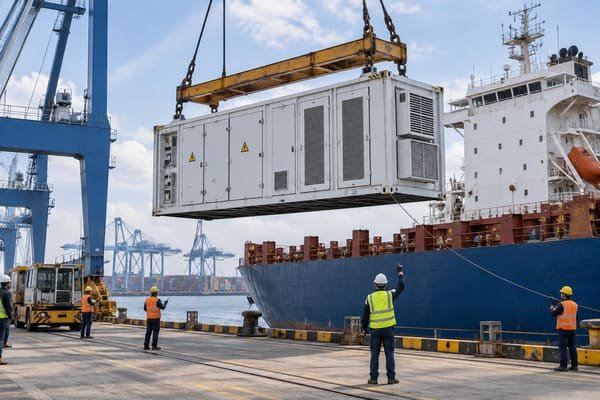
Shipping these battery systems is not like moving regular goods. The demand for renewable energy is growing, so more of these containers are moving across the ocean. But the risks are also higher. As your logistics partner, I've seen firsthand how a small mistake in paperwork or loading can cause huge problems. It's my job to help you understand these challenges. We need to look at the details to make sure your valuable cargo arrives safely and on time. Let's break down what you need to know.
What are the UN3480 Lithium Battery Shipping Requirements?
The rules for UN3480 cargo can be very confusing. A mistake with the paperwork or labels can get your shipment stopped, causing major delays and even fines.
For UN3480 shipments, you must have correct classification, UN-certified packaging, proper DG labels, and a complete Material Safety Data Sheet (MSDS). The batteries also need a UN38.3 test report1 to prove they passed mandatory safety tests for transport.
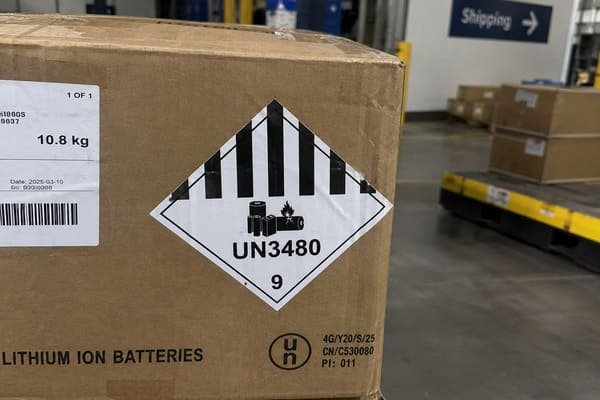
Getting the requirements right for UN3480, which covers lithium-ion batteries2, is the foundation of a successful shipment. These aren't just carrier preferences; they are strict international regulations under the IMDG (International Maritime Dangerous Goods) Code. I once had a client whose shipment was held at the port for two weeks. The problem was an outdated MSDS. The factory gave them an old version, and the carrier's DG desk rejected it instantly. This simple document error cost them time and money. To avoid this, you need to focus on two main areas: documentation and physical preparation.
Key Documents and Actions
Your paperwork must be perfect. The carrier's safety team will review every page before they even consider accepting your booking.
| Document / Action | Purpose | Why It's Critical |
|---|---|---|
| MSDS | Provides chemical safety and handling information. | Carriers use it for risk assessment and emergency response plans. |
| UN38.3 Test Report | Proves batteries passed rigorous safety tests. | This is mandatory proof that the batteries are safe for transport. |
| Correct Labeling | Visually identifies the cargo as hazardous. | Ensures handlers use caution and stow the container correctly. |
| DG Application | The formal request to the carrier to ship DG cargo. | This starts the carrier's internal approval process. |
Getting these documents from the manufacturer early is essential. You should get them even before you ask for a shipping quote, as it will make the entire process smoother.
Why do Ocean Carriers Have Stricter Acceptance Rules for Batteries?
You find that carriers keep rejecting your battery shipments. This disrupts your supply chain and can make your customers angry. Understanding why they are so cautious helps you succeed.
Carriers have stricter rules because of the high risk of fire from lithium batteries. Major incidents have caused huge losses of ships and cargo.3 To protect their crew, vessels, and other cargo, they must be extremely careful with all battery shipments.

The core issue is a phenomenon called "thermal runaway4." If one battery overheats, it can cause a chain reaction, setting nearby batteries on fire.5 On a container ship, this can be a disaster. I remember talking to a safety officer from a major carrier. He told me that a single mis-declared battery container is one of their biggest fears. The financial loss from a vessel fire can be hundreds of millions of dollars, not to mention the risk to human life. Because of this, carriers have created their own safety rules that often go beyond the basic IMDG Code.
General Rules vs. Carrier-Specific Policies
Each shipping line has its own Dangerous Goods department. Their job is to protect the company from risk. This means they can reject a shipment even if it technically meets all public regulations.
| Aspect | IMDG Code (General Rule) | Carrier Policy (Example) |
|---|---|---|
| Document Review | Standard check of MSDS and UN38.3. | An in-depth review by a special DG team, who may ask for more data. |
| Stowage Position | Provides general guidelines for Class 9. | May require that all battery containers be stowed on deck only. |
| Manufacturer Check | Not required. | May have an internal "approved" or "banned" list of manufacturers. |
This is why we at DeepLinker always check the rules for the specific carrier we plan to use. Some carriers won't accept batteries from certain factories with a poor safety record. Others might require the battery's state of charge (SoC) to be below a certain percentage. Knowing these details before booking saves a lot of time and trouble.
Why do Battery Containers Need Special Stowage Attention?
Your container is packed and ready. But where the carrier places it on the ship is very important. The wrong spot can turn a small problem into a catastrophe.
Battery containers need special stowage because of the risk of thermal runaway. Placing them on deck, away from heat and other dangerous goods, allows for ventilation and quick access for firefighting. This helps prevent a fire from spreading and protects the entire vessel.

Stowage planning is a complex puzzle for ocean carriers. They have to balance the ship's weight, manage different cargo types, and plan for unloading at multiple ports. For dangerous goods, especially batteries, safety is the number one priority. The main goal is to isolate the risk. We work with the carrier's planners to communicate the needs of your cargo. It’s a critical conversation that happens behind the scenes.
The Dangers of Under-Deck Stowage
Placing a battery container "under deck" in the cargo hold is the worst-case scenario. If a fire starts there, it is extremely difficult for the crew to reach. Heat can build up quickly, and there is poor ventilation. The ship's built-in CO2 fire suppression system is often not effective against chemical fires from batteries.6
On-Deck Stowage Advantages
This is why we always push for on-deck stowage for our clients' battery shipments. The benefits are clear:
- Ventilation: Open air helps dissipate any heat buildup.
- Accessibility: The crew can visually inspect the container during the voyage.
- Emergency Response: In case of a fire, the crew can fight it directly with water. This is much more effective.
- Isolation: The container can be stowed away from other dangerous goods and crew living quarters.
Carriers often assign specific stowage codes to these containers to ensure they are placed in a pre-approved, safe location. Getting this right requires clear communication and a strong relationship with the carrier, which is a key part of our service.
What are the Peak Season Challenges for Dangerous Goods Booking?
Peak season shipping is already stressful. When you add dangerous goods to the mix, it can feel like a nightmare of delays, rolled bookings, and constant uncertainty.
During peak season, limited vessel space is given to general cargo first. Dangerous goods bookings face longer approval times, fewer available slots, and a much higher chance of being rolled over to a later vessel as carriers become more risk-averse.

Peak season, typically from August to October, puts enormous pressure on the entire shipping network. Ships are full, ports are congested, and everyone is in a hurry. For DG cargo, this pressure is even greater. A carrier would rather fill a slot with a simple, safe cargo like t-shirts than with a complex, risky cargo like batteries, especially when they are under pressure. I always tell my clients to think of DG booking in peak season as trying to get a last-minute ticket to the most popular concert of the year. The tickets are few, the demand is high, and the process is slow.
The Squeeze on DG Slots and Approval Delays
Every vessel has a legal limit on how much DG cargo it can carry and where it can be placed. During peak season, these limited DG slots are the first to disappear. At the same time, the carrier's DG approval desks are flooded with requests. A process that might take 2-3 days in the off-season can easily stretch to a week or more. This delay is critical because if you don't get approval in time, you will miss your planned vessel.
| Task | General Cargo (Peak Season) | DG Cargo (Peak Season) |
|---|---|---|
| Booking Request | 2-3 weeks before sailing | 4-6 weeks before sailing |
| Document Submission | 1 week before sailing | With the booking request |
| Carrier Approval | Instant or within 24 hours | 3-10 business days |
| Rollover Risk | Medium | High to Very High |
My best advice is to plan far ahead. If you intend to ship energy storage containers during peak season, you must start the booking process at least a month, and ideally six weeks, before your target departure date. This extra time provides a buffer for the inevitable delays in DG approval and increases your chance of securing a spot.
What is the Essential Pre-Shipment Checklist for Energy Storage Containers?
You think you are ready to ship, but you missed one small step. That single oversight could delay your shipment for weeks and cost you thousands in extra fees.
Your checklist must include: verifying the UN classification, preparing the MSDS and UN38.3 report, checking carrier rules in advance, booking early, and ensuring the container is correctly packed, labeled, and placarded according to IMDG regulations before it leaves the factory.
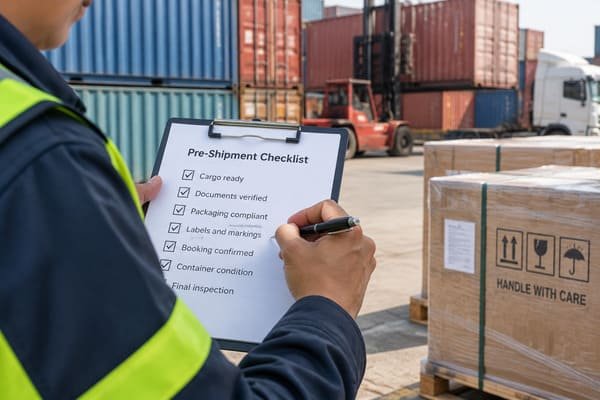
A successful shipment is all about preparation and attention to detail. Over my 20 years in logistics, I've seen that problems rarely happen by surprise. They are almost always the result of a missed step in the preparation phase. To help my clients, I've developed a simple checklist that covers the entire process from start to finish. Following this checklist ensures that all parties—the manufacturer, your team, and us as your forwarder—are aligned and that nothing is forgotten. This proactive approach is the best way to ensure your cargo, your investment, and your supply chain are protected.
Documentation Phase
- [ ] Confirm the correct UN Number (e.g., UN3480).
- [ ] Obtain a valid, complete, and up-to-date MSDS from the factory.
- [ ] Get the full UN38.3 test report or summary.
- [ ] Check with us if the battery manufacturer is on the carrier's approved list.
Booking & Approval Phase
- [ ] Contact us to identify carriers with favorable rules for your specific cargo.
- [ ] Submit the booking request with all DG documents 4-6 weeks before the desired sailing date.
- [ ] Wait for the official DG approval confirmation from the carrier before arranging container trucking to the factory.
Physical Loading Phase
- [ ] Use UN-certified packaging for the batteries if required.
- [ ] Ensure correct Class 9 DG labels are applied to the packages.
- [ ] Apply the correct, weather-resistant DG placards (Class 9) to all four sides of the container.
- [ ] Take photos of the loaded container, showing the labels and placards, as proof for the carrier.
Conclusion
Shipping energy storage containers is complex, but success is achievable. Early planning, perfect documentation, and close work with your logistics partner are the keys to avoiding delays and extra costs.
FAQ
Are energy storage containers considered regular cargo for ocean shipping?
No. Energy storage containers containing lithium-ion batteries are generally treated as dangerous goods rather than standard cargo. Unlike ordinary containerized cargo, they may require additional documentation, carrier approval and special handling procedures before shipment.
The shipping process usually involves additional steps such as dangerous goods review, document verification and confirmation that the carrier and destination port can accept the cargo.
What documents are required for shipping UN3480 lithium batteries from China?
The required documents may vary depending on the battery type, shipment details, carrier and destination requirements. Common documents may include:
- UN38.3 Test Report
- Safety Data Sheet (SDS/MSDS)
- Dangerous Goods Declaration (DGD)
- Battery specifications and technical information
- Packing Certificate or related transport documents
Before booking, shippers should confirm the exact document requirements with their freight forwarder and shipping line to avoid delays caused by incomplete information.
Why is it harder to book ocean space for energy storage containers during peak season?
Dangerous goods shipments usually require more review and coordination than standard cargo. During peak seasons, available vessel space becomes tighter, while DG acceptance procedures may require additional approval time.
A shipment may face delays if:
- Documents are submitted too late
- Carrier approval is not completed
- The selected sailing does not accept the cargo type
- Additional handling requirements affect the booking schedule
For this reason, energy storage shipments should be planned earlier than normal cargo, with sufficient time reserved for document review and carrier confirmation.
"Lithium Battery Test Summaries (TS) | PHMSA", https://www.phmsa.dot.gov/training/hazmat/new-un-requirement-test-summaries. The UN Manual of Tests and Criteria, Part III, subsection 38.3, sets out lithium battery transport tests, supporting the requirement that lithium batteries demonstrate compliance with UN 38.3 before transport. Evidence role: mechanism; source type: institution. Supports: Lithium batteries need UN38.3 evidence to prove they passed mandatory transport safety tests.. Scope note: The source supports the test requirement framework; the exact document accepted by a carrier may vary between a full test report and a test summary depending on applicable rules. ↩
"[PDF] UN-SCETDG-61-INF37e.pdf - UNECE", https://unece.org/sites/default/files/2022-11/UN-SCETDG-61-INF37e.pdf. The UN Model Regulations identify UN3480 as the proper shipping entry for lithium ion batteries, providing the regulatory basis for classifying standalone lithium-ion battery shipments under this UN number. Evidence role: definition; source type: institution. Supports: UN3480 covers lithium-ion batteries for transport classification.. ↩
"Safety and Shipping Review 2026", https://commercial.allianz.com/news-and-insights/reports/shipping-safety.html. Marine casualty reports and insurer analyses document container-ship fires involving misdeclared or dangerous cargo, supporting the contextual claim that serious shipboard fires can produce major cargo and vessel losses. Evidence role: case_reference; source type: institution. Supports: Major dangerous-goods incidents at sea have caused large losses of ships and cargo.. Scope note: Not every major container-ship fire is proven to involve lithium batteries specifically; the source should be used to support the broader maritime dangerous-goods fire risk unless it documents a battery-specific incident. ↩
"Detection and Prevention of Thermal Runaway in Li ion Batteries", https://www.nasa.gov/wp-content/uploads/2024/01/passive-prevention-of-thermal-runaway-and-fire-propagation-in-li-ion-batteries.pdf. Scientific reviews of lithium-ion battery safety define thermal runaway as self-heating that can propagate through cells and lead to fire or explosion, supporting the article’s explanation of the main battery fire mechanism. Evidence role: mechanism; source type: paper. Supports: Thermal runaway is the core fire risk mechanism for lithium battery shipments.. Scope note: The source explains the mechanism generally; the likelihood and severity depend on battery chemistry, design, state of charge, packaging, and suppression conditions. ↩
"Preventing thermal runaway propagation in lithium ion ...", https://ui.adsabs.harvard.edu/abs/2017JPS...340...51W/abstract. Research on lithium-ion battery packs shows that thermal runaway in one cell can propagate to neighboring cells, supporting the claim that overheating may initiate a chain reaction within battery assemblies. Evidence role: mechanism; source type: paper. Supports: One overheated lithium battery cell or module can trigger propagation to nearby cells or batteries.. Scope note: Propagation behavior is context-specific and depends on spacing, thermal barriers, battery format, and suppression measures. ↩
"Exhibit 17J - Hazardous Materials - A Study of Passenger ...", https://data.ntsb.gov/Docket/Document/docBLOB?ID=40263096&FileExtension=.PDF&FileName=Exhibit%2017J%20-%20Hazardous%20Materials%20-%20A%20Study%20of%20Passenger%20Aircraft%20Cargo%20Hold%20Environments-Master.PDF. Fire-safety research on lithium-ion batteries notes that extinguishing and cooling battery fires can be difficult and that suppression effectiveness depends on cooling cells and preventing propagation, supporting the concern that fixed CO2 systems may be insufficient in some battery-fire scenarios. Evidence role: mechanism; source type: research. Supports: Built-in CO2 fire suppression may be ineffective or insufficient against some lithium battery fires in cargo holds.. Scope note: The support is contextual because effectiveness varies by system design, fire location, battery quantity, ventilation, and whether the fire is primarily battery-driven or involves surrounding materials. ↩