

For businesses shipping through the Danube–Black Sea corridor, Sulina Canal delays can affect much more than a vessel’s arrival date. Waiting time can increase transport charges, tie up working capital and disrupt onward deliveries.
The exposure is route-specific. Sulina connects the Danube to the Black Sea through Romania’s Danube Delta. Its importance to Ukrainian river-port exports does not mean that congestion there delays every Asia–Europe container shipment.
The practical question for a shipper is whether its cargo actually depends on a Sulina transit—and which costs become payable if that transit takes longer than planned.
Research checked: 21 October 2026. Operational reports and freight assessments below are dated snapshots, not live sailing instructions or binding quotations. Commercial implications and calculations are identified as analysis or illustrations.
Table of Contents
- Which Shipping Routes Are Most Exposed?
- Sulina Canal Delays: What the Recent Evidence Shows
- Is the Sulina Canal Operating Around the Clock?
- How Sulina Canal Delays Affect Transit Times
- Shipping Cost Breakdown for B2B Shippers
- Shipper Action Checklist
- Frequently Asked Questions
- Conclusion: Budget for Your Shipment’s Actual Exposure
- References and Publication Dates
Which Shipping Routes Are Most Exposed?
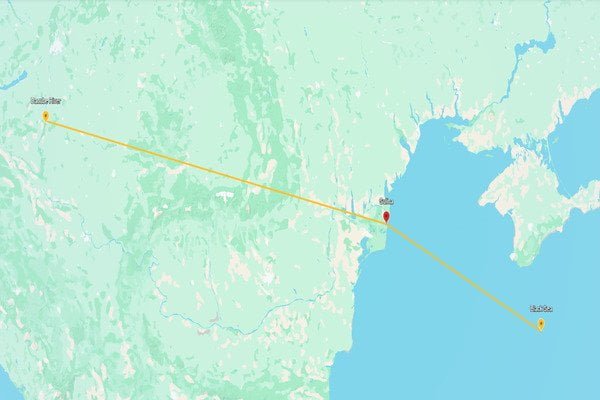
The clearest direct exposure is a shipment booked through Sulina to or from a Danube port, including Ukrainian ports such as Izmail and Reni.
For procurement and logistics teams, three situations deserve attention:
| Shipment arrangement | Potential exposure |
|---|---|
| A seagoing vessel enters Sulina to load or discharge at a Danube port | Inbound waiting can affect berth arrival and cargo operations. |
| A loaded vessel leaves a Danube port through Sulina | Outbound restrictions can delay departure into the Black Sea and arrival at the destination. |
| Cargo connects with another vessel, terminal or inland service | A delayed first leg can cause missed connections, storage or rescheduling costs. |
Planning analysis: A shipment from Asia to a European seaport has direct Sulina exposure only if its booked transport chain includes the canal. An Asian origin, European destination or Black Sea connection alone does not establish that dependency.
Ask your forwarder to identify the actual ports, waterways and transfer points before accepting a surcharge attributed to “Danube congestion.”
Sulina Canal Delays: What the Recent Evidence Shows
September 2026: Queues Affected a Specific Grain Corridor
In its 23 September 2026 report on Danube entry procedures, Reuters described redirected Ukrainian cargo following Russian attacks on Black Sea ports. It reported entry waits exceeding two weeks and cited shippers saying grain deliveries from Ukraine to Egypt had lengthened from 12 days to more than a month.
The same report, citing ASAP Agri, provided these freight examples:
| Observation date or period | Reported grain freight to Egyptian ports |
|---|---|
| 11 July 2026 | About US$30 per metric tonne |
| 11 September 2026 | About US$105 per metric tonne |
| Week of the 23 September report | About US$100 per metric tonne |
These are reported market observations. They are not container rates, canal tolls or proof that congestion alone caused the entire increase. Port availability, vessel supply and security conditions also changed.
Early October: Navigation Resumed, but Waiting Vessels Remained
Radio România Constanța’s report published on 7 October and updated on 8 October 2026 quoted Tulcea’s chief port captain following an almost week-long weather interruption.
According to the report:
- Maritime navigation resumed on 3 October after conditions had prevented safe pilot boarding and disembarkation.
- By the report date, maritime vessels were moving in both directions.
- 87 vessels had been waiting to enter the Danube on the preceding Tuesday evening.
- Some waiting vessels lacked firm transport contracts; access for Ukrainian-bound vessels depended on cargo and berth availability.
- River vessels were unaffected by that particular restriction, and port operations continued.
Planning analysis: An offshore vessel count is not a reliable countdown to your own transit. It can include ships with different readiness, destinations and access priorities.
Mid-October: Security Risk Remained a Separate Constraint
On 15 October 2026, Reuters reported drone strikes on two tankers near the Sulina entrance, citing Romanian officials. Romania’s president confirmed drone strikes but did not attribute responsibility in that report.
This establishes a security incident near the route. It does not, by itself, establish a canal-wide closure or a particular insurance surcharge.
Planning analysis: Even when navigation is permitted, owners and insurers may assess whether they will accept a voyage and on what terms. Treat navigational availability, vessel acceptance and insurance acceptance as separate booking checks.
Latest Industry Assessment Reviewed: 19 October 2026
The Ukrainian Grain Association’s 19 October market update, citing ASAP Agri and Atria Brokers, described continuing uncertainty from security risks and weather-related navigation interruptions.
Atria Brokers assessed freight for 6,000 tonnes of corn from Ukrainian Danube ports to Egypt at approximately US$100 per tonne, unchanged over the week. The update also noted that limited new contracting made current freight levels difficult to establish.
That assessment is useful context for a comparable grain parcel. It is not a firm offer for another cargo, vessel size, loading window or destination.
Is the Sulina Canal Operating Around the Clock?
“24-hour navigation” needs qualification.
The Romanian-language navigation rules published by AFDJ, the Lower Danube River Administration, distinguish upstream and downstream movements. The posted rules permit upstream navigation between the canal mouth and nautical mile 43 around the clock, subject to vessel and cargo exceptions. They restrict downstream night navigation for maritime and sea-river vessels and generally limit exit through the mouth to daylight, with exceptions.
The rules also provide for temporary restrictions and supplementary notices. Their web page does not display a clear publication date.
For a particular voyage, obtain confirmation of the applicable direction, vessel eligibility, pilot arrangements and permitted draft. Consult AFDJ’s notices to navigators, whose register included notices dated 20 October 2026 when reviewed.
Verification limit: The sources reviewed do not establish a live queue length, universal waiting time or unrestricted operating status for every vessel on 21 October.
How Sulina Canal Delays Affect Transit Times
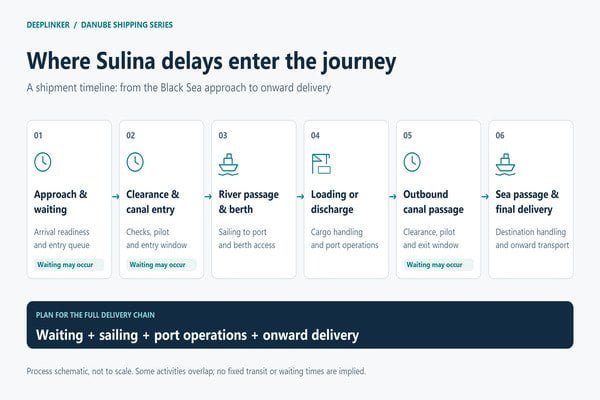
Planning analysis: A sailing-time estimate covers only part of the delivery chain. A useful schedule separates:
- Arrival at the approach or waiting area.
- Clearance, pilot assignment and canal entry.
- River passage and berth availability.
- Loading or discharge.
- Outbound clearance and canal passage.
- Sea passage, destination handling and onward delivery.
Several activities may overlap. Ask the operator to explain which milestones run sequentially and where time is already included.
The distinction matters commercially. A vessel can complete its river passage yet wait for a berth. Cargo can finish loading yet miss an outbound movement window. An onward connection can then introduce another delay.
Request an expected delivery window and a disruption scenario tied to identified constraints. A single promised date hides the assumptions that determine whether the schedule is achievable.
Shipping Cost Breakdown for B2B Shippers
Commercial analysis: Compare quotations by cost component and allocation of responsibility. Not every delay creates every charge.
| Cost component | How disruption may affect it | What to confirm |
|---|---|---|
| Base freight | An owner may price expected waiting and reduced vessel availability into the offer. | Cargo quantity, route, loading window, inclusions and quote validity. |
| Canal and pilotage charges | Charges depend on applicable tariffs and vessel particulars. | Which charges are included and which are payable separately. |
| Waiting charges or demurrage | Additional amounts may become payable under the transport contract. | The trigger, daily rate, counting rules and applicable exceptions. |
| Port storage and handling | Cargo may remain ashore longer or require additional handling. | Free time, charging unit and responsibility for the invoice. |
| Insurance and security-related charges | Voyage acceptance, cover and pricing may change. | Written terms for the actual vessel, cargo, route and dates. |
| Inventory financing | A longer delivery cycle ties up capital. | Cargo value, additional days and the business’s financing rate. |
| Onward transport | Missed loading slots or connections may require rebooking. | Cancellation terms, storage exposure and revised availability. |
Do not add a separate congestion allowance if the quoted freight already includes the same expected waiting cost.
For containerized cargo, check equipment demurrage and detention separately. Those charges should not be treated as interchangeable with vessel demurrage under a charter arrangement.
Canal Tariffs Are Not Cargo Freight Rates
AFDJ’s published 2026 transit tariff lists US$1.98 per NRTSulina for loaded maritime ships and US$0.77 per NRTSulina for ships in ballast, alongside other categories and discounts.
NRTSulina is the vessel tonnage basis used for the tariff—not the weight of cargo shipped. Multiplying US$1.98 by a cargo’s metric tonnes would therefore produce the wrong calculation.
Have the agent identify the applicable vessel measurement, tariff category, discounts and included services. These published tariffs do not establish a congestion surcharge.
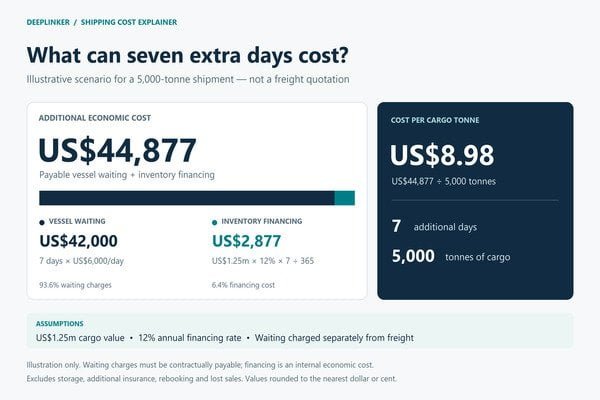
Worked Example: The Cost of Seven Additional Days
Illustration only—not a market quotation or forecast.
Assume:
- Cargo quantity: 5,000 metric tonnes.
- Cargo value: US$1.25 million.
- Additional delay: seven days.
- A contractually payable waiting charge: US$6,000 per day.
- Annual inventory financing rate: 12%.
- The waiting charge is additional to freight and has not already been included elsewhere.
| Incremental item | Calculation | Estimated cost |
|---|---|---|
| Payable vessel waiting | 7 × US$6,000 | US$42,000 |
| Inventory financing | US$1,250,000 × 12% × 7 ÷ 365 | US$2,877 |
| Combined incremental economic cost | Waiting plus financing | US$44,877 |
| Equivalent per cargo tonne | US$44,877 ÷ 5,000 | US$8.98 |
The financing amount is an internal economic cost, not necessarily a carrier invoice. Storage, additional insurance, rebooking and lost sales are excluded.
If waiting is included in the original freight or is not payable under the agreed terms, the US$42,000 line must be removed or recalculated. The purpose is to expose the cost assumptions before booking.
Shipper Action Checklist
Before confirming a Sulina-dependent shipment:
- Verify the route. Obtain the named loading and discharge ports and confirmation that the vessel will transit Sulina.
- Request a dated operational update. Confirm inbound and outbound conditions separately, including pilot availability, draft and any applicable restrictions.
- Confirm cargo and berth readiness. Establish whether the vessel has an accepted loading or discharge window.
- Separate time estimates. Ask for approach waiting, port time, outbound waiting and sailing time.
- Check the quotation’s scope. Identify included canal, pilotage, port and waiting costs.
- Agree delay responsibility. Record the charging trigger and daily exposure before booking.
- Confirm vessel and insurance acceptance. Obtain terms covering the actual voyage and dates.
- Protect onward deliveries. Review receiving appointments, connection flexibility and inventory coverage.
- Set update triggers. Request revised timing and cost estimates when entry, berth or departure milestones slip.
Frequently Asked Questions
How Long Do Sulina Canal Delays Last?
There is no verified universal delay allowance. Waiting varies with weather, direction, vessel eligibility, traffic, cargo readiness and berth access. The September 2026 examples above describe a particular disruption period, not a standing transit-time guarantee.
Do Sulina Delays Increase All Asia–Europe Container Freight Rates?
No direct, universal effect is established by the evidence reviewed here. The cited freight examples concern Ukrainian grain movements through Danube ports. For a container shipment, establish whether Sulina is actually part of the booked route before attributing extra cost or time to the canal.
Who Pays When a Vessel Waits?
Payment depends on the agreed sale and transport arrangements and the cause and location of the delay. Obtain written confirmation of which costs are included, which events trigger additional charges and which party receives each invoice. Do not assume that every day offshore automatically becomes payable demurrage.
Conclusion: Budget for Your Shipment’s Actual Exposure
Sulina Canal delays matter most when a cargo’s booked route depends on the Danube–Black Sea connection. Recent evidence shows how traffic pressure, weather and security incidents can interact, while dated grain-freight assessments demonstrate why a quotation must be tied to a specific route and period.
For B2B shippers, the practical response is to verify the operating conditions, separate sailing time from waiting time and calculate the costs that the business would actually bear.
Planning a shipment with a Danube or Black Sea connection? Contact Deeplinker with your origin, destination, cargo details and required delivery date to discuss the questions your shipping quotation needs to answer.
This is the first article in Deeplinker’s Danube shipping series. A companion article will examine broader alternative-route choices and their trade-offs.
References and Publication Dates
The sources are linked beside the relevant claims above. All were accessed on 21 October 2026.
- Reuters, via MarketScreener: “Officials change Danube entry procedures to tackle Ukrainian shipping queue.” Published and updated 23 September 2026.
- Radio România Constanța: Report on resumed Sulina navigation following a weather interruption. Published 7 October 2026; updated 8 October 2026.
- Reuters, via ThePrint: “Seven sailors missing after drones hit two tankers off Romania’s Black Sea coast.” Published 15 October 2026.
- Ukrainian Grain Association: Update on security risks and Sulina interruptions, citing ASAP Agri and Atria Brokers. Listed 19 October 2026.
- AFDJ: Special navigation rules for the Sulina roadstead–Brăila sector. Undated web publication; reviewed as posted on the access date.
- AFDJ: Notices to navigators. Continuously updated register, including entries dated 20 October 2026.
- AFDJ: Tariffs for transit from the Sulina Channel mouth to nautical mile 34. 2026 tariff schedule; exact web publication date not displayed.