
Updated: November 11, 2026
Foreign businesses importing goods into the United States will face new customs requirements beginning January 5, 2027.
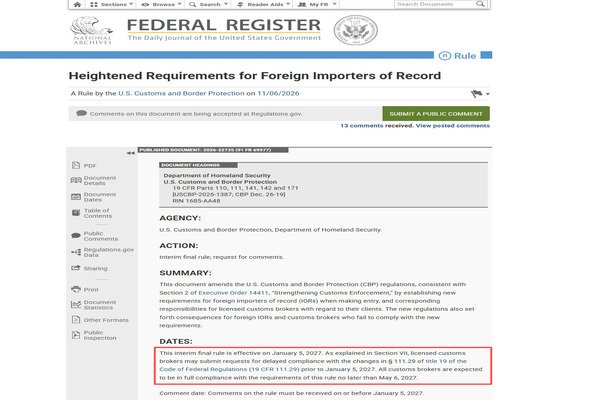
On November 6, 2026, U.S. Customs and Border Protection (CBP) published an interim final rule titled Heightened Requirements for Foreign Importers of Record.
The regulation introduces stricter eligibility and verification requirements for foreign importers of record (IORs) and additional responsibilities for licensed customs brokers.
For Chinese manufacturers, international trading companies, overseas sellers, and businesses using DDP shipping arrangements, the changes could affect how shipments are cleared through U.S. customs.
The key question is no longer just who pays the import duties. It is whether the party acting as importer of record—and its customs broker—meets the new requirements.
1. What Changes Under the New US Importer of Record Rules?
The new regulation, published as Federal Register document 2026-22735, amends several sections of U.S. customs regulations.
The principal change concerns foreign importers of record.
Starting January 5, 2027, a foreign IOR making an applicable entry for consumption must satisfy one of two conditions:
- Be a CTPAT-validated importer, or
- Use a U.S.-licensed customs broker that is CTPAT validated to make entry.
CTPAT stands for Customs Trade Partnership Against Terrorism, a voluntary supply chain security partnership administered by CBP.
Under the new rule, CTPAT validation becomes an important qualification for foreign importers and the customs brokers handling their entries.
Foreign importers that are not themselves CTPAT validated will need a broker with the required validation.
The restriction applies to formal entries and certain informal entries requiring CBP Form 3461 or Form 7501, or their electronic equivalents.
The regulation does not mean that every foreign company is automatically prohibited from importing into the United States.
Instead, it changes the conditions under which qualifying foreign parties can make customs entry.
2. Who Is Considered a Foreign Importer of Record?
An importer of record is the party legally responsible for making customs entry and meeting applicable import obligations.
These responsibilities generally include ensuring that the import declaration is accurate and that applicable duties, taxes, and other customs requirements are addressed.
Under the new regulation, CBP distinguishes between a U.S. IOR and a foreign IOR.
A U.S. IOR may be a U.S. citizen or lawful permanent resident. A business entity must satisfy the rule's applicable U.S. organization, location, and ownership or property requirements.
For example, the new framework includes specific requirements relating to U.S. beneficial ownership and control, or significant qualifying U.S. real property ownership.
An importer that does not meet the definition of a U.S. IOR is treated as a foreign IOR under the new framework.
Why This Matters for Overseas Companies
Consider a Chinese manufacturer selling industrial equipment directly to a customer in the United States.
If the Chinese company is named as the importer of record, it must determine whether it qualifies as a foreign IOR under the new rules.
If it is not CTPAT validated, it will need a properly qualified, CTPAT-validated licensed customs broker for the applicable entry.
A company should not assume that having a U.S. importer number, registered office, or U.S.-based business contact automatically establishes U.S. IOR status.
CBP's new criteria must be evaluated separately.
The official regulation explains these definitions under 19 CFR Part 110.
3. What Is Changing for Customs Brokers?
The regulation also affects the customs brokers who prepare and file import entries.
Previously, a foreign importer might have worked with a licensed customs broker without separately considering the broker's CTPAT validation status.
Under the new requirements, that distinction becomes essential.
CTPAT Validation Matters
A foreign IOR that is not CTPAT validated must use a licensed customs broker with CTPAT validation.
A broker license alone is not sufficient in that situation.
However, when the foreign IOR itself is CTPAT validated, the rule allows it to designate a licensed broker without requiring that broker to be CTPAT validated.
Additional Client Verification
Customs brokers also have responsibilities concerning the status of clients represented as U.S. importers of record.
They may need to obtain and maintain documentation supporting the client's eligibility.
Brokers must also provide required information when acting as importer of record on behalf of another principal.
New Import Entry Information
CBP has introduced additional information fields for:
- CBP Form 3461.
- CBP Form 7501.
- Their electronic equivalents.
These address U.S. IOR status, whether a broker is acting on behalf of another party, and relevant principal identification.
CBP explains the new fields in its Cargo Systems Messaging Service bulletin CSMS #70381183.
Practical recommendation: Foreign importers should contact their U.S. customs broker before January 2027 to confirm that the intended entry arrangement will remain compliant.
4. Important Dates Importers Should Know
| Date | Regulatory milestone |
|---|---|
| November 6, 2026 | CBP publishes the interim final rule |
| January 5, 2027 | New foreign IOR entry requirements become effective |
| January 5, 2027 | Deadline for comments on the interim final rule |
| January 5, 2027 | Deadline for eligible brokers to request delayed compliance with specified verification obligations |
| May 6, 2027 | Final date by which brokers are expected to fully comply with the relevant delayed verification requirements |
Importers should not confuse the May 6 deadline with a general postponement of the foreign IOR requirements.
The delayed-compliance mechanism is directed at specified customs broker verification obligations and requires an eligible request and approval.
The main foreign IOR entry requirements are scheduled to begin on January 5, 2027.
Businesses should also monitor subsequent CBP guidance and any amendments following public comments.
5. How Will the New Rules Affect DDP Shipping from China?
DDP, or Delivered Duty Paid, is frequently used when a seller agrees to arrange transportation and import-related obligations through to an agreed destination.
Under the standard Incoterms 2020 DDP rule, the seller generally assumes responsibility for import clearance and applicable import duties and taxes.
However, DDP is a commercial delivery term, not an exemption from U.S. customs law.
Example: A Chinese Supplier Selling DDP to a US Buyer
Imagine that a Chinese supplier sells machinery to a U.S. company under DDP terms.
The supplier arranges international transportation, customs clearance, and delivery to the buyer's warehouse.
If the Chinese supplier acts as the foreign IOR, the new CTPAT-related requirements may apply.
If the supplier is not CTPAT validated, it will need an eligible CTPAT-validated customs broker to make the applicable entry.
This requirement is separate from whether the seller has already agreed to pay the transportation charges and import duties.
What if the US Buyer Is the Importer of Record?
The position may be different if the U.S. buyer is properly designated as the importer of record and satisfies the applicable U.S. IOR criteria.
However, the parties must establish a legally and commercially consistent arrangement.
They should not simply change the importer name on documents to avoid the foreign IOR requirements.
If the buyer assumes import clearance responsibilities, the sales contract and chosen delivery terms should accurately reflect the parties' actual obligations.
The International Chamber of Commerce's Incoterms 2020 guidance provides the framework for distinguishing DDP from alternatives such as DAP.
6. What Foreign Importers Should Prepare Before January 2027
Businesses shipping goods from China to the United States should review their import arrangements before the new requirements take effect.
Step 1: Identify the Importer of Record
Confirm which company is currently named as the importer of record.
Do not assume that the seller, buyer, consignee, and importer of record are necessarily the same legal entity.
Step 2: Verify Importer Status
Determine whether the IOR meets CBP's new U.S. IOR criteria or will be classified as a foreign IOR.
Corporate ownership, U.S. business presence, and supporting documentation may be relevant.
Step 3: Confirm CTPAT Arrangements
If the importer is a foreign IOR, confirm whether it is CTPAT validated.
If not, ask whether the customs broker intended to handle its entry is both licensed and CTPAT validated.
Step 4: Review Importer Registration
Check that the relevant importer information is correctly registered with CBP.
Foreign businesses may use a CBP-assigned importer number where appropriate, but an importer number alone does not establish eligibility under the new rule.
CBP explains importer identification in its Importer Numbers guidance.
Step 5: Review the Broker's Power of Attorney
Confirm that the customs broker has a properly executed power of attorney where required.
The legal principal and importer arrangements should be consistent with the information submitted to CBP.
Step 6: Update Shipping Instructions
Ensure that the supplier, freight forwarder, customs broker, and U.S. consignee have consistent information about:
- The importer of record.
- The customs broker.
- The consignee.
- The commercial invoice.
- The customs entry requirements.
- The destination delivery arrangement.
Addressing discrepancies before departure can reduce avoidable clearance problems.

7. What Could Happen If Importers Do Not Comply?
CBP has indicated that its systems will include additional validation checks beginning January 5, 2027.
Relevant entries or entry summaries may be rejected when required qualifications or principal identification information are missing.
This could affect the timing of customs clearance and cargo release.
Potential commercial consequences may include:
- Delays in customs processing.
- Additional storage or handling charges.
- Missed delivery appointments.
- Changes to brokerage arrangements.
- Disruption to inventory replenishment.
The exact consequences depend on the circumstances and the applicable customs procedures.
Importers should not assume that using a freight forwarder automatically satisfies the new broker requirements.
A freight forwarder and a U.S.-licensed customs broker may perform different functions.
Although the foreign IOR requirements primarily concern customs entry, the transportation process should be coordinated with the correct import arrangements.
Before booking a shipment from China, importers should provide:
- Chinese supplier name and pickup address.
- U.S. consignee and delivery address.
- Correct importer of record details.
- Customs broker contact information.
- Commercial invoice and packing list.
- Product descriptions and classifications.
- Shipment value and country of origin.
- Cargo-ready date and estimated arrival schedule.
- Any special product compliance information.
Freight forwarders can assist with shipment coordination and transportation documents.
However, the responsibility for determining IOR eligibility, preparing legally compliant customs entries, and satisfying relevant broker requirements should be addressed with the appropriate importer, licensed broker, and legal or customs advisers.
9. Pre-2027 US Import Compliance Checklist
Before arranging shipments arriving under the new requirements, review the following:
Importer status
- Has the importer of record been identified?
- Has its U.S. or foreign IOR status been assessed?
- Is the relevant registration information accurate?
Customs broker
- Is the broker appropriately licensed?
- Is CTPAT validation required for this entry?
- Has the broker's CTPAT status been confirmed?
- Is the required power of attorney in place?
Shipping arrangements
- Do the commercial terms match the actual import responsibilities?
- Are the consignee and importer details correct?
- Has the broker reviewed the expected arrival and entry arrangements?
- Are the necessary shipping and customs documents ready?
Regulatory monitoring
- Has the business reviewed the November 6, 2026 interim final rule?
- Has it confirmed whether the January 5, 2027 requirements apply?
- Is it monitoring further CBP guidance and changes?
Completing these checks before shipment is especially important for businesses that regularly import goods into the United States under nonresident IOR arrangements.
Frequently Asked Questions
1. Can a Chinese company still act as importer of record in the United States in 2027?
Potentially, yes. Foreign importers of record are not categorically prohibited. Under the new rules, a qualifying foreign IOR must meet the applicable CTPAT validation requirements or use an appropriately CTPAT-validated, licensed customs broker for covered entries.
2. Does every foreign importer need its own CTPAT validation?
No. The regulation provides an alternative through a CTPAT-validated, licensed customs broker. Businesses should confirm the exact entry arrangement with their customs adviser.
3. Does the new regulation ban DDP shipping from China?
No. The regulation does not directly prohibit DDP transactions. However, sellers using DDP arrangements must ensure that the customs entry process satisfies the applicable U.S. importer and broker requirements.
4. What happens on January 5, 2027?
The new requirements are scheduled to take effect, including additional importer status declarations and CTPAT-related conditions for relevant foreign IOR entries.
5. Can a freight forwarder handle the new requirements automatically?
Not necessarily. Freight forwarding services and licensed customs brokerage are distinct functions. The importer must verify that the customs entry is handled through a legally qualified arrangement.
Conclusion
The new U.S. importer of record rules introduce significant changes for foreign businesses importing goods into the United States.
Beginning January 5, 2027, the distinction between U.S. and foreign importers of record, as well as CTPAT validation requirements, will become more important in customs entry planning.
For businesses shipping from China, the practical priority is to verify importer status, confirm customs broker eligibility, review DDP arrangements, and prepare accurate shipping documentation before cargo arrives.
These steps can reduce the risk of avoidable clearance delays and improve coordination across the international supply chain.
Shipping Commercial Cargo from China to the United States?
Accurate shipment information and clearly defined customs responsibilities are essential for reliable international delivery.
Deeplinker helps businesses evaluate international freight solutions and coordinate transportation requirements based on their cargo, destination, and delivery needs.
Contact Deeplinker to discuss your shipment
References
- U.S. Federal Register — Heightened Requirements for Foreign Importers of Record (November 6, 2026)
- CBP — Cargo Systems Messaging Service Bulletin #70381183
- CBP — Importer Numbers
- CBP — Customs Trade Partnership Against Terrorism
- International Chamber of Commerce — Incoterms 2020
Disclaimer: This article provides general trade and logistics information based on the interim final rule published November 6, 2026. Businesses should consult CBP guidance and qualified U.S. customs professionals to assess their specific obligations.