
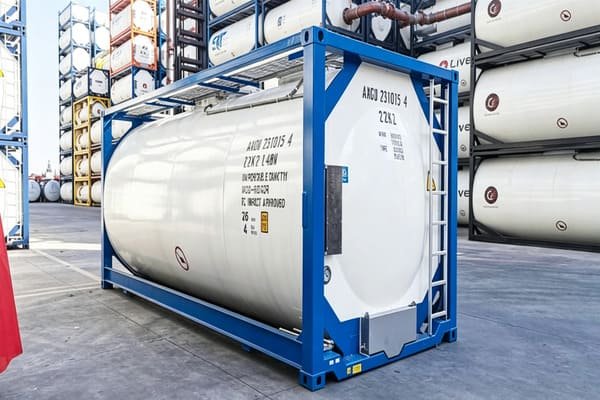
Shipping flammable liquids is not like shipping sneakers or phone cases. One missing document, one wrong label, or one mis-declared UN number, and your entire container can be rejected at the port of loading—or worse, held at Hamburg while demurrage fees pile up. If you're sourcing paints, solvents, alcohol-based products, or perfumes from China and need them safely delivered to Germany, you're dealing with one of the most tightly regulated categories in ocean freight.
To ship Class 3 flammable liquids from China to Germany by sea, you must book with a HAZMAT-approved carrier under the IMDG Code, use UN-certified packaging matching the correct Packing Group1, submit a full dangerous goods documentation set (SDS, DG Declaration, Packing Certificate), and ensure compliance with EU REACH/CLP rules on arrival.
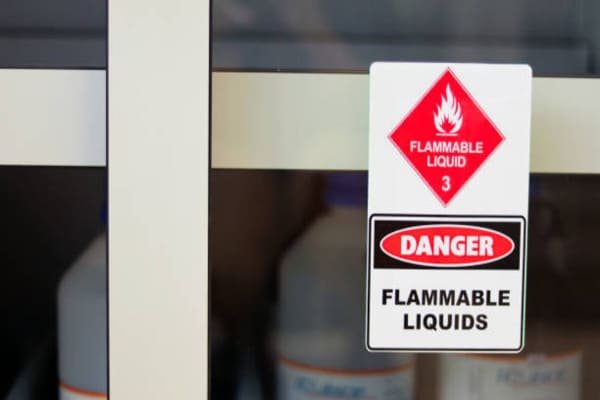
With 15+ years handling dangerous goods bookings across sea, air, and land, Deeplinker has guided importers through exactly these hurdles. Below is a complete, practical guide covering what Class 3 goods are, how to ship them, what they cost, and the specific pitfalls unique to the China–Germany route.
What Are Class 3 Flammable Liquids and How Does HAZMAT Shipping Work?
Before booking anything, you need to understand what category your cargo falls into and why carriers treat it so cautiously.
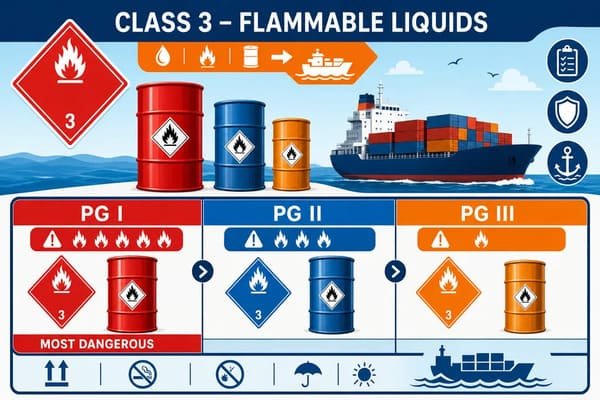
Class 3 covers flammable liquids with a flash point of 60°C or below, and they are divided into three Packing Groups—Packing Group I is the most dangerous, with the lowest flash point and highest volatility.
What Is Class 3 Flammable Liquids Transportation?
Class 3 transportation refers to the regulated movement of liquids that can ignite easily. Common examples exported from China include:
- Ethanol and alcohol-based cleaners
- Paints, thinners, and coatings
- Perfumes and aerosol-free fragrance concentrates
- Adhesives and certain solvents
- Some cosmetic and chemical intermediates
Every one of these must be classified with a UN number (e.g., UN 1263 for paint, UN 1170 for ethanol2) and shipped in accordance with the IMDG Code (International Maritime Dangerous Goods Code), which is the global rulebook for transporting hazardous cargo by sea.
Which Packing Group Is the Most Dangerous?
This is one of the most common questions importers ask—and the answer directly affects your packaging and cost. Packing Group (PG) reflects the degree of danger:
| Packing Group | Danger Level | Flash Point / Boiling Point | Typical Examples |
|---|---|---|---|
| PG I | Highest danger | Flash point < 23°C, boiling point ≤ 35°C | Diethyl ether, low-flash solvents |
| PG II | Medium danger | Flash point < 23°C, boiling point > 35°C | Ethanol, acetone, many paints |
| PG III | Lower danger | Flash point 23°C–60°C | Diesel-type liquids, some coatings |
PG I is the most hazardous and faces the strictest packaging, stowage, and quantity limits. Most consumer-related liquids from China fall into PG II or III, but misdeclaring the group to save money is a serious violation that carriers actively check.
How Do You Ship HAZMAT Internationally?
International HAZMAT shipping follows a clear framework:
- Classify the goods (UN number, class, packing group) using the manufacturer's SDS.
- Book with a carrier that accepts dangerous goods on the specific route.
- Package and label according to IMDG requirements.
- Declare the cargo with a signed Dangerous Goods Declaration.
- Obtain carrier approval before the cargo is accepted.
How Much Does It Cost to Ship Class 3 Liquids from China to Germany?
Cost is almost always the second question after safety—and dangerous goods pricing works differently from regular cargo.
Shipping Class 3 flammable liquids from China to Germany by sea typically costs more than standard freight because of dangerous goods surcharges, but a full-container load (FCL) via Shanghai, Ningbo, or Shenzhen to Hamburg or Bremerhaven usually offers the most cost-effective and compliant route.
Main Ports and Transit Times
The China–Germany ocean corridor is well established and efficient:
| Origin Port (China) | Destination Port (Germany) | Approx. Transit Time |
|---|---|---|
| Shanghai (CNSHA) | Hamburg (DEHAM) | 30–38 days |
| Ningbo (CNNGB) | Bremerhaven (DEBRV) | 32–40 days |
| Shenzhen/Yantian (CNYTN) | Hamburg (DEHAM) | 33–40 days |
| Qingdao (CNTAO) | Hamburg (DEHAM) | 35–42 days |
Hamburg is Germany's largest port and the primary gateway for containerized dangerous goods, with dedicated hazardous cargo handling areas.
How Much Is Sea Freight from China? Understanding the Cost Structure
For dangerous goods, your total quote is built from several layers:
| Cost Component | Notes |
|---|---|
| Base ocean freight | Standard container rate (fluctuates with market) |
| Dangerous Goods Surcharge | Added per container for HAZMAT handling |
| DG documentation fee | For DG declaration and processing |
| Origin charges | Export customs, DG inspection, port fees in China |
| Destination charges | German port handling, customs clearance |
| Import duty & VAT | Paid in Germany (see below) |
Because rates shift with fuel prices, season, and space availability, always request a live quote rather than relying on old figures.
What Is the Cheapest Way to Ship to Germany?
Here's where dangerous goods differ sharply from normal cargo. For standard goods, LCL (less-than-container-load) consolidation is the cheapest option for small volumes. But for Class 3 flammable liquids, many consolidators refuse to mix dangerous goods with other cargo, and DG-approved LCL space is limited and often surcharged heavily.
Practical cost-saving advice:
- If you have volume, FCL is usually cheaper per unit and far less risky than fighting for scarce DG-LCL slots.
- Consolidate multiple small orders into one FCL shipment when possible.
- Book early—DG space per vessel is capped, and last-minute bookings pay premium rates.
We recently helped a German cosmetics distributor importing PG II fragrance concentrate. They were quoted an extremely high DG-LCL rate by another agent. By consolidating two of their monthly orders into a single 20ft FCL, Deeplinker cut their per-liter shipping cost by roughly 35% while keeping full IMDG compliance.
What Makes Shipping Class 3 Liquids to Germany Different?
This is where the China–Germany route has its own personality. Getting the goods on a ship is only half the battle—Germany and the EU apply some of the strictest chemical rules in the world, and several of them catch importers off guard.
Beyond standard packaging and documents, shipping flammable liquids into Germany requires EU REACH/CLP compliance, German-language hazard labeling, and awareness that once the cargo lands, inland transport switches from IMDG to ADR3—the European agreement governing the road transport of dangerous goods.
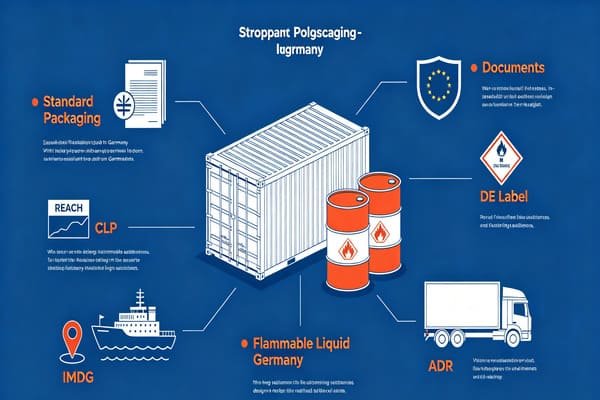
REACH & CLP: The EU's Invisible Barrier
Most Class 3 liquids are chemical substances, and the EU regulates them under REACH (Registration, Evaluation, Authorisation of Chemicals). If your substance isn't properly registered or covered, German customs can hold or reject it—even when the shipment itself is packed perfectly.
Alongside REACH, the CLP Regulation4 governs classification, labeling, and packaging of hazardous chemicals. Your Safety Data Sheet must be in the EU 16-section format. This is a step where many China-origin shipments stumble, because a compliant SDS from the Chinese manufacturer isn't automatically an EU-compliant one.
German-Language Hazard Labels
Germany requires that hazard information be understandable to local handlers. In practice, this means:
- Labels and the SDS must be available in German.
- GHS pictograms, signal words ("Gefahr"/"Achtung"), and H/P statements must follow EU CLP formatting.
- Product identifiers must match across the SDS, labels, and shipping documents.
A mismatch between your English commercial invoice and German-format labels is a common reason for clearance delays.
From IMDG to ADR: Don't Forget the "Last Mile"
This is the point most importers overlook entirely. Your ocean leg is governed by the IMDG Code—but the moment your container is discharged at Hamburg or Bremerhaven, the inland truck journey falls under ADR, the road-transport rulebook for dangerous goods in Europe.
ADR requires certified vehicles, trained drivers with ADR licenses, and specific transport documents. If this "last mile" isn't arranged in advance, dangerous goods can sit stuck at the port because a standard truck simply can't legally move them. When you plan your shipment, confirm early who is responsible for the ADR-compliant inland leg under your chosen trade term (for example, under DDP the seller/forwarder arranges it, while under FOB or CIF the buyer must organize onward transport).
EORI Number & Import VAT
Finally, two administrative essentials for Germany:
- The importer (consignee) must hold a valid EORI number to clear customs in the EU.
- Germany applies import VAT (currently 19%) plus any applicable duty based on the product's HS code. Flammable liquids' duty rates vary widely by product, so classify accurately in advance.
We assisted a first-time importer of industrial adhesive (PG II) who had no EORI number and an SDS only in Chinese and English. The shipment was flagged at Hamburg. Deeplinker's team coordinated an EORI application and arranged a properly formatted German SDS, releasing the cargo before storage charges became significant.
Conclusion
Shipping Class 3 flammable liquids from China to Germany by sea is entirely achievable, but it rewards preparation and punishes shortcuts. Get the essentials right—correct Packing Group classification, HAZMAT-approved ocean space (usually FCL for the best cost and reliability), a complete EU-compliant document set, and early planning for the route's unique demands like REACH/CLP, German-language labeling, the IMDG-to-ADR handover, and EORI/VAT—and your flammable liquids will move safely and predictably from Chinese factories to German doorsteps.
References
International Maritime Organization (IMO), *IMDG Code — Carriage of Dangerous Goods by Sea (packaging and packing group requirements)*. https://www.imo.org/en/OurWork/Safety/Pages/DangerousGoods-default.aspx ↩
NOAA, *CAMEO Chemicals — UN/NA 1170 (Ethanol)*. https://cameochemicals.noaa.gov/unna/1170 ↩
UNECE (United Nations Economic Commission for Europe), *ADR 2025 — European Agreement Concerning the International Carriage of Dangerous Goods by Road*. https://unece.org/adr-2025-files ↩
European Chemicals Agency (ECHA), *Understanding CLP (Classification, Labelling and Packaging Regulation)*. https://echa.europa.eu/regulations/clp/understanding-clp ↩