


Container services are gradually returning to the Red Sea and Suez Canal in 2026, giving shippers more routing options between Asia, Europe and the Mediterranean.
But for lithium battery cargo, a carrier's return to Suez does not mean the shipment has suddenly become simple.
Battery cargo remains subject to dangerous goods (DG) requirements, carrier acceptance procedures and insurance conditions. At the same time, Red Sea security risks can introduce another layer of uncertainty involving war, piracy, route deviation and insurance coverage.
For exporters shipping lithium batteries from China, one principle is especially important:
Carrier acceptance does not automatically mean insurance coverage.
Before cargo leaves the factory, shippers should review both the DG requirements for the batteries and the insurance terms that apply to the actual route.
1. Why Lithium Battery Cargo Needs Extra Attention on Red Sea Routes
Lithium battery shipments already require more preparation than ordinary cargo.
When the shipment moves through the Red Sea and Suez Canal, two different types of risk need to be considered.
Cargo Risk
Lithium batteries may present risks including:
- Thermal runaway1
- Fire propagation2
- Incorrect classification
- Improper packaging
- Misdeclaration
- Incorrect marking or labelling
Depending on the shipment configuration, lithium-ion batteries may be classified under different UN numbers.
For example:
- UN3480 — Lithium-ion batteries shipped by themselves
- UN3481 — Lithium-ion batteries contained in equipment or packed with equipment
The correct classification depends on the actual cargo. Shippers should not assume that every lithium battery shipment is UN3480.
The International Maritime Dangerous Goods (IMDG) Code establishes requirements covering the classification, packing, marking, labelling, documentation, stowage and segregation of dangerous goods transported by sea.
The 2024 Edition incorporating Amendment 42-24 became mandatory on January 1, 2026.
Route Risk
The Red Sea introduces a separate set of considerations.
These may include:
- Regional security conditions
- Piracy exposure
- War-related risks
- Carrier rerouting
- Longer voyages if vessels return to the Cape of Good Hope
- Changes to insurance availability or pricing
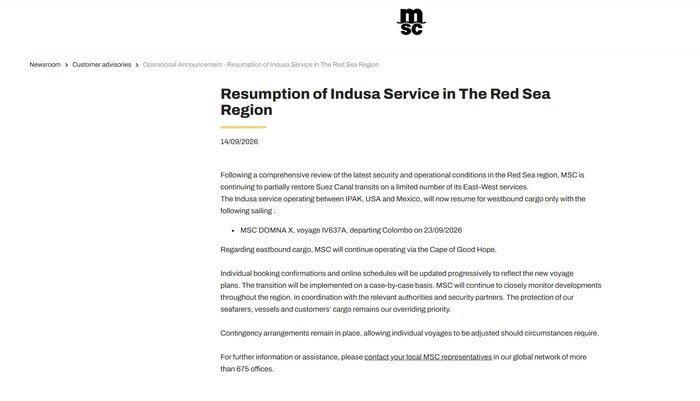
In September 2026, MSC confirmed that it was partially restoring Suez Canal transits on a limited number of East–West services. However, the transition remains case-by-case, and contingency arrangements are still in place.
This means a shipment initially booked via Suez could potentially face a routing adjustment if security conditions change.
For lithium battery cargo, cargo risk and route risk should be reviewed separately.
2. What Should Shippers Check in Their Cargo Insurance?
One of the biggest mistakes a shipper can make is assuming:
"The carrier accepted my battery container, so the cargo must be insured."
These are two different decisions.
A carrier determines whether it is willing and able to transport the cargo under its operational and dangerous goods requirements.
An insurer determines whether a particular loss is covered under the terms, conditions, exclusions and endorsements of the insurance policy.
Check the Policy Before Departure
For battery cargo moving through or near the Red Sea, shippers should review issues such as:
- Geographic limits
- War-risk exclusions
- Piracy-related provisions
- Strikes and terrorism clauses
- Dangerous goods conditions
- Lithium battery-related conditions
- Misdeclaration or non-disclosure provisions
- Route deviation provisions
- Deductibles
- Coverage period

Do not assume that the words "All Risks" mean every possible battery-related or Red Sea-related loss is automatically covered.
The actual scope of coverage depends on the policy wording.
Insurance conditions in the region can also change.
During the 2026 Middle East disruptions, Maersk stated that its cargo insurance continued to provide cover according to applicable policy terms, while also noting that some insurers had reduced or withdrawn certain coverage involving the Red Sea, Gulf of Oman and Persian Gulf regions.
Source: Maersk – Middle East Operational Update
What If the Vessel Changes Route?
This is another point worth checking before departure.
Imagine the original booking is:
Shanghai → Suez Canal → Mediterranean → Europe
But the carrier later changes the voyage to:
Shanghai → Cape of Good Hope → Europe
The cargo may still reach the same destination, but the route, voyage duration and risk profile have changed.
Shippers should understand how their policy treats route deviations or carrier-initiated routing changes and whether notification to the insurer or broker is required.
The safest approach is simple:
Confirm the coverage in writing before the shipment departs.
3. What DG Documents Should Be Ready Before Booking?
For lithium battery shipments, documentation should be prepared before requesting final carrier approval.
Waiting until the container is already packed can create unnecessary delays.
Depending on the battery type, shipment configuration, carrier and applicable regulations, documentation may include:
UN38.3 Test Documentation
Lithium batteries offered for transport generally need to meet the applicable UN 38.3 testing requirements.
The documentation should correspond to the actual battery being shipped.
A common mistake is submitting a UN38.3 document for a similar battery model rather than the exact product involved in the shipment.
SDS / MSDS
A Safety Data Sheet may be requested as part of the carrier's DG review.
Information should be current and consistent with the battery specifications and other shipping documents.
Dangerous Goods Declaration
Where required, the Dangerous Goods Declaration should accurately identify information such as:
- UN number
- Proper Shipping Name
- Hazard class
- Packing information
- Quantity
- Shipper details
Container Packing Documentation
Applicable container or vehicle packing documentation may also be required.
The party responsible for packing should ensure that the cargo has been packed, secured and documented according to the applicable requirements.
Commercial Documents
Do not forget the ordinary shipping documents.
The following should remain consistent with the DG information:
- Commercial invoice
- Packing list
- Booking information
- Cargo description
- Battery specifications
- Shipping instructions
A shipment described as "electronic accessories" on one document and "lithium-ion batteries" on another can trigger questions during carrier review.
Packaging, Marking and Labelling
Lithium battery packaging must comply with the applicable requirements for the specific classification and shipment configuration.
Avoid using a blanket rule such as:
"All lithium batteries require the same UN packaging."
Different battery configurations and conditions can be subject to different packing instructions.
Markings, labels and container placards should also match the actual dangerous goods classification.

4. Common Mistakes That Can Delay a Shipment or Complicate an Insurance Claim
Many problems with battery shipments begin before the container reaches the port.
Here are some common mistakes to avoid.
Mistake 1: Using a Vague Cargo Description
Declaring the cargo simply as:
Electronics
or:
Electrical Equipment
may not accurately describe a shipment containing regulated lithium batteries.
Cargo descriptions should reflect the actual goods and be consistent across the relevant documentation.
Mistake 2: Using the Wrong UN Number
UN3480 and UN3481 are not interchangeable.
The correct classification depends on whether the batteries are shipped independently, packed with equipment or contained in equipment.
Incorrect classification can affect documentation, packaging and carrier acceptance.
Mistake 3: Documentation Does Not Match the Actual Battery
Battery model, capacity, manufacturer information and test documentation should be checked for consistency.
Submitting unrelated or outdated documentation can delay DG approval.
Mistake 4: Assuming Carrier Approval Means Insurance Approval
This is one of the most important points for shippers.
Carrier acceptance ≠ Insurance confirmation
The carrier may approve the shipment operationally while the insurance policy contains separate conditions or exclusions.
Always check both.
Mistake 5: Failing to Recheck Coverage After a Route Change
Red Sea routing remains subject to change.
If the carrier switches from Suez to the Cape of Good Hope — or makes another significant routing adjustment — shippers should check whether the insurance arrangement requires notification or any additional action.
Mistake 6: Incomplete Disclosure
If an insurer or broker requires information about the dangerous nature of the cargo, route or other material shipment details, incomplete or inaccurate information can create problems later.
A documentation error does not automatically mean that every insurance claim will be rejected.
Claim outcomes depend on the policy wording, the circumstances of the loss, applicable law and the facts of the individual shipment.
However, incomplete or inaccurate information can contribute to coverage disputes, additional investigation or claim delays.
5. Pre-Shipment Checklist for Lithium Battery Cargo via Suez
Before a lithium battery shipment leaves China, complete a final review covering the cargo, documents, carrier and insurance.
Cargo Classification
- [ ] Confirm the battery type
- [ ] Confirm the correct UN number
- [ ] Confirm the Proper Shipping Name
- [ ] Check battery specifications
- [ ] Confirm whether batteries are shipped alone, packed with equipment or contained in equipment
- [ ] Identify damaged, defective or otherwise special-condition batteries where applicable
Documentation
- [ ] UN38.3 documentation matches the battery
- [ ] SDS/MSDS is available where required
- [ ] Dangerous Goods Declaration is complete where applicable
- [ ] Container packing documentation is prepared where applicable
- [ ] Commercial invoice is accurate
- [ ] Packing list matches the cargo
- [ ] Cargo descriptions are consistent across documents
Packaging & Labelling
- [ ] Applicable IMDG packing instruction has been checked
- [ ] Packaging meets the applicable requirements
- [ ] Packages carry the correct marks and labels
- [ ] Container placards are applied where required
- [ ] Cargo is properly secured for ocean transport
Carrier
- [ ] Carrier DG acceptance has been confirmed
- [ ] Actual service routing has been checked
- [ ] Suez / Red Sea routing is confirmed for the intended sailing
- [ ] Carrier-specific battery requirements have been reviewed
- [ ] Stowage or operational restrictions have been checked
- [ ] A backup plan exists if the carrier changes routing
Insurance
- [ ] Lithium battery cargo is accurately disclosed
- [ ] Geographic coverage has been checked
- [ ] War-risk provisions have been reviewed
- [ ] Piracy-related provisions have been reviewed
- [ ] Dangerous goods conditions have been checked
- [ ] Route deviation treatment has been confirmed
- [ ] Deductibles and major exclusions are understood
- [ ] Written confirmation of coverage is retained where appropriate
The goal is not simply to get the container accepted by the shipping line.
The goal is to make sure the cargo, documentation, carrier approval, routing and insurance arrangement all match before departure.
FAQ
Does carrier approval mean my lithium battery cargo is insured?
No.
Carrier acceptance and cargo insurance are separate matters. A shipping line may approve the dangerous goods booking, while the insurance policy may contain separate conditions, exclusions or geographic limitations.
Shippers should review the policy terms and confirm coverage with their insurer or broker before departure.
Are all lithium-ion battery shipments classified as UN3480?
No.
UN3480 generally applies to lithium-ion batteries shipped by themselves.
Lithium-ion batteries packed with equipment or contained in equipment may fall under UN3481.
The correct UN number should be determined based on the actual battery configuration and applicable dangerous goods regulations.
What happens if the carrier changes from the Suez route to the Cape of Good Hope?
The cargo may continue to its destination, but the route and voyage duration will change.
Shippers should check whether the insurance policy requires notification of route deviations or other material changes and confirm whether coverage remains appropriate for the revised voyage.
Carrier routing changes should also be monitored because they can affect transit time, ETA and supply-chain planning.
Conclusion
The gradual return of container services to the Red Sea and Suez Canal is improving routing options for international shippers in 2026.
But for lithium battery cargo, the return to Suez does not remove the need for careful preparation.
Battery shipments remain subject to dangerous goods classification, documentation, packaging, marking, carrier approval and other applicable IMDG requirements. At the same time, Red Sea security conditions can introduce separate insurance and routing considerations.
The most important lesson is:
Carrier acceptance does not equal insurance coverage.
Before shipping lithium batteries from China via Suez, exporters and importers should confirm the correct DG classification, prepare the required documentation, review carrier-specific requirements and understand the insurance terms that apply to the cargo and route.
If the carrier later changes the voyage, the insurance arrangement and delivery plan may also need to be reviewed.
A successful battery shipment is not just about securing vessel space. It is about making sure the cargo, documents, routing and insurance coverage are aligned before the container leaves China.
References
"Thermal Runaway Risks for Li-ion Batteries in Energy ...", https://www.sandia.gov/app/uploads/sites/163/2022/04/PR19_05_Safety_Wang.pdf. Technical safety literature describes thermal runaway as a failure mode of lithium-ion cells in which heat generation can become self-sustaining and may lead to fire or explosion, supporting its identification as a lithium-battery transport hazard. Evidence role: mechanism; source type: research. Supports: Lithium batteries may present thermal runaway risks during transport.. ↩
"Lithium Battery Resources - Federal Aviation Administration", https://www.faa.gov/hazmat/resources/lithium_batteries. Battery-safety studies show that heat and flame from a failing lithium-ion cell can propagate to adjacent cells or packages under certain conditions, supporting fire propagation as a recognized hazard. Evidence role: mechanism; source type: paper. Supports: Lithium battery shipments may present fire propagation risks.. Scope note: The severity of propagation depends on cell chemistry, state of charge, packaging, spacing, and suppression conditions. ↩