
The Strait of Hormuz crisis is creating new cost pressures for businesses importing goods from China.
For shipments heading to the Persian Gulf, the impact can be direct: emergency freight charges, insurance concerns and disrupted vessel schedules.
But what about cargo bound for Europe, Egypt or other destinations that never pass through Hormuz?
The answer depends on your route, carrier and cargo type.
This article examines which shipping routes are affected, how much additional freight costs could be, and what importers can do to manage the risk.
1. What Happened in the Strait of Hormuz?
Commercial shipping in the Strait of Hormuz has faced another wave of attacks in October 2026.
According to the Maritime and Port Authority of Singapore (MPA), two Singapore-registered container vessels were struck on October 13 and 14. [1]
- GFS Pride: Attacked on October 13, caught fire and subsequently sank. All 21 crew members were safely evacuated.
- GFS Giselle: Sustained hull damage on October 14 but reached a safe anchorage under its own power. All 22 crew members were safe.
These incidents have reinforced concerns about vessel safety, insurance exposure and shipping-service reliability.
For importers, the important question is not simply whether a ship can pass through Hormuz.
It is how shipping disruptions translate into additional costs and delivery uncertainty.
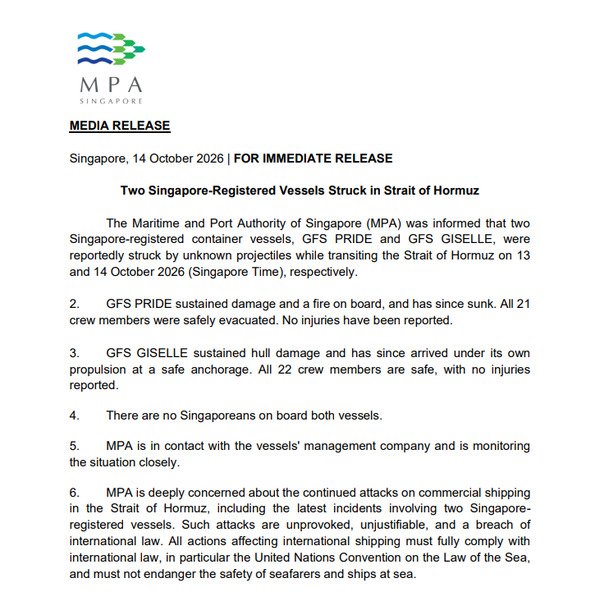 Source: Maritime and Port Authority of Singapore, October 14, 2026.
2. Which Shipping Routes from China Are Affected?
Not every shipment to the Middle East passes through the Strait of Hormuz. The actual port of discharge matters more than the destination country.
| Destination | Hormuz Transit Normally Required? | Main Exposure |
|---|---|---|
| UAE – Jebel Ali | Yes, for direct sea access | Vessel disruptions, emergency surcharges |
| Saudi Arabia – Dammam / Jubail | Yes, for direct sea access | Restricted access, additional logistics costs |
| Iraq – Umm Qasr | Yes, for direct sea access | Delays, insurance and routing uncertainty |
| Saudi Arabia – Jeddah | No | Possible wider Red Sea and network disruptions |
| Oman – Salalah / Sohar | No | Regional disruption and potential inland costs |
| Egypt / Mediterranean / Europe | Generally no | Indirect fuel, capacity and schedule effects |
Persian Gulf: Direct Exposure
Shipments to ports inside the Gulf face the most immediate risks.
When carriers cannot operate according to their original schedules, they may arrange temporary storage, alternative discharge ports or onward inland transportation.
These changes can introduce substantial additional costs.
Europe and the Mediterranean: Indirect Exposure
Cargo from China to Europe or Egypt generally does not need to pass through Hormuz.
However, wider regional instability can still affect bunker prices, insurance conditions, vessel deployment and service schedules.
This does not mean every Europe-bound shipment will become more expensive.
Importers should check their actual routing and carrier quotations rather than assume a universal freight increase.
3. How Much Extra Could Importers Pay?
This is where the crisis becomes a purchasing-cost issue.
In its Middle East Operational Update 51, updated October 8, 2026, Maersk listed Emergency Freight charges for certain affected Gulf shipments and existing ocean bookings or cargo in transit, subject to applicable conditions and regulatory approvals. [2]
Published Emergency Freight Charges
| Container Type | Emergency Freight Charge |
|---|---|
| 20-foot dry container | USD 1,800 |
| 40-foot dry container | USD 3,000 |
| Reefer, special or dangerous-goods container | USD 3,800 |
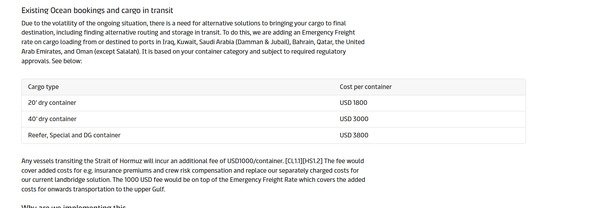 Source: Maersk Middle East Operational Update 51, October 8, 2026.
For qualifying shipments on vessels actually transiting the Strait of Hormuz, Maersk also lists an additional USD 1,000 per container.
This charge covers added costs such as insurance premiums and crew risk compensation and replaces certain separately charged landbridge-related costs.
These are carrier-specific charges for affected shipments, not standard prices for every shipment from China.
Real Example: A 40-Foot Container
Consider a qualifying 40-foot dry-container shipment to an affected Gulf port, with both charges applicable.
| Cost Item | Amount |
|---|---|
| Emergency Freight charge | USD 3,000 |
| Additional Hormuz transit charge | USD 1,000 |
| Combined emergency-related charges | USD 4,000 |
In this scenario, the importer could face USD 4,000 in additional emergency-related charges before other applicable costs.
To understand the effect on landed cost, consider the following illustrative shipment budget:
| Cost Component | Before | After |
|---|---|---|
| Goods value | $30,000 | $30,000 |
| Base ocean freight | $2,000 | $2,000 |
| Other applicable insurance, duties and fees | $4,000 | $4,000 |
| Applicable emergency-related charges | $0 | $4,000 |
| Estimated landed cost | $36,000 | $40,000 |
Note: The goods value, base freight and other costs are hypothetical. The USD 4,000 surcharge example uses the published Maersk charges, assuming both apply. Actual invoices depend on the contract, cargo, routing and carrier.
In this illustration, landed cost increases by approximately 11.1%.
A simplified calculation is:
Landed Cost = Goods Cost + Freight + Insurance + Duties, Taxes and Other Applicable Costs
The exact calculation depends on the agreed Incoterms and which costs are already included in the purchase price.
Before accepting a quote, ask:
- Which emergency surcharges apply to this booking?
- Are fuel, insurance or risk-related charges already included?
- Could temporary storage or a change of destination generate additional costs?
- How long is the quotation valid?
4. Which Cargo Types Face Higher Risks?
The impact differs by cargo type.
General Cargo
Consumer goods, machinery, furniture and electronics mainly face changes in freight quotations, vessel schedules and delivery planning.
Chemicals and Dangerous Goods
Certain chemical shipments may encounter additional carrier acceptance checks, routing restrictions and insurance requirements.
The actual impact depends on their classification, packaging and transport conditions.
Lithium Batteries and Energy-Storage Equipment
Products such as standalone lithium-ion batteries classified under UN3480 require appropriate dangerous-goods documentation and handling.
The International Maritime Organization's IMDG Code governs the maritime transport of packaged dangerous goods. Its 2024 edition, incorporating Amendment 42-24, became mandatory on January 1, 2026. [3]
Importers should confirm the UN classification, packing requirements and carrier acceptance before changing routes or transport modes.
Bulk oil and liquid chemical shipments carried by tankers form another category. Their freight-market movements should not be used as direct estimates for containerized cargo.
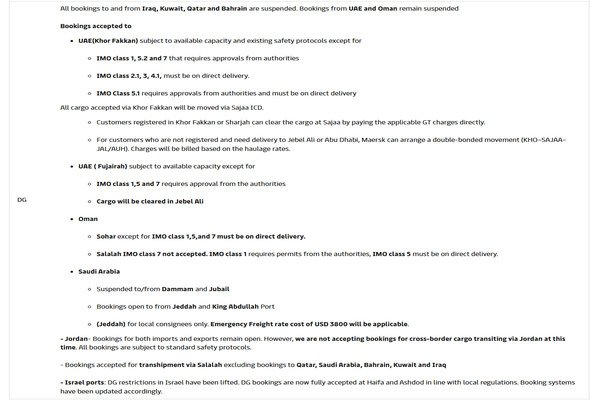 Source: Maersk Middle East Operational Update 51, October 8, 2026.
5. Can Importers Avoid the Hormuz Risk?
Yes, depending on the destination and cargo. But avoiding the strait does not automatically mean reducing the total transport cost.
| Destination | Alternative to Evaluate | Key Consideration |
|---|---|---|
| Persian Gulf | Alternative ports and inland trucking | Port capacity, border clearance and inland costs |
| Central Asia | China–Central Asia rail or road transport | Border conditions and cargo suitability |
| Europe | China–Europe rail or multimodal transport | Total cost, transit time and transit-country compliance |
| Russia / CIS | Applicable rail and road corridors | Customs, sanctions compliance and route availability |
China–Europe Rail: An Alternative for Selected Destinations
For shipments to Central Asia and parts of Europe, rail transport provides an option that avoids both the Strait of Hormuz and the Red Sea.
Different corridors are available, including rail routes through Kazakhstan or Mongolia, as well as the Trans-Caspian International Transport Route, commonly known as the Middle Corridor.
The World Bank's assessment of the Middle Corridor identifies its potential to strengthen trade connectivity and supply-chain resilience between China and Europe. [4]
However, rail is not necessarily cheaper than ocean freight. It may also be unsuitable for some dangerous goods or shipments requiring particular handling arrangements.
The best alternative is the one that meets your delivery deadline, cargo requirements and total budget — not simply the route that avoids the most headlines.
[Image 2 — 600 × 400: Realistic freight railway terminal in China with containers being loaded onto a China–Europe freight train, no map or text]
6. Five Things Importers Should Do Now
You cannot control maritime security conditions, but you can reduce uncertainty before your next shipment.
1. Request an itemized freight quotation.
Separate base freight, emergency charges, fuel adjustments and destination costs. This makes it easier to compare quotations and identify possible duplicate charges.
2. Check your insurance coverage.
Confirm war-risk exclusions, insured routes, claims conditions and who is responsible under your contract.
3. Verify the actual routing.
A shipment to the Middle East does not necessarily pass through Hormuz. Ask about the discharge port, transshipment points and possible rerouting arrangements.
4. Build flexibility into delivery schedules.
Review inventory buffers, alternative bookings and potential storage costs before committing to a delivery deadline.
5. Compare the total cost of alternative routes.
Include inland trucking, customs, handling and transit time — not just the headline freight rate.
7. Conclusion: Focus on the Total Cost, Not Just the Freight Rate
The Strait of Hormuz crisis is a reminder that shipping costs depend on more than distance and container availability.
For some Gulf shipments, published emergency charges can add thousands of dollars per container. For other destinations, the effect may be indirect or limited.
The practical response is to verify the route, understand every charge and compare realistic transport options before booking.
If you are importing goods from China, our logistics team can help review shipment requirements, compare available freight solutions and clarify applicable transport costs.
We support China-origin freight movements involving general cargo, chemicals, new-energy products and selected rail, road and multimodal routes, subject to cargo acceptance and route availability.
Contact us with your cargo details, origin, destination and delivery requirements for a shipment-specific logistics quotation.
Frequently Asked Questions
1. Does shipping from China to Europe pass through the Strait of Hormuz?
Generally, no. China–Europe ocean freight services do not normally require Hormuz transit. However, fuel costs, service changes and wider shipping disruptions may still affect individual quotations.
2. How much does the Hormuz crisis add to container shipping costs?
It depends on the carrier, route and booking conditions.
Maersk's October 8, 2026 update lists Emergency Freight charges of USD 1,800 for a 20-foot dry container and USD 3,000 for a 40-foot dry container on certain affected Gulf shipments.
A further USD 1,000 per container applies to qualifying vessels transiting Hormuz.
These charges should not be treated as universal market rates.
3. Can lithium batteries and chemical cargo be shipped by rail instead of sea?
Some products may be eligible, but acceptance depends on the exact dangerous-goods classification, packaging, rail corridor and applicable national and international rules.
Importers should confirm eligibility before relying on rail as an alternative.
References
[1] Maritime and Port Authority of Singapore (October 14, 2026). Two Singapore-Registered Vessels Struck in Strait of Hormuz.
[2] Maersk (Updated October 8, 2026). Middle East Operational Update 51 — Emergency Freight and Strait of Hormuz Charges.
[3] International Maritime Organization (IMO). IMDG Code — 2024 Edition, Amendment 42-24.
[4] World Bank (November 27, 2023). Middle Corridor Through Central Asia, Caucasus Can Boost Trade, Connectivity and Supply Chain Resilience.