
Shipping goods across borders is complex. The new 2026 single document rule promises to simplify it, but it also creates new challenges you must understand.
Yes, the 2026 Multimodal Transport Single Document system removes many customs and transit procedures[^1]. It eliminates repeated declarations at intermediate transit points, creating a single, streamlined customs process from origin to final destination under one contract.
This change sounds great on the surface. It promises faster, more efficient shipping. But to truly benefit, we need to understand exactly what it is and how it works. Let's break it down together, so you can be prepared for what's coming.
What Is a Multimodal Transport Single Document?
You keep hearing about the "multimodal transport single document". It sounds like technical jargon. But not understanding it could lead to costly mistakes on your future shipments.
It is a single contract that covers the entire journey of your cargo[^2]. This journey can use multiple types of transport, like ships, trains, and trucks. One company, the operator, is responsible for everything from start to finish.
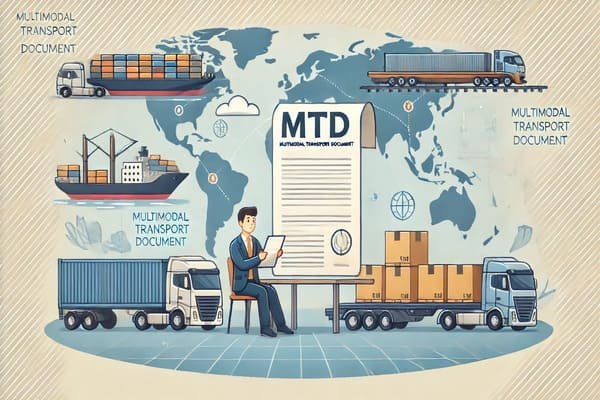
I've been in logistics for over 20 years, and I can tell you this is a huge shift. We used to deal with a lot of finger-pointing. The new system changes the game by putting all the responsibility in one place. To see the difference, let's look at how things worked before and how they will work now.
The Old Way: A Chain of Separate Contracts
In the past, shipping from a factory in Shenzhen to a warehouse in Germany involved multiple contracts. You had a contract with a trucking company to get goods to the port. Then you had a separate contract with the ocean carrier. Once it arrived in Hamburg, you needed another contract for rail or truck transport to Munich. If a delay happened, the blame game would start. The ocean carrier would blame the rail company, and the rail company would blame the port. For you, the owner of the goods, it was a nightmare to figure out who was responsible and how to get your shipment moving again.
The New Way: One Contract, One Responsibility
The Multimodal Transport Single Document changes all of that. Now, you have one contract with one company, the Multimodal Transport Operator (MTO). We at Deeplinker often act as the MTO for our clients. This means we take full responsibility for the entire journey. From the factory door in China to the warehouse door in Germany, it's our job to manage every step. If there's a delay on the rail leg, it's our problem to solve. You have one point of contact and one company accountable for the safety and timely delivery of your goods.
What This Means for You
This shift simplifies things immensely for you, the shipper. It reduces your administrative burden and gives you a single, clear source of truth for your shipment's status.
| Feature | Segmented Transport (Old Way) | Multimodal Transport (New Way) |
|---|---|---|
| Contracts | Multiple contracts, one for each leg | One single contract for the whole journey |
| Responsibility | Split between multiple carriers | Held by one operator (the MTO) |
| Communication | You talk to many different companies | You talk to one single point of contact |
| Problem Solving | Difficult, involves multiple parties | Streamlined, handled by the MTO |
This single point of responsibility is the foundation that makes the new customs procedures possible.
Which Customs and Transit Procedures Are Removed?
Customs paperwork feels endless. Every border crossing can mean more forms and potential delays. The new system promises to cut through this red tape, but what exactly gets cut?
The biggest change is the removal of re-declarations at transit hubs. If your container moves from a ship to a train in a port, you will not need new customs paperwork there. The original clearance covers it.
Think about a typical journey today. A container might travel through several countries or customs zones before reaching its final stop. Each time, it requires new transit documents. This process adds time, cost, and risk. The 2026 single document system aims to eliminate this friction.
The End of Repetitive Transit Declarations
Let’s use a real-world example. Say we are shipping a container of electronics from South Korea to Poland. The sea route might land the container at the Port of Hamburg in Germany first. Under the old system, the container would have to enter a "transit procedure" in Hamburg. This involves filing a T1 transit document[^3] to allow the goods to move through Germany to Poland under customs control. This step requires paperwork, can cause delays, and opens up another point for potential errors or inspections. With the new single document system, this step is largely removed. The electronic data from the initial export filing in Korea follows the cargo. As long as the container's seal is intact, it can move from the ship to a train in Hamburg and head to Poland without a new, separate transit filing.
How "In-Bond" Movement is Simplified
This new process works because the entire journey is treated as a single "in-bond" movement under the control of the MTO[^4]. Customs authorities trust the MTO and the digital trail of the single document. They know the goods are sealed and tracked. They don't need to re-verify everything at every internal border. This makes the supply chain not only faster but also much more predictable. You can plan your inventory with more confidence because you are less likely to face unexpected delays at a transit port.
A Single Data Set for the Entire Journey
The key technology behind this is a shared digital platform. Instead of different systems for sea, rail, and customs, there is one data set. This data is created at the origin and is visible to all authorized parties, including customs authorities along the route.
| Procedure at Transit Port | Before 2026 System | After 2026 System |
|---|---|---|
| Documentation | File new transit documents (e.g., T1) | No new filing; original data is used |
| Customs Action | Potential for full review and hold | System checks electronic data and seal |
| Time Delay | Can be hours or even days | Often just minutes for transfer |
| Risk | Risk of errors in new paperwork | Risk is low if original data is correct |
This streamlined process is a massive win for efficiency. But it also raises a very important question: what happens if that original data is wrong?
What Risks Still Exist in Single Document Shipping?
A faster, simpler system sounds too good to be true. And in some ways, it is. This new efficiency removes the safety nets we used to have. It creates a new set of high-stakes risks.
The main risk is the lack of a safety net. An error in your initial customs declaration is much harder to fix. With fewer checkpoints, a mistake can travel all the way to the destination, causing major fines and delays.

In the past, a mistake made on export paperwork might be caught by a customs broker or agent at a transit port. It was an unofficial safety check. With those checks gone, the pressure to get everything 100% right at the very beginning is immense.
The "Garbage In, Garbage Out" Problem
The new system operates on the principle of "Garbage In, Garbage Out." If the initial data you provide is wrong, the entire process will be wrong. There is no longer an opportunity for correction mid-journey. Let's say you accidentally use the wrong HS code for your product. Before, an experienced agent in a transit port might have noticed the code didn't match the cargo description and flagged it. You could correct it with a small delay. Now, that wrong HS code will follow your container all the way to the final destination. When the destination country's customs finds the error, they won't just see it as a simple mistake. They will see it as a potential attempt to avoid duties, leading to severe penalties[^5].
Heightened Scrutiny at Final Destination
Because there are fewer checks along the way, you can expect much stricter inspections at the final destination. Customs authorities will place more trust in the data, but they will also perform more rigorous audits to ensure that data is accurate. A small discrepancy in weight, quantity, or value that might have been overlooked before could now trigger a full container inspection. I saw this happen with a client shipping furniture to the UK. A small error in the declared value on their initial paperwork led to their container being held for two weeks, a full unload and inspection, and a fine that was ten times the cost of the original shipping fee. Under the 2026 system, this will become much more common.
Why Your Forwarder is More Important Than Ever
This is why your relationship with your freight forwarder is no longer just about finding the cheapest rate. It's about risk management. An expert forwarder like Deeplinker becomes your first and most important line of defense. We don't just move boxes; we scrutinize your paperwork. We double-check your HS codes, your valuations, and your product descriptions against our decades of experience. We catch the small mistakes before they become big, costly problems. In this new world, a good forwarder isn't a cost; it's an investment in supply chain security.
| Error Type | Old System Consequence | New System Consequence |
|---|---|---|
| Wrong HS Code | Delay at transit port, correction fee | Heavy fines, cargo seizure at destination |
| Incorrect Value | Possible adjustment and tax payment | Accusation of fraud, blacklisting |
| Quantity Mismatch | Minor delay for clarification | Full container inspection, storage fees |
The rules are getting simpler, but the stakes are getting much, much higher.
Conclusion
The 2026 single document simplifies transit but demands perfect upfront accuracy. Partnering with an expert forwarder is no longer a choice; it is essential for success.