
After years of widespread diversions around the Cape of Good Hope, container shipping through the Red Sea and Suez Canal is beginning to return — but only gradually1.
In September 2026, several major carriers expanded their use of the Suez route. Maersk and Hapag-Lloyd announced that four additional Gemini Cooperation services would return to the Suez Canal, while MSC continued a limited restoration of selected East–West services.
For companies shipping between China, Europe and the Mediterranean, this could mean shorter transit times and changes to vessel schedules.
However, the Red Sea has not returned to normal.
Security risks remain, some services are still sailing around the Cape of Good Hope, and carriers continue to reserve the right to change routing if conditions deteriorate.
So what has actually changed — and what should shippers expect?
1. Which Shipping Lines Have Returned to the Red Sea and Suez Canal?
The most significant change in September came from the Gemini Cooperation between Maersk and Hapag-Lloyd.
On September 14, 2026, the two carriers announced that four additional services would switch from the Cape of Good Hope back to the Red Sea–Suez Canal route:
| Service | Trade Lane | New Routing |
|---|---|---|
| AE5 | Asia – Northern Europe | Via Suez Canal |
| AE11 | Asia – Mediterranean | Via Suez Canal |
| AE12 | Asia – Mediterranean | Via Suez Canal |
| ME2 | India – Europe | Via Suez Canal |
These services join AE15 and AE19, which were already operating via Suez.
For China exporters, AE5, AE11 and AE12 are particularly relevant.
The new rotations include major Chinese ports such as:
- Qingdao
- Ningbo
- Shanghai
- Yantian
and connect them with European gateways including:
- Rotterdam
- Hamburg
- Bremerhaven
- London
- Valencia
- Barcelona
- Genoa
- La Spezia
- Koper
- Rijeka
For example, the revised AE11 rotation is:
Shanghai → Yantian → Tanjung Pelepas → Suez Canal → Tangier → Valencia → Barcelona → La Spezia → Genoa → Vado Ligure → Suez Canal → Singapore
The first westbound sailings for several of these revised services began from September 19–21, while implementation dates vary by service and direction.
The first AE12 sailing under the revised routing had not yet been announced in Maersk's September 14 advisory.
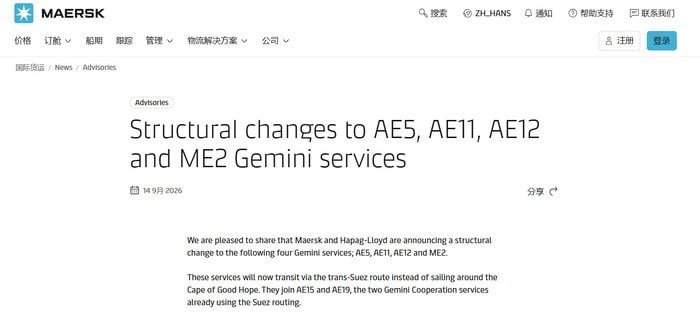
Source: Maersk – Structural Changes to AE5, AE11, AE12 and ME2 Gemini Services
2. MSC Is Also Returning — But More Cautiously
MSC is also gradually restoring Red Sea and Suez Canal transits, but its approach remains more limited.
On September 14, MSC announced that it was continuing to partially restore Suez Canal transits on a limited number of East–West services.
One example is the Indusa service, connecting the Indian subcontinent with the United States and Mexico.
MSC announced that westbound cargo would resume Red Sea routing with:
MSC DOMNA X — Voyage IV637A — departing Colombo on September 23, 2026
However, eastbound cargo on the same service would continue sailing around the Cape of Good Hope.
That distinction is important.
A shipping line may resume Suez transits for:
- One service
- One direction
- Selected vessels
- Specific sailings
while continuing to divert other voyages around Africa.
MSC also stated that the transition would be implemented case by case, with contingency arrangements remaining in place if regional conditions change.
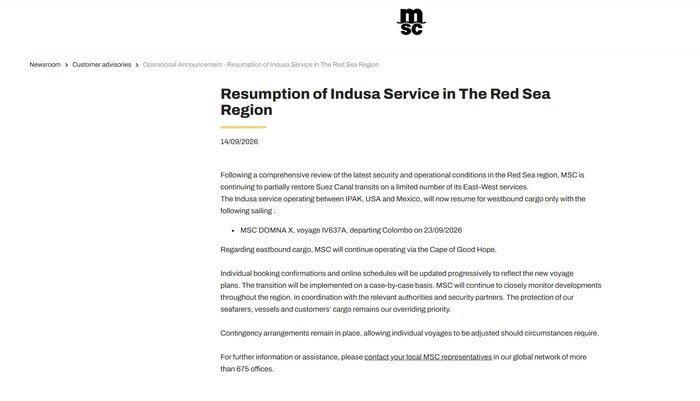
Source: MSC – Resumption of Indusa Service in the Red Sea Region
3. What Does the Return to Suez Mean for China–Europe Shipping?
The biggest operational advantage of the Suez route is simple:
It is shorter than sailing around the Cape of Good Hope.
For Asia–Europe container shipping, the basic routing difference looks like this:
Suez Route
China
↓
Southeast Asia
↓
Indian Ocean
↓
Bab el-Mandeb
↓
Red Sea
↓
Suez Canal
↓
Mediterranean
↓
Europe
Cape of Good Hope Route
China
↓
Southeast Asia
↓
Indian Ocean
↓
Cape of Good Hope
↓
West Africa
↓
Europe
Returning to Suez can reduce sailing distance and improve transit times.
For importers, that may provide several potential benefits:
- Shorter transit times
- Faster inventory replenishment
- Reduced vessel operating distance
- More efficient equipment rotation
- Potentially more stable Asia–Europe schedules
But shippers should be careful about assuming that every China–Europe service has already returned to its old schedule.
The transition is happening service by service.2
A booking from Shanghai to Rotterdam, for example, could now travel through Suez on one service while another carrier or service may still route around the Cape of Good Hope.
Before booking, shippers should therefore confirm the actual routing of the specific service, not simply assume that all Asia–Europe cargo is moving through Suez again.
4. Does the Red Sea Restart Mean Freight Rates and Surcharges Will Fall?
Not necessarily.
A shorter Suez routing can reduce sailing distance and vessel operating requirements compared with the Cape of Good Hope diversion.
In theory, that can improve vessel utilization and reduce some of the additional costs created by long diversions.
However:
Route normalization does not automatically mean freight-cost normalization.
Freight rates are influenced by many factors beyond sailing distance3, including:
- Vessel capacity
- Seasonal demand
- Fuel prices
- Port congestion
- Equipment availability
- Security costs
- Insurance costs4
- Carrier capacity management
Security-related surcharges may also remain in place on some trades.5
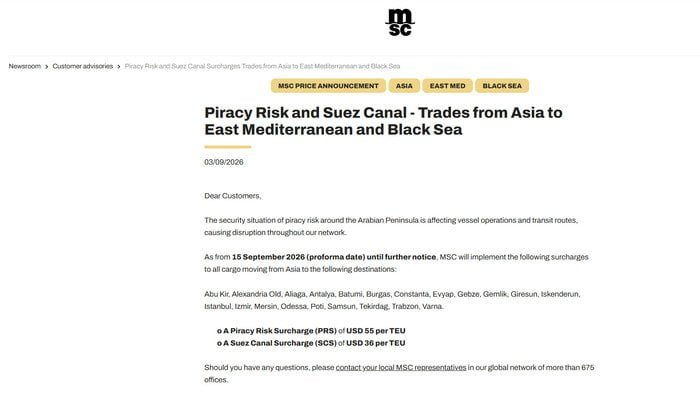
For example, MSC announced a Piracy Risk Surcharge (PRS) and Suez Canal Surcharge (SCS)6 in September for cargo moving from Asia to selected East Mediterranean and Black Sea destinations.
This demonstrates why shippers should not assume:
"The vessel is using Suez again, so the Red Sea surcharge must disappear."
Instead, check the actual freight quotation and confirm which surcharges apply to the specific carrier, route and sailing.
5. Why Shippers Still Need a Backup Plan
The return to Suez is an important development, but the security situation remains uncertain.
Maersk and Hapag-Lloyd explicitly stated that future routing decisions remain dependent on:
- Continued stability in the Red Sea
- The absence of escalation in regional conflicts
MSC has taken a similarly cautious approach, keeping contingency arrangements in place and allowing individual voyages to be adjusted if conditions require.
That caution is understandable.
The Bab el-Mandeb Strait, connecting the Gulf of Aden with the Red Sea, remains a strategically sensitive maritime chokepoint7.
Security concerns in the region have not disappeared, and naval protection efforts remain active.
For shippers, this means routing could still change after a booking is made.
Before Booking China–Europe Cargo
Check:
- [ ] Is the selected service currently routing through Suez?
- [ ] Is the routing confirmed in both directions?
- [ ] What is the current transit time?
- [ ] Are Red Sea, piracy or Suez-related surcharges included?
- [ ] Could the carrier revert to the Cape of Good Hope?
- [ ] How would a routing change affect the ETA?
- [ ] Is additional inventory buffer required?
- [ ] Are alternative sailings available?
For time-sensitive cargo, the actual service routing and schedule reliability may now be more important than simply choosing the lowest ocean freight rate.
FAQ
Have shipping lines fully returned to the Red Sea in 2026?
No. The return is still partial.
Maersk and Hapag-Lloyd have expanded Suez routing across several Gemini Cooperation services, while MSC has resumed selected Red Sea transits on a limited and case-by-case basis.
Other services may continue routing around the Cape of Good Hope.
Shippers should check the routing of the specific service and sailing before booking.
Which China–Europe services have returned to the Suez Canal?
As of September 2026, Gemini Cooperation services including AE5, AE11 and AE12 have been announced for Suez routing, joining AE15 and AE19.
These services connect major Asian ports, including several Chinese gateways, with Northern European and Mediterranean destinations.
Implementation dates vary by service and sailing.
Will Suez Canal resumption make China–Europe freight cheaper?
Not automatically.
Returning to Suez can reduce sailing distance and potentially improve vessel utilization, but freight rates depend on many other factors, including capacity, demand, fuel prices, insurance costs and carrier pricing strategies.
Security-related or route-specific surcharges may also remain in place.
Conclusion
The return of major container services to the Red Sea and Suez Canal marks an important shift for Asia–Europe shipping in 2026.
Maersk and Hapag-Lloyd are expanding Suez routing across several Gemini services, while MSC is gradually restoring selected transits.
For China exporters and European importers, the change could mean shorter transit times and more efficient routing compared with sailing around the Cape of Good Hope.
But this is not yet a full return to normal.
Security risks remain, implementation differs by carrier and service, and some voyages continue to use the Cape route. Shipping lines also retain contingency plans that allow them to change routing if regional conditions deteriorate.
For shippers, the best approach is therefore to confirm the actual vessel routing, transit time and applicable surcharges for each booking rather than assuming that the entire China–Europe trade has returned to Suez.
In the current market, routing flexibility and schedule visibility remain just as important as freight price.
"Red Sea Shipping 2026: Suez Canal Recovery Explained", https://seaprince.ae/blog/rising-pressure-on-red-sea-transit-5/red-sea-shipping-in-2026-what-the-suez-canal-recovery-really-means-for-your-cargo-30. Suez Canal Authority or UNCTAD traffic data showing a partial rebound in Suez transits would support the claim that traffic is returning gradually rather than immediately normalizing. Evidence role: statistic; source type: institution. Supports: Container shipping through the Red Sea and Suez Canal is recovering gradually rather than returning all at once.. Scope note: Aggregate canal traffic data may not isolate container services or specific China–Europe lanes. ↩
"Ocean carriers accelerate their return to the Suez Canal ...", https://mykn.kuehne-nagel.com/news/article/ocean-carriers-accelerate-their-return-to-the. Carrier advisories identifying only selected services, directions, and sailings for renewed Suez transits would support the statement that the return is being implemented service by service. Evidence role: case_reference; source type: other. Supports: The return to Suez is being implemented on selected services rather than across all China–Europe shipping at once.. Scope note: Carrier advisories are primary operational sources and support the cited carriers’ networks, not all global container services. ↩
"Review of Maritime Transport 2025: Staying the course in ...", https://unctad.org/publication/review-maritime-transport-2025. UNCTAD’s maritime transport work identifies freight rates as being shaped by supply-demand balance, fleet capacity, fuel costs, port conditions, and other market factors, supporting the claim that distance alone does not determine freight costs. Evidence role: expert_consensus; source type: institution. Supports: Freight rates depend on multiple factors beyond sailing distance.. Scope note: Such sources explain general freight-rate determinants and may not quantify the effect of each factor on a specific China–Europe quotation. ↩
"Risks and Resilience in Global Trade", https://www.oecd.org/en/publications/risks-and-resilience-in-global-trade_1c66c439-en/full-report/component-6.html?utm_source=openai. Insurance-market and maritime security analyses note that war-risk and piracy-risk conditions can increase marine insurance premiums for vessels operating in high-risk areas, supporting the inclusion of insurance costs among freight-cost drivers. Evidence role: mechanism; source type: institution. Supports: Insurance costs can affect shipping costs on routes exposed to war-risk or piracy-risk conditions.. Scope note: Insurance cost increases may be embedded in carrier pricing and are not always separately visible on customer invoices. ↩
"Maritime Disruption 2026: Red Sea, Suez and Hormuz Impact on ...", https://gofreight.com/blog/maritime-disruption. Carrier surcharge notices for Red Sea, piracy-risk, or Suez-related charges provide direct evidence that security-related surcharges can remain applicable even when selected Suez routings resume. Evidence role: case_reference; source type: other. Supports: Security-related surcharges may remain in place on some trades despite partial route normalization.. Scope note: Carrier surcharge notices are carrier-specific commercial documents and do not establish that all carriers or trades apply the same charges. ↩
"Piracy Risk and Suez Canal - Trades from Asia to East ...", https://www.msc.com/en/newsroom/customer-advisories/2026/september/piracy-risk-and-suez-canal-surcharges-trades-from-asia-to-east-mediterranean-and-black-sea. MSC’s customer advisory announcing a Piracy Risk Surcharge and Suez Canal Surcharge for specified Asia-origin cargo would support the article’s example of continuing route- and risk-related surcharges. Evidence role: case_reference; source type: other. Supports: MSC announced PRS and SCS charges for certain Asia to East Mediterranean and Black Sea cargo in September.. Scope note: This is direct evidence for MSC’s announced charges only and should not be generalized to every carrier or destination. ↩
"The Bab el-Mandeb Strait is a strategic route for oil and ...", https://www.eia.gov/todayinenergy/detail.php?id=41073. The U.S. Energy Information Administration and other institutional sources describe Bab el-Mandeb as a major maritime chokepoint linking the Red Sea with the Gulf of Aden, supporting the characterization of its strategic sensitivity. Evidence role: definition; source type: government. Supports: The Bab el-Mandeb Strait is a strategically sensitive maritime chokepoint.. Scope note: Chokepoint status explains strategic importance but does not by itself measure the current threat level. ↩