

Shipping oversized cargo is complex and choosing the wrong method can be a costly mistake. You end up with unexpected fees, frustrating delays, and even potential damage to your valuable goods.
RoRo (Roll-on/Roll-off) is best for any cargo with wheels, like cars and machinery, which can be driven onto the ship. Breakbulk is for oversized, non-wheeled items, such as transformers or large pipes, that are lifted by crane. Choosing the right one saves you time and money.

Choosing between these two methods isn't just a simple cost comparison. It's about finding the perfect fit for your cargo's specific size, shape, and handling requirements. An incorrect choice can lead to logistical nightmares, but the right one ensures a smooth, efficient journey from port to port. Let's dive deeper into each method to see which one is the right solution for you.
What Exactly Is RoRo Shipping & Its Core Features?
Moving vehicles or heavy machinery overseas seems like a huge challenge. You might worry about the complex loading process and the risk of damage from cranes and heavy handling. RoRo shipping solves this problem.
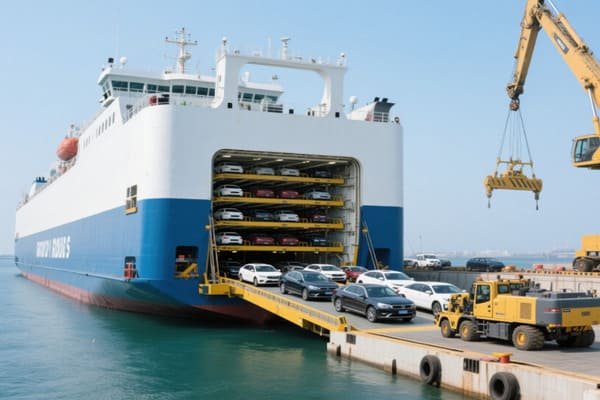
RoRo, or Roll-on/Roll-off, shipping is a method where wheeled cargo is driven directly onto a specialized vessel, much like a giant parking garage on the water. This method is ideal for cars, trucks, and self-propelled machinery, offering speed and reduced handling risks1.
How Does RoRo Work?
The process is straightforward. Your cargo is driven up the ramp and onto the RoRo vessel, where it is securely parked and lashed to the deck to prevent movement during the sea voyage.2 This minimizes the need for cranes and lifting3, which is a major advantage.
Table: Key Features of RoRo Shipping
| Feature | Description |
|---|---|
| Speed & Efficiency | Cargo is driven on and off the vessel quickly, which greatly reduces port turnaround times. |
| Reduced Handling | With no need for cranes to lift your cargo, the risk of accidental drops or damage is much lower. |
| Cost-Effective | For wheeled and self-propelled cargo, RoRo is often the most affordable shipping option. |
| Weather Protection | Most cargo is stored below deck, keeping it safe from saltwater, rain, and other harsh elements. |
What Is Breakbulk Shipping & When to Use It?
You have cargo that is too big, too heavy, or too awkwardly shaped for a standard container. You might feel stuck, thinking it is impossible or extremely expensive to ship. Breakbulk shipping is the classic solution for exactly these kinds of items.
Breakbulk shipping involves transporting cargo that does not fit into standard containers4. These items are loaded individually, often using cranes, and secured directly within the vessel’s hold. It is perfect for oversized machinery, large pipes, or construction components.

Think of breakbulk as the original form of shipping, before containers became standard.5 It’s for anything that needs special handling. We recently managed a shipment of massive power generators for a new plant project in Brazil. Each generator was far too large and heavy for a container, so breakbulk was the only viable option. Our team worked on-site to ensure each unit was lifted, placed, and secured perfectly for the long journey.
The Breakbulk Process Explained
With breakbulk, cargo is loaded piece-by-piece. These items can be in crates, barrels, or simply loaded as-is, like large steel beams. This requires expert stevedores and a logistics team to plan the stowage carefully6, ensuring the ship remains balanced and the cargo is safe.
Table: When to Choose Breakbulk
| Cargo Type | Example | Reason for Breakbulk |
|---|---|---|
| Oversized Machinery | Wind turbines, factory equipment | Too large for containers or RoRo decks. |
| Construction Materials | Steel beams, large pipes | Irregular shapes and long lengths. |
| Project Cargo | Components for a new factory | Multiple, non-uniform items shipped together. |
| Non-Wheeled Heavy Items | Transformers, boat hulls, generators | Cannot be rolled onto a vessel and require a crane. |
What Are the Main Differences Between RoRo and Breakbulk?
You now know the basics of RoRo and Breakbulk, but they might still seem a bit similar. Choosing the wrong one could mean you pay more for a slower and riskier shipment. Let's compare them directly to make the best choice for your cargo clear.
The key difference is the loading method. RoRo uses wheels to roll cargo on and off the ship. Breakbulk uses cranes to lift individual, non-containerized items.7 RoRo is faster for vehicles, while breakbulk is more versatile for any oversized item.

The choice you make has a direct impact on your shipping timeline, budget, and the safety of your cargo. While RoRo is streamlined and fast for the right type of goods, breakbulk offers unmatched flexibility for complex, heavy-lift projects. It's not about which one is "better" overall, but which one is better for your specific shipment. A good logistics partner helps you analyze these factors to prevent costly errors.
Head-to-Head: RoRo vs. Breakbulk
Let's break down the comparison into a simple table to see how they stack up against each other on the most important factors. This will help you see at a glance which method aligns with your priorities.
Table: RoRo vs. Breakbulk Comparison
| Factor | RoRo Shipping | Breakbulk Shipping |
|---|---|---|
| Cargo Type | Wheeled/Self-propelled (cars, trucks) | Oversized, heavy, non-uniform items |
| Loading Method | Driven on/off via ramps | Lifted on/off with cranes |
| Handling | Minimal; cargo is driven and parked | Extensive; requires lifting, lashing, securing |
| Speed | Faster port turnaround and loading | Slower, more labor-intensive process |
| Cost | Generally cheaper for suitable cargo | Can be more expensive due to labor and equipment |
| Risk of Damage | Lower, due to less handling | Higher, as there are more touchpoints |
Conclusion
RoRo is for wheeled cargo; breakbulk is for oversized, non-uniform items. Choosing correctly saves time and money. If you are unsure, Deeplinker can help match the right shipping solution for your cargo.
Sea Year Vessels — overview of vessel types including Roll-on/Roll-off (RoRo) ships and their operational advantages — *United States Merchant Marine Academy (USMMA)*: https://www.usmma.edu/sea-year/vessels ↩
Roll-on/roll-off — vessels designed to carry wheeled cargo that is driven on and off via built-in ramps — *Wikipedia*: https://en.wikipedia.org/wiki/Roll-on/roll-off ↩
Maritime Administration Vessel Characteristics — technical pamphlet detailing RoRo vessel design and reduced-crane loading — *U.S. Maritime Administration (MARAD)*: https://www.maritime.dot.gov/sites/marad.dot.gov/files/docs/national-defense/office-ship-operations/rrf/2691/maritime-administration-vessel-characterstics-pamphlet-32016.pdf ↩
Breakbulk and general cargo transport — World Bank analysis of non-containerized shipping methods — *World Bank Open Knowledge Repository*: https://openknowledge.worldbank.org/bitstreams/67e27cb9-7ffd-52b7-8e97-9903ce132cc3/download ↩
Break bulk cargo — goods transported in individually loaded pieces rather than in containers — *Wikipedia*: https://en.wikipedia.org/wiki/Break_bulk_cargo ↩
Cargo Stowage and Securing — academic paper on stowage planning, vessel balance, and cargo securing methods — *Academia.edu*: https://www.academia.edu/17545389/Cargo_stowage_and_securing ↩
Comparison of RoRo and general/breakbulk cargo handling systems — technical study on loading methods and efficiency — *Universitat Politècnica de Catalunya (UPC Commons)*: https://upcommons.upc.edu/bitstreams/3c7fc178-7234-4e95-b55b-69f5c8e7e27f/download ↩