
Are you worried that new US sanctions could disrupt your shipments from China to Russia?
The sanctions landscape is becoming more complex, and exporters, importers and logistics companies may need to pay closer attention to who they are doing business with, what they are shipping, where the goods will ultimately go and how payment will be processed.
H.R. 5334 does not create a blanket ban on all trade between China and Russia. However, the new law expands US sanctions, tariff authorities and other restrictions related to Russia. Whether a specific shipment can proceed depends on factors such as the parties involved, the type of goods, the end user, the final destination, applicable export controls and the payment route.
For companies involved in China–Russia trade, the key is not to assume that every shipment is prohibited — or that every shipment is automatically safe.
Instead, businesses should take a risk-based approach and review the transaction before the cargo leaves China.
Let's look at what international shippers should know.
What Changed Under H.R. 5334?
H.R. 5334, the Lindsey O. Graham Sanctioning Russia and Iran Act of 2026, was signed into law on September 18, 2026.1
The law expands statutory sanctions, tariff authorities and other restrictions related to Russia, while also extending existing sanctions authorities related to Iran.
For international shippers, the key point is not that all China–Russia trade has stopped.
Instead, companies involved in Russia-related transactions may need to pay closer attention to:
- Buyers and consignees
- Final end users
- Product classifications
- Financial institutions
- Payment routes
- Final destinations
- Transshipment arrangements
- Potential sanctions-evasion risks
The exact compliance requirements depend on the transaction, the parties involved and the applicable sanctions and export-control rules.
Can Companies Still Ship Goods from China to Russia?
Worried that new US sanctions will halt your China–Russia shipments? The answer depends on the specific transaction.
H.R. 5334 does not impose a blanket prohibition on all China–Russia shipments2. However, individual transactions may still be restricted depending on the product, buyer, consignee, end user, financial institutions involved and applicable US sanctions or export-control rules.
The important point is that sanctions compliance cannot be determined by looking only at the shipping route.
For example, a shipment of ordinary consumer products to a legitimate commercial buyer may present a very different risk profile from a shipment involving advanced electronics, controlled technology, a sanctioned entity or a military-related end user.
Before accepting or arranging a shipment, companies should understand:
- Who is buying the goods?
- Who is receiving the cargo?
- Who is the final end user?
- What exactly is being shipped?
- What is the intended end use?
- Which banks are involved in payment?
- Where will the goods ultimately be delivered?
Understanding Sanctions Screening
Transactions involving parties on the US Specially Designated Nationals (SDN) List require particular attention.
US persons are generally prohibited from dealing with blocked persons unless an exemption or OFAC authorization applies.3
For non-US companies, the situation can be different. Non-US persons may also face sanctions exposure in certain circumstances4 depending on the transaction, the sanctioned party involved and the applicable sanctions authority.
This is why companies should avoid assuming that checking only the shipping destination is enough.
The Importance of Due Diligence
Before proceeding with a Russia-related shipment, companies should consider screening the relevant parties and reviewing the transaction as part of their sanctions compliance process.
This may include:
- Buyer
- Consignee
- End user
- Financial institutions
- Intermediaries
- Freight and trading partners
Understanding the final destination and intended use of the goods can also be an important part of risk-based due diligence.
Which Transactions May Face Greater Sanctions Risk?
Not all shipments carry the same level of sanctions or export-control risk.
Transactions involving sanctioned parties, controlled or dual-use goods, sensitive end uses, certain financial institutions or unclear final destinations may require greater compliance review before shipment.
For example, consider a Chinese exporter receiving an order for advanced electronic components.
If the buyer provides clear corporate information, a legitimate civilian end use and a transparent delivery destination, the transaction can be evaluated based on those facts.
But if the buyer refuses to identify the final end user, requests unusual routing through several intermediaries or provides inconsistent information about the goods and destination, additional due diligence may be appropriate.
The goal is to identify potential warning signs before the cargo is shipped.
High-Risk Transaction Categories
| Risk Category | Examples | Why It May Require Additional Review |
|---|---|---|
| Sanctioned Parties | Companies or individuals appearing on applicable sanctions lists | Transactions involving blocked or otherwise restricted parties may be prohibited or create sanctions exposure depending on the applicable rules |
| Dual-Use or Controlled Goods5 | Advanced electronics, certain machine tools, chemicals or high-performance computing products | These goods may be subject to export controls or restrictions based on their technical characteristics and end use |
| Sensitive End Uses6 | Defense, military-industrial, aerospace or other restricted applications | Certain end uses can trigger additional export-control or sanctions restrictions |
| Unclear End User | Intermediaries or trading companies that will not identify the ultimate recipient | Lack of transparency can make it difficult to determine whether the transaction complies with applicable restrictions |
| Unusual Payment Structure | Payments involving multiple intermediaries or financial institutions | Complex payment chains may require additional sanctions and banking review |
Companies should evaluate the complete transaction rather than relying on a single factor such as cargo type or destination.
What About Cargo Moving Through Central Asia?
Does routing cargo through Kazakhstan, Kyrgyzstan, Uzbekistan or another third country remove sanctions risk?
Not necessarily. Third-country transit does not by itself eliminate sanctions or export-control risk.7 The final destination, end user, goods involved and overall transaction structure may still matter.
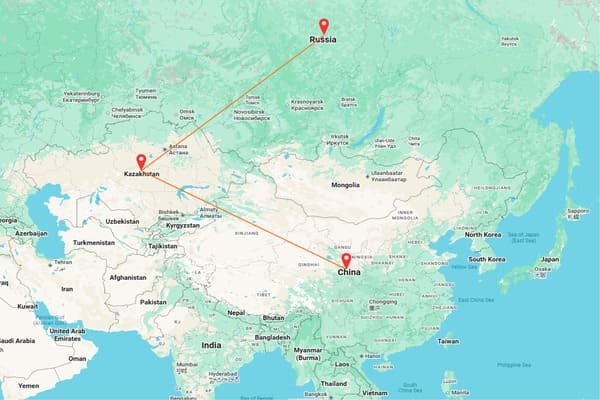
Central Asia is an important logistics corridor for legitimate international trade.8
A shipment moving from China to Kazakhstan, Kyrgyzstan or another Central Asian market should therefore not automatically be treated as suspicious simply because of its route.
However, transactions involving third-country intermediaries may require additional due diligence when there are indications that goods could ultimately be re-exported to a sanctioned party or prohibited end user in Russia.
For example:
China → Kazakhstan → Local Customer
and
China → Kazakhstan → Intermediary → Restricted Russian End User
may look similar on the first shipping leg but present very different compliance considerations.
Third-Country Transit Is Not Automatically a Loophole
The key question is not simply:
"Which country appears on the first bill of lading?"
Companies may also need to understand:
- Who ultimately owns the goods?
- Who will use them?
- Where will they ultimately be delivered?
- Is the intermediary a genuine customer or only a transit party?
- Are the commercial and payment arrangements consistent with the stated transaction?
Tracing the Final Destination
Understanding the final destination and end user is an important part of risk-based due diligence.
For higher-risk transactions, exporters may consider requesting additional information from the buyer, such as:
- Final delivery address
- End-user information
- Intended use
- Re-export information
- Supporting commercial documents
If important information remains unclear or inconsistent, the transaction may require further compliance review before shipment.
Could Banks and Payments Be Affected?
Even when the physical cargo can move, the payment side of the transaction may face separate compliance issues.
Yes. Cargo compliance and payment compliance are separate issues. Financial institutions may apply enhanced reviews to certain Russia-related transactions, particularly where sanctioned entities, restricted financial institutions or higher-risk payment structures are involved.
US sanctions can affect financial institutions differently depending on the parties and transaction involved.
Certain foreign financial institutions may also face sanctions exposure for particular activities involving sanctioned Russian entities or Russia's military-industrial base.9
As a result, banks may conduct enhanced compliance reviews before processing Russia-related payments.
This does not mean that every payment connected to Russia will automatically be blocked.
The result can depend on:
- The paying bank
- The receiving bank
- Intermediary banks
- Currency
- Buyer and seller
- Underlying goods
- Applicable sanctions
- Available exemptions or authorizations
Payment Delays Can Occur Even When Goods Are Not Prohibited
For example, a transaction may involve goods that are not themselves prohibited, while a bank still requests additional documentation before processing payment.
The bank may ask for:
- Commercial invoice
- Contract
- Shipping documents
- Product description
- End-user information
- Source or purpose of funds
This is why companies should confirm the payment arrangement early rather than waiting until the cargo has already shipped.
Best Practices for Financial Transactions
Before shipment:
- Confirm the buyer's proposed payment bank
- Check relevant financial institutions against applicable sanctions lists
- Confirm that the bank is willing to process the specific transaction
- Keep payment and shipping documents consistent
- Be prepared to provide supporting commercial documents
Using a large or well-known bank does not by itself guarantee that a Russia-related transaction will be accepted.
The bank's own compliance policies and the specific facts of the transaction will still matter.
Pre-Shipment Sanctions Checklist for Exporters
Sanctions compliance can feel complicated, but breaking the process into several practical checks can make it easier to identify potential issues before cargo leaves China.
Before shipping, review the parties, cargo, destination, end user and payment route. For higher-risk transactions, additional compliance or legal review may be appropriate.
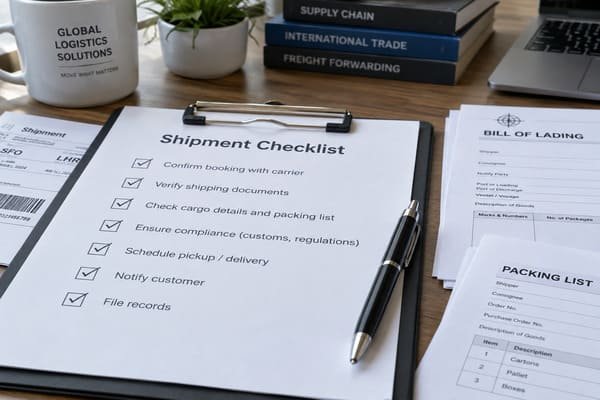
Your Sanctions Compliance Checklist
| Step | Action Item | What to Check |
|---|---|---|
| 1. Party Screening | Screen relevant parties involved in the transaction | Check the buyer, consignee, end user and relevant intermediaries against applicable sanctions and restricted-party lists |
| 2. Product Classification | Confirm how the product is classified | Review the HS code for customs purposes and, where relevant, determine whether an ECCN or other export-control classification applies |
| 3. End-Use Verification | Understand how and by whom the goods will be used | For higher-risk transactions, consider obtaining appropriate end-user and end-use information |
| 4. Destination Check | Verify the actual final destination | Confirm that the stated delivery point is consistent with the commercial transaction and investigate unexplained routing changes |
| 5. Financial Screening | Review relevant banks and payment parties | Check whether financial institutions involved are subject to applicable sanctions or restrictions and confirm the payment route |
| 6. Document Consistency | Review commercial and shipping documents | Make sure buyer, consignee, cargo description, quantity, value and destination information are accurate and consistent |
| 7. Transshipment Review | Understand third-country routing | Determine whether the goods will be re-exported or transferred after reaching the stated destination |
| 8. Escalate Unclear Transactions | Seek specialist advice where necessary | Transactions involving sensitive goods, sanctioned parties or unclear end users may require professional sanctions or export-control advice |
HS Code vs. ECCN
These two classifications should not be confused.
An HS code is primarily used for customs classification, tariffs and trade statistics.
An Export Control Classification Number (ECCN) is used under US export-control rules to identify certain items subject to specific controls.
Depending on the transaction and product, one or both classifications may be relevant.
Sanctions List Screening
The US Treasury's OFAC Sanctions List Search can be useful as one part of a sanctions-screening process.
However, checking only the SDN List may not be sufficient for every transaction.
Depending on the goods, jurisdictions and parties involved, companies may need to review additional sanctions, export-control and restricted-party lists.
FAQ
Can companies still ship goods from China to Russia after H.R. 5334?
H.R. 5334 does not automatically prohibit all trade or shipments between China and Russia.
However, certain transactions may face greater sanctions and compliance scrutiny depending on the buyer, consignee, end user, product, payment channel and other parties involved.
Before shipping, exporters should screen the relevant parties and confirm whether the goods or transaction are subject to applicable sanctions or export-control restrictions.
Does shipping through Kazakhstan, Kyrgyzstan or another third country avoid sanctions risk?
Not necessarily.
Using a third country as a transit or trading point does not by itself remove sanctions risk.
For shipments moving through Central Asia or other intermediary markets, exporters should confirm the actual consignee, final destination and end user, and understand whether the goods may be re-exported to Russia.
Commercial invoices, packing lists, transport documents and payment information should also accurately reflect the transaction.
Can a payment be blocked even if the cargo itself is allowed?
Yes. Cargo compliance and payment compliance are separate issues.
Even when the goods themselves are not prohibited, a payment may face additional review depending on the banks, intermediaries and other parties involved in the transaction.
Exporters should therefore review both the physical movement of the goods and the payment route before completing a transaction.
For complex or uncertain cases, professional sanctions or legal advice may be appropriate.
Conclusion
H.R. 5334 does not mean that every shipment from China to Russia is automatically prohibited. However, the new US sanctions framework makes it increasingly important for exporters, importers and logistics companies to understand exactly who they are doing business with, where the cargo is ultimately going and how payment will be processed.
For China–Russia trade — including shipments transiting through Central Asia — compliance should begin before the cargo leaves the factory.
Shippers should review the buyer, consignee, final end user, destination, product classification, payment banks and any transshipment or re-export arrangements. Shipping documents should also remain accurate and consistent throughout the transaction.
The key takeaway is simple:
Do not evaluate sanctions risk based only on the shipping route.
The cargo, parties, end use, destination and payment chain can all affect the compliance assessment.
When a transaction involves sanctioned parties, controlled or sensitive goods, unusual routing or an unclear final destination, exporters should consider obtaining appropriate sanctions, export-control or legal advice before proceeding.
"Lindsey O. Graham Sanctioning Russia and Iran Act of 2026", https://www.congress.gov/bill/119th-congress/house-bill/5334/text. Official congressional or federal legislative records support the bill number, short title, enactment status, and enactment date; the record does not by itself establish how every private shipment is treated under the resulting sanctions framework. Evidence role: historical_context; source type: government. Supports: H.R. 5334 became law on September 18, 2026 and is titled the Lindsey O. Graham Sanctioning Russia and Iran Act of 2026.. Scope note: Supports legislative status and date, not transaction-specific compliance conclusions. ↩
"Congressional Bill H.R. 5334 Signed into Law", https://www.whitehouse.gov/briefings-statements/2026/09/congressional-bill-h-r-5334-signed-into-law/. The statutory text and implementing agency guidance describe targeted sanctions, tariffs, export controls, or party-based restrictions rather than a categorical prohibition on every China–Russia shipment; this support is contextual because individual transactions may still be prohibited under separate authorities. Evidence role: general_support; source type: government. Supports: H.R. 5334 does not create a blanket ban on all China–Russia shipments.. Scope note: Contextual support only; the source would not determine the legality of any specific shipment. ↩
"Basic Information on OFAC and Sanctions", https://ofac.treasury.gov/faqs/topic/1501. OFAC guidance explains that U.S. persons are generally prohibited from transacting with persons whose property and interests in property are blocked, unless an exemption or OFAC license authorizes the activity. Evidence role: definition; source type: government. Supports: U.S. persons generally may not deal with blocked persons absent an exemption or OFAC authorization.. ↩
"Home | Office of Foreign Assets Control", https://ofac.treasury.gov/. OFAC and U.S. Treasury guidance describes circumstances in which non-U.S. persons may face sanctions exposure, including certain dealings with sanctioned persons, evasion, or activities covered by secondary sanctions authorities; the applicability depends on the specific authority and facts. Evidence role: general_support; source type: government. Supports: Non-U.S. companies can face U.S. sanctions exposure in some circumstances.. Scope note: Does not mean all non-U.S. persons are subject to U.S. sanctions in every Russia-related transaction. ↩
"Bureau of Industry and Security: Homepage", https://www.bis.doc.gov/. Bureau of Industry and Security materials explain that dual-use and controlled items may require licensing or be restricted based on technical characteristics, destination, end user, or end use under the Export Administration Regulations. Evidence role: definition; source type: government. Supports: Dual-use or controlled goods can require additional export-control review.. Scope note: Supports the general category; classification of any specific item requires technical analysis under the applicable control list. ↩
"Bureau of Industry and Security: Homepage", https://www.bis.doc.gov/. U.S. export-control rules and BIS guidance identify military, military-intelligence, aerospace, and related end uses or end users as triggers for licensing requirements or prohibitions in certain destinations, including Russia-related controls. Evidence role: mechanism; source type: government. Supports: Sensitive end uses can trigger additional export-control or sanctions restrictions.. Scope note: The exact restriction depends on the item, destination, end user, and applicable regulatory provision. ↩
"[PDF] SANCTIONS ADVISORY Updated Guidance for Foreign Financial ...", https://ofac.treasury.gov/media/932436/download?inline. U.S. government advisories on Russia sanctions evasion note that third-country transshipment and intermediary routing can be used to divert goods to restricted Russian end users, supporting the need to evaluate final destination and end use beyond the first transit country. Evidence role: mechanism; source type: government. Supports: Routing cargo through a third country does not automatically remove sanctions or export-control risk.. Scope note: The source supports the risk mechanism; it does not imply that all Central Asian transit is suspicious or prohibited. ↩
"World Bank, Middle Trade and Transport Corridor (2023)", https://thedocs.worldbank.org/en/doc/6248f697aed4be0f770d319dcaa4ca52-0080062023/original/Middle-Trade-and-Transport-Corridor-World-Bank-FINAL.pdf. International institution or development-bank reporting on Eurasian transport corridors describes Central Asian routes as part of legitimate regional and intercontinental trade networks; this provides logistical context rather than proof about any individual shipment’s compliance status. Evidence role: historical_context; source type: institution. Supports: Central Asia functions as a significant logistics corridor for lawful international trade.. Scope note: Contextual support only; does not assess sanctions risk for specific cargo routed through Central Asia. ↩
"1181 | Office of Foreign Assets Control", https://ofac.treasury.gov/faqs/1181. U.S. Treasury materials on Russia-related sanctions state that foreign financial institutions may be subject to sanctions for conducting or facilitating certain transactions involving Russia’s military-industrial base or designated Russian persons; applicability depends on the exact authority and transaction. Evidence role: general_support; source type: government. Supports: Foreign financial institutions may face sanctions exposure for specified Russia-related activities.. Scope note: Does not establish that every Russia-related payment creates sanctions exposure for a foreign bank. ↩