
Your shipment is delayed, not by customs paperwork, but by the wooden pallet it sits on. The new 2026 rules make this risk higher than ever. Here is how to stay compliant.
The 2026 rules for wooden packaging tighten ISPM 15 standards1. Key changes include making branded (heat-stamped) IPPC marks mandatory, phasing out methyl bromide (MB) fumigation2 in favor of heat treatment (HT), and enforcing a zero-tolerance policy for any bark on wood packaging materials.
I've seen it happen. A multi-million dollar shipment of electronics gets held up at the port for weeks. The reason? A $15 pallet that didn't meet the standards. The client was furious, the buyer was threatening penalties, and the entire supply chain was frozen. It was a costly lesson about how a tiny detail can create a massive problem. These new rules are designed to prevent the spread of pests, but for shippers, they are a new set of traps to avoid. Let's break down exactly what you need to do so this never happens to you.
What Actually Changed in 2026?
You think you know the wood treatment rules, but they have changed. Using old standards can get your shipment rejected, costing you time and money. Here are the critical updates.
The main changes for 2026 are stricter IPPC marking rules (branding only, no more ink stamps), a faster phase-out of methyl bromide fumigation, and a zero-tolerance policy for bark on wooden packaging. These updates aim to prevent pest spread and standardize global practices.
The changes coming in 2026 are not just small adjustments; they represent a significant shift in how customs authorities view wood packaging. They are closing loopholes that have been exploited for years. Let's look at the specifics.
The End of Stickers and Stamps
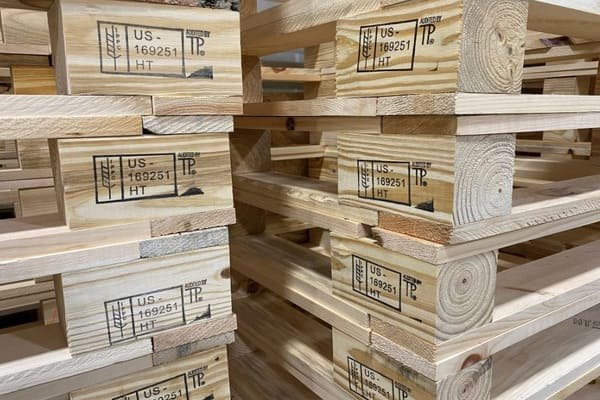
For years, you could get by with a clear ink stamp. Not anymore. The new rules mandate that the IPPC mark must be applied so that it is legible, permanent, and non-transferable3, increasingly meaning a branding iron that burns the mark permanently into the wood. Why the change? Ink stamps can fade, smudge, or be easily faked. I once saw a shipment where the ink had run in the humidity of the container, making it unreadable. The customs officer declared it non-compliant on the spot. A branded mark is permanent and much harder to counterfeit, providing officials with a reliable sign of compliance.
Methyl Bromide on the Way Out
Methyl Bromide (MB) has long been an option for fumigation, but it's an ozone-depleting substance controlled under the Montreal Protocol4. The 2026 rules accelerate its phase-out. Heat Treatment (HT) is now the globally preferred standard. It's cleaner, safer for most products, and accepted everywhere without question. Many regions, especially the European Union, already heavily restrict or ban MB-treated wood5. Sticking with HT is the safest, most future-proof choice for your shipments.
Zero Tolerance for Bark
Previously, a small amount of bark might have been overlooked. The 2026 regulations enforce a "zero tolerance" policy. Any visible bark on pallets, crates, or dunnage can be grounds for rejection6. Bark can harbor invasive insect species and their eggs, which can survive treatment. Officials will now inspect wood packaging more closely than ever for any sign of bark.
Which Wood Must Be Treated? One Table to Understand It All?
You are confused about which wood needs treatment and which does not. Guessing wrong means your entire shipment could be stopped at the border. This simple table clarifies everything.
All solid, raw wood packaging material (WPM) over 6mm thick requires ISPM 15 treatment. This includes pallets, crates, and dunnage. However, processed wood like plywood, particle board, and OSB are exempt7 because the manufacturing process of heat and pressure eliminates any pests.
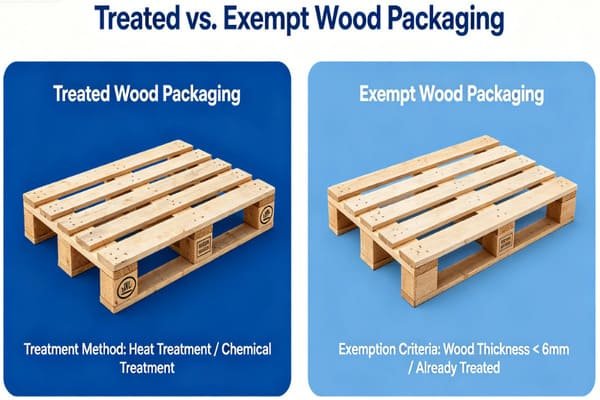
The core principle is simple: if it's natural, solid wood, it needs to be treated. If it's been engineered or processed with heat and glue, it doesn't. The logic is that the manufacturing process for things like plywood effectively sterilizes the material, killing any pests or larvae within the wood fibers. This is why customs authorities consider them low-risk and exempt them from the ISPM 15 standard. But for any raw wood used to brace, block, or support a cargo, treatment is non-negotiable. I once saw a shipment of heavy machinery held up because of a single untreated wooden block used as dunnage. It was a tiny piece of wood, but it violated the rules and cost the shipper a week of delay and thousands in fees.
Solid Wood vs. Engineered Wood
To make it perfectly clear, here is a breakdown of common packaging materials and whether they require treatment.
| Material Type | Examples | Requires ISPM 15 Treatment? | Why? |
|---|---|---|---|
| Solid Wood | Pallets, Crates, Dunnage, Reels | Yes | Raw wood can carry invasive pests. |
| Engineered Wood | Plywood, Particle Board, OSB | No | Manufacturing process (heat/pressure) sterilizes the wood. |
| Other Materials | Plastic Pallets, Presswood Pallets | No | Not made of solid, untreated wood. |
| Thin Wood | Wood less than 6mm thick | No | Considered too thin to harbor pests. |
IPPC Markings: The 3 Most Common Pitfalls?
Your pallet has a mark, so you think you are safe. But a faint, incorrect, or fake mark is just as bad as no mark at all. You need to avoid these common pitfalls.
The most common IPPC marking mistakes are: 1) The mark is illegible, faint, or obstructed by straps or labels. 2) The mark is applied with a non-permanent method like an ink stamp. 3) The mark is fraudulent or from an uncertified treatment provider.
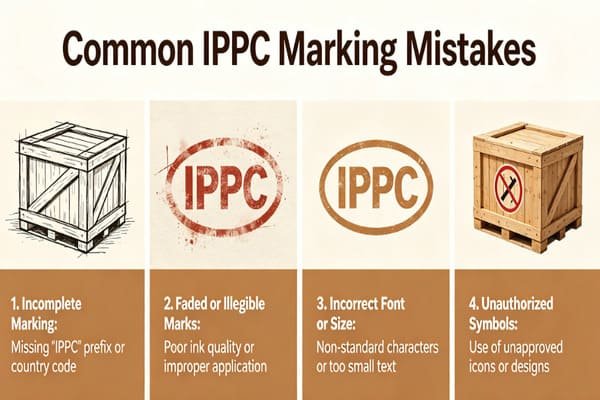
The IPPC mark is your pallet's passport. If there is anything wrong with it, your shipment isn't going anywhere. It's not enough to just have a mark; it has to be the right mark, applied the right way, and be perfectly clear. Over the years, I've seen all kinds of errors, but they almost always fall into one of three categories.
Pitfall #1: Illegible or Obstructed Marks
The rule states the mark must be legible and placed on at least two opposite sides of the wooden packaging8. This is where many shippers get into trouble. A forklift might scrape the mark, making it unreadable. A shipping label or a strap might be placed directly over it. If the customs inspector cannot clearly read every part of the mark—the country code, the provider number, and the treatment code (HT)—they will reject it. Think of it this way: if a passport stamp is smudged, immigration won't let you through. It's the same principle.
Pitfall #2: The Wrong Application Method
This is the biggest change for 2026. Ink stamps are no longer sufficient. The mark must be a permanent brand burned into the wood. Ink can fade, wash away, or be tampered with. A brand is permanent. If you are still receiving pallets with ink-stamped marks, you need to talk to your supplier immediately. Starting in 2026, those pallets will be considered non-compliant.
Pitfall #3: Uncertified or Fake Marks
This is the most dangerous pitfall. To save money, some companies buy pallets from uncertified providers who use a fake IPPC brand. Customs authorities have global databases of registered treatment providers. They can check the code on your pallet in seconds. If the code is invalid or doesn't match a certified provider, you are in serious trouble. This is not just a compliance issue; it's considered fraud and can lead to severe penalties and your company being blacklisted. Always use a reputable, certified pallet supplier.
Heat Treatment vs. Methyl Bromide: The Wrong Choice Costs You?
You have two treatment options for your wooden pallets. But choosing the wrong one can get your shipment banned from certain countries or even damage your goods. Here is how to decide.
Heat Treatment (HT) is the globally preferred and safest method. It involves heating the wood's core to 56°C for a minimum of 30 continuous minutes9. Methyl Bromide (MB) is a chemical fumigant that is being phased out, is banned for imports in many countries, and can damage sensitive products.
Choosing your wood treatment method isn't just a technical detail; it's a strategic decision that affects your market access and cargo safety. While MB was once common, the world has moved on. The environmental damage caused by MB has led to heavy restrictions, making Heat Treatment the default global standard. In my experience, there is almost no reason to choose MB today. It introduces risks that are completely avoidable with HT. For example, MB fumigation can be absorbed by plastics, and can taint food products or pharmaceuticals, making them unsellable. Why take that chance?
The Clear Winner: HT
Let's compare the two methods directly to see why HT is the only logical choice for international shippers in 2026.
| Feature | Heat Treatment (HT) | Methyl Bromide (MB) |
|---|---|---|
| Method | Wood is heated in a kiln | Wood is fumigated with chemical gas |
| Global Acceptance | Universal. Accepted in all countries. | Decreasing. Banned or restricted in the EU and others. |
| Environmental Impact | Low. Uses only heat. | High. Ozone-depleting substance. |
| Effect on Cargo | None. Safe for all products. | Risk. Can damage or taint food, pharma, plastics. |
| Worker Safety | Safe | Toxic chemical requires special handling. |
| The Verdict | The safe, future-proof standard. | A risky, outdated method to avoid. |
What Happens When You Get Caught? The Numbers Don't Lie?
You might think a pallet violation is a small administrative issue. But the fines, delays, and treatment costs can spiral into tens of thousands of dollars. The real costs are shocking.
If caught with non-compliant wood packaging, you face mandatory treatment, re-export, or destruction of the packaging at your expense10, hefty fines, long port delays with mounting fees, and even the re-export of your entire container. The costs add up incredibly fast.
The penalties for non-compliance are not just a slap on the wrist. They are designed to be painful to ensure shippers take the rules seriously. I worked with a client who had a container of seasonal goods stopped due to untreated dunnage wood. The fine was the least of their worries. The container sat at the port for three weeks waiting for a resolution. By the time it was released, they had missed their delivery window, the retailer cancelled the order, and they had to pay thousands in demurrage fees11 to the port. The total loss on that one container was over $50,000.
The Direct and Indirect Costs
The financial damage comes from many different places. It's not just a single fine.
Direct Costs
- Fines: These can range from a few thousand to over $10,000 per violation.
- Forced Treatment/Destruction: You will be billed for the cost of having the non-compliant wood treated on-site (if possible) or destroyed. This is always done at emergency-service prices.
- Re-Export Freight: In many cases, the authorities will simply order the entire container to be sent back to its origin, at your expense.
Indirect Costs (Often Higher)
- Demurrage & Detention: These are daily fees charged by the port and the shipping line for using their container and terminal space beyond the allotted free time. They can be hundreds of dollars per day.
- Lost Sales & Contract Penalties: A delayed shipment often means a cancelled order and financial penalties from your buyer.
- Reputation Damage: Becoming known as a shipper with compliance issues can damage your relationships with both customers and logistics partners.
Spend 5 Minutes Before Shipping, Save $50,000 Later?
Checking pallets feels like a waste of time when you are busy. But skipping this final check is a huge gamble with your shipment's value and schedule. This 5-minute checklist is your insurance.
Before your container is sealed, take five minutes to check your wooden pallets. Verify the IPPC mark is clear, branded, and on two sides. Ensure there is no visible bark. Ask your supplier for the treatment certificate. This simple check is your best insurance policy.
Ultimately, you, the shipper, are responsible for compliance. You can't just blame your supplier if something goes wrong. A simple verification process before the container doors close can prevent a disaster. I always tell my team: trust, but verify. Ask the factory or supplier to send you clear photos of the pallets being used for your shipment. Specifically, ask for close-ups of the IPPC marks. It takes them a few minutes, and it gives you peace of mind and documented proof that you did your due diligence. This simple habit is the difference between a smooth shipment and a financial nightmare.
Your Pre-Shipment Pallet Checklist
Use this checklist for every shipment that uses solid wood packaging.
- [ ] Check the Mark: Is the IPPC stamp present and clearly visible on at least two opposite sides of the pallet or crate?
- [ ] Check the Method: Is the mark branded (burned) into the wood? It should not be an ink stamp or a sticker.
- [ ] Check the Clarity: Can you easily read the country code, the unique provider code, and the treatment code (it must say "HT")?
- [ ] Check for Bark: Do a quick visual inspection. Is the wood clean and completely free of any bark?
- [ ] Check the Paperwork: Do you have a copy of the heat treatment certificate? Does the provider code on the certificate match the code branded on the pallet?
Conclusion
Pallet compliance is a small but critical shipping detail. The 2026 rules are much stricter, but a quick five-minute check before you ship is all it takes to avoid massive fines and delays.
"International Standards for Phytosanitary Measures (ISPMs) - IPPC", https://www.ippc.int/en/core-activities/standards-setting/ispms/. Official portal of the International Plant Protection Convention listing the ISPM standards, including ISPM 15, which regulates wood packaging material in international trade. Evidence role: definition; source type: institution. Supports: ISPM 15 is the international standard governing the treatment and marking of wood packaging material to prevent pest spread. Scope note: The IPPC sets the framework standard; national plant protection organizations implement and enforce it, and enforcement timing may vary by country. ↩
"Methyl Bromide - U.S. Environmental Protection Agency", https://www.epa.gov/ods-phaseout/methyl-bromide. Official EPA guidance identifying methyl bromide as an ozone-depleting substance subject to phase-out under U.S. and international regulations. Evidence role: general_support; source type: government. Supports: Methyl bromide is an ozone-depleting fumigant being phased out in favor of alternatives such as heat treatment. Scope note: Certain quarantine and pre-shipment (QPS) uses have historically retained exemptions; regulatory status varies by jurisdiction and over time. ↩
"ISPM 15: Regulation of wood packaging material in international trade - IPPC", https://www.ippc.int/en/publications/85128/. The ISPM 15 standard specifies that the IPPC mark must be legible, permanent, and not transferable, and applied to treated wood packaging. Evidence role: requirement; source type: institution. Supports: The IPPC mark must be applied in a durable, legible, and non-transferable manner, which favors branding over easily degraded ink stamps. Scope note: ISPM 15 specifies durability and legibility rather than mandating one single application technology in all cases; national rules may add specifics. ↩
"About Montreal Protocol - UNEP OzonAction", https://www.unep.org/ozonaction/who-we-are/about-montreal-protocol. UNEP overview of the Montreal Protocol, the international treaty controlling ozone-depleting substances, including methyl bromide. Evidence role: mechanism; source type: institution. Supports: Methyl bromide is controlled internationally under the Montreal Protocol as an ozone-depleting substance, driving its global phase-out. Scope note: The treaty governs production and consumption controls; specific national phase-out schedules and exemptions differ. ↩
"Wood packaging material - European Commission", https://ec.europa.eu/food/plant/plant_health_biosecurity/non_eu_trade/wood_packaging_material_en. Official European Commission guidance on plant-health requirements for wood packaging material entering the EU, including ISPM 15 compliance. Evidence role: requirement; source type: government. Supports: The EU enforces ISPM 15 requirements for imported wood packaging and restricts non-compliant or inadequately treated material. Scope note: Applies to shipments entering the EU; requirements and permitted treatments are subject to EU regulatory updates. ↩
"Wood Packaging Material (WPM) - USDA APHIS", https://www.aphis.usda.gov/aphis/ourfocus/planthealth/import-information/wood-packaging-material. USDA Animal and Plant Health Inspection Service guidance on U.S. import requirements for wood packaging material, including treatment, marking, and bark-related standards. Evidence role: requirement; source type: government. Supports: Wood packaging material must meet ISPM 15 treatment and marking requirements, and bark presence beyond permitted tolerances can render packaging non-compliant. Scope note: Precise bark tolerances are defined within ISPM 15; enforcement practices apply to shipments entering the United States. ↩
"ISPM 15: Regulation of wood packaging material in international trade - IPPC", https://www.ippc.int/en/publications/85128/. The ISPM 15 standard identifies exemptions for processed wood products such as plywood, oriented strand board, and particle board manufactured using glue, heat, and pressure. Evidence role: definition; source type: institution. Supports: Engineered wood products like plywood, OSB, and particle board are exempt from ISPM 15 treatment because their manufacturing process eliminates pest risk. Scope note: Exemptions apply to specified processed wood products; thin raw wood under 6mm is also treated as low risk under the standard. ↩
"ISPM 15: Regulation of wood packaging material in international trade - IPPC", https://www.ippc.int/en/publications/85128/. The ISPM 15 standard requires that the mark be legible and applied to at least two opposite sides of the wood packaging unit. Evidence role: requirement; source type: institution. Supports: The IPPC mark must be legible and displayed on at least two opposite sides of the wood packaging. Scope note: Placement and legibility requirements are defined by the standard; obstructed or damaged marks can be treated as non-compliant. ↩
"ISPM 15: Regulation of wood packaging material in international trade - IPPC", https://www.ippc.int/en/publications/85128/. The ISPM 15 standard specifies conventional heat treatment reaching a minimum core temperature of 56°C for a minimum of 30 continuous minutes. Evidence role: mechanism; source type: institution. Supports: Approved heat treatment requires the wood core to reach at least 56°C for a minimum of 30 continuous minutes. Scope note: ISPM 15 also recognizes additional approved treatment methods (e.g., dielectric heating) with their own parameters. ↩
"Wood Packaging Material (WPM) - USDA APHIS", https://www.aphis.usda.gov/aphis/ourfocus/planthealth/import-information/wood-packaging-material. USDA APHIS guidance describing enforcement actions for non-compliant wood packaging, which can include re-export or destruction of the packaging at the importer's expense. Evidence role: mechanism; source type: government. Supports: Non-compliant wood packaging can be subject to mandatory treatment, re-export, or destruction at the responsible party's expense. Scope note: Specific enforcement outcomes depend on the destination country's regulations and the nature of the violation. ↩
"Demurrage - Wikipedia", https://en.wikipedia.org/wiki/Demurrage. Reference overview of demurrage, the charges levied when cargo or containers remain at a port or terminal beyond the allotted free time. Evidence role: definition; source type: reference. Supports: Demurrage fees accrue daily when containers are held at port beyond free time, which is why compliance delays can generate large cumulative costs. Scope note: Actual demurrage and detention rates vary by port, carrier, and contract terms. ↩