


Why can a lightweight shipment cost more to transport by air than a heavier one? The answer often comes down to chargeable weight.
In air freight, airlines and freight forwarders do not calculate shipping costs based only on the actual weight of the cargo. They also consider how much space the shipment occupies inside an aircraft.
This is particularly important for businesses shipping lightweight but bulky products, such as furniture, textiles, packaging materials, plastic products, and certain electronic goods.
A shipment weighing 100 kg may have a volumetric weight of 180 kg. If the applicable carrier rules use the higher figure, the freight charge will be calculated on 180 kg rather than 100 kg.
Understanding how chargeable weight works can help importers and exporters estimate shipping costs more accurately, compare freight quotations, and avoid unexpected charges.
This guide explains the difference between actual weight and volumetric weight, how to calculate air freight chargeable weight, and how to reduce unnecessary shipping costs.
1. What Is Chargeable Weight in Air Freight?
Chargeable weight is the weight used by an airline or freight carrier to calculate the basic transportation charge.
It is generally determined by comparing two values:
- Actual Gross Weight: The physical weight of the shipment, including its packaging and pallets.
- Volumetric Weight: A calculated weight based on the external dimensions of the shipment.
The higher value is normally used as the chargeable weight, subject to the carrier's applicable pricing rules.
1.1 Actual Weight vs. Volumetric Weight
These two measurements serve different purposes.
Actual Gross Weight
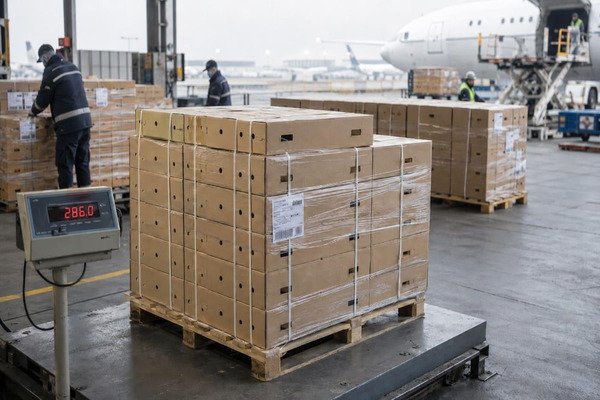
Actual gross weight is the weight measured on a scale. It includes the product, packaging, cartons, pallets, and other materials that form part of the shipment.
For example, if a pallet contains 20 cartons weighing 5 kg each and the pallet and wrapping weigh another 10 kg:
Actual Gross Weight = (20 × 5) + 10 = 110 kg.
Volumetric Weight
Volumetric weight, also called dimensional weight, converts the space occupied by a shipment into a weight equivalent.
A large but lightweight package can therefore have a much higher volumetric weight than its actual gross weight.
For example:
| Measurement | Shipment A | Shipment B |
|---|---|---|
| Dimensions | 60 × 50 × 40 cm | 100 × 80 × 60 cm |
| Actual Gross Weight | 25 kg | 65 kg |
| Volumetric Weight (÷6000) | 20 kg | 80 kg |
| Chargeable Weight | 25 kg | 80 kg |
Shipment A is charged by actual weight, while Shipment B is charged by volumetric weight.
1.2 How Is Chargeable Weight Determined?
The basic calculation is:
Chargeable Weight = Higher of Actual Gross Weight and Volumetric Weight
In mathematical form:
[ CW=max(AW,VW) ]
Where:
- CW = Chargeable Weight
- AW = Actual Gross Weight
- VW = Volumetric Weight
This calculation explains why two shipments with the same actual weight can have different freight charges if their package dimensions are different.
1.3 Why Do Airlines Charge by Volume?
Aircraft cargo space is limited.
A shipment containing dense metal components may weigh a lot but occupy relatively little space. Another shipment containing lightweight plastic products may weigh much less while taking up significantly more cargo space.
If airlines charged only by actual weight, large and lightweight shipments could occupy considerable aircraft capacity without reflecting the space they use.
Volumetric weight provides a way to account for both weight and space when calculating freight charges.
For importers and exporters, this means that packaging dimensions can directly affect the cost of air transportation.
2. How to Calculate Volumetric Weight in Air Freight
Calculating volumetric weight is straightforward once you know the shipment dimensions and the applicable volumetric divisor.
2.1 The Volumetric Weight Formula
A commonly used formula for traditional air freight is:
Volumetric Weight (kg) = Length × Width × Height ÷ 6000
All dimensions must be measured in centimeters.
For example, if a carton measures:
- Length: 80 cm
- Width: 60 cm
- Height: 50 cm
The calculation is:
[ frac{80times60times50}{6000}=40text{ kg} ]
The volumetric weight of this carton is 40 kg.
However, the divisor is not universal. Some carriers and specific services use 5000 or other applicable factors.
Always confirm the divisor specified in the freight quotation or carrier's current rate and service conditions.
2.2 How to Measure Cargo Dimensions Correctly
Accurate measurements are essential because even small differences in package dimensions can affect the final chargeable weight.
When measuring your cargo:
- Measure the outer length, width, and height of each package.
- Include the complete packaging, not just the product dimensions.
- Include pallets, protective materials, and other external packaging where applicable.
- Measure irregularly shaped packages at their maximum external dimensions.
- Record the number of packages and the actual gross weight of each piece.
For palletized shipments, measure the complete loaded pallet, including the pallet base and any wrapping or protective materials.
For example, a product may measure 100 × 80 × 60 cm before packing. However, if the finished wooden crate measures 110 × 90 × 75 cm, the freight calculation should use the relevant outer shipping dimensions rather than the original product dimensions.
Important: Carriers may use their own measuring equipment and rounding rules. The dimensions recorded at the origin warehouse may differ from the shipper's initial measurements.

2.3 Why Do Some Carriers Use 5000 Instead of 6000?
This is one of the most common sources of confusion for air freight customers.
Both 5000 and 6000 are used in international shipping, but they do not necessarily apply to the same services.
| Divisor | Common application |
|---|---|
| 6000 | Traditional air freight calculations under commonly used airline pricing arrangements |
| 5000 | International express services and certain carrier-specific air freight arrangements |
The difference is significant.
Consider a carton measuring 100 × 80 × 60 cm.
Using a divisor of 6000:
[ frac{100times80times60}{6000}=80text{ kg} ]
Using a divisor of 5000:
[ frac{100times80times60}{5000}=96text{ kg} ]
| Calculation | Divisor 6000 | Divisor 5000 |
|---|---|---|
| Cargo volume | 480,000 cm³ | 480,000 cm³ |
| Volumetric Weight | 80 kg | 96 kg |
| Difference | — | 16 kg |
The same carton produces a 16 kg difference in volumetric weight.
If the shipment is charged according to volumetric weight, the difference can directly affect the freight cost.
DHL Express, for example, publishes a standard volumetric divisor of 5000 for dimensions measured in centimeters and weight in kilograms. FedEx Singapore also specifies 5000 for its dimensional-weight calculation. 12
For traditional air freight, 6000 is commonly used, but individual carrier and service conditions must still be checked. Maersk also explains that some carriers use 5000 rather than 6000. 3
The practical lesson: Never assume that every air freight quotation uses the same volumetric divisor. Ask your freight forwarder to confirm the applicable calculation before comparing rates.
3. How to Calculate Air Freight Chargeable Weight: Practical Examples
Understanding the formula is easier when you apply it to real shipment scenarios.
The following examples use a divisor of 6000 for illustration. Actual rounding and billing rules depend on the carrier and service.
3.1 Example 1: Actual Weight Is Higher
A shipment contains one carton with the following details:
| Item | Value |
|---|---|
| Length | 60 cm |
| Width | 50 cm |
| Height | 40 cm |
| Actual Gross Weight | 25 kg |
| Volumetric Divisor | 6000 |
Step 1: Calculate the carton volume.
60 × 50 × 40 = 120,000 cm³
Step 2: Calculate volumetric weight.
120,000 ÷ 6000 = 20 kg
Step 3: Compare both weights.
- Actual Gross Weight: 25 kg
- Volumetric Weight: 20 kg
Chargeable Weight = 25 kg
The shipment is charged according to its actual gross weight.
3.2 Example 2: Volumetric Weight Is Higher
Now consider a larger but lighter carton.
| Item | Value |
|---|---|
| Length | 100 cm |
| Width | 80 cm |
| Height | 60 cm |
| Actual Gross Weight | 65 kg |
| Volumetric Divisor | 6000 |
Step 1: Calculate the carton volume.
100 × 80 × 60 = 480,000 cm³
Step 2: Calculate volumetric weight.
480,000 ÷ 6000 = 80 kg
Step 3: Compare both weights.
- Actual Gross Weight: 65 kg
- Volumetric Weight: 80 kg
Chargeable Weight = 80 kg
Although the cargo physically weighs only 65 kg, the shipment is charged based on 80 kg because it occupies more cargo space.
3.3 Example 3: Calculating Chargeable Weight for Multiple Packages
Multiple-package shipments require more attention because each carton may have different dimensions and weights.
Suppose a shipment contains three cartons:
| Package | Dimensions (cm) | Actual Weight |
|---|---|---|
| Carton 1 | 60 × 50 × 40 | 25 kg |
| Carton 2 | 80 × 60 × 50 | 30 kg |
| Carton 3 | 100 × 80 × 60 | 65 kg |
| Total | — | 120 kg |
Using a divisor of 6000:
Carton 1:
60 × 50 × 40 ÷ 6000 = 20 kg
Carton 2:
80 × 60 × 50 ÷ 6000 = 40 kg
Carton 3:
100 × 80 × 60 ÷ 6000 = 80 kg
Total Volumetric Weight:
20 + 40 + 80 = 140 kg
Compare the two totals:
- Actual Gross Weight: 120 kg
- Volumetric Weight: 140 kg
Chargeable Weight = 140 kg
The freight calculation is therefore based on 140 kg, subject to the applicable carrier's rounding and billing rules.
For multi-piece shipments, some carriers calculate and round each package separately, while others may apply specific shipment-level calculation rules. Confirm this before finalizing the quotation.
4. Air Freight vs. Express Courier: Are Volumetric Weight Rules the Same?
Air freight and international express courier services both use dimensional or volumetric weight calculations, but their pricing structures and operational rules are not necessarily identical.
Understanding the difference is important when choosing a transportation solution.
4.1 Traditional Air Freight
Traditional air freight is generally suitable for commercial shipments, palletized cargo, larger consignments, and businesses that require airport-to-airport or coordinated door-to-door transportation.
Its pricing may depend on:
- Actual gross weight.
- Volumetric weight.
- Chargeable weight.
- Origin and destination airports.
- Airline and available capacity.
- Cargo type and handling requirements.
- Additional surcharges.
A divisor of 6000 is commonly used in traditional air freight calculations, although the specific carrier arrangement should always be checked.
For larger shipments, freight forwarders may also compare different airline options and service arrangements to find a suitable balance between cost and transit time.
4.2 International Express Services
International express services are commonly used for documents, parcels, samples, and smaller commercial shipments.
Companies such as DHL, FedEx, and UPS apply dimensional-weight pricing according to their respective service and rate rules.
For example:
- DHL Express publishes a 5000 divisor for standard metric volumetric-weight calculations. 1
- FedEx Singapore uses a 5000 divisor for dimensional weight when measuring in centimeters. 2
- UPS Singapore also publishes a 5000 divisor for its dimensional-weight calculation, with specific rounding rules depending on the service. 4
These are carrier-specific examples, not a universal formula for every air cargo service.
4.3 What Should Shippers Check Before Comparing Quotes?
When comparing quotations from different freight forwarders, do not look only at the price per kilogram.
Check the following:
| Item | What to Confirm |
|---|---|
| Volumetric divisor | 5000, 6000, or another applicable factor |
| Actual weight | Whether the quotation uses gross weight |
| Dimension rounding | How package measurements are rounded |
| Weight rounding | Whether billing is rounded to the next 0.5 kg, 1 kg, or another increment |
| Minimum charge | Whether a minimum chargeable weight applies |
| Additional fees | Fuel, security, handling, and other applicable charges |
| Service type | Airport-to-airport, door-to-airport, or door-to-door |
A quotation with a lower rate per kilogram is not necessarily cheaper if it uses a different divisor or includes fewer services.
Always compare quotations using the same shipment dimensions, weight, service scope, and applicable billing rules.
5. How Chargeable Weight Affects Your Air Freight Cost
Chargeable weight directly influences the basic air freight charge.
However, it is important to distinguish the basic freight calculation from the complete transportation cost.
5.1 Why Lightweight Cargo Can Be Expensive to Ship
Consider products such as:
- Furniture and home accessories.
- Textiles and garments.
- Plastic components.
- Foam products.
- Empty packaging materials.
- Lightweight industrial products.
These products may have relatively low actual weights but occupy considerable space.
If their volumetric weight exceeds their actual weight, the higher volumetric figure determines the basic freight calculation.
This explains why a shipment of lightweight products can cost more than expected even when the total gross weight seems low.
5.2 How Are Air Freight Charges Calculated?
The basic air freight calculation is:
Basic Air Freight = Chargeable Weight × Freight Rate per kg
For example:
- Chargeable Weight: 200 kg
- Freight Rate: USD 4.00/kg
Basic Air Freight:
200 × USD 4.00 = USD 800
However, the final shipping cost may also include:
- Fuel surcharge.
- Security surcharge.
- Terminal handling charges.
- Documentation fees.
- Customs clearance fees.
- Pickup and delivery charges.
- Other applicable service charges.
Therefore, the basic freight calculation should not be confused with the final door-to-door shipping cost.
5.3 Why Can Two Similar Shipments Have Different Freight Charges?
Two shipments with similar actual weights may receive different quotations for several reasons.
Different package dimensions
Larger packages may have higher volumetric weights.
Different carriers
Airlines and express companies may apply different calculation methods and service conditions.
Different routes
The available flight capacity and transportation arrangements can affect the quoted rate.
Different cargo requirements
Special handling, restricted cargo, or unusual package dimensions may result in additional charges.
Different service levels
Express, standard air freight, and consolidated air cargo services may have different pricing structures.
For businesses shipping regularly, it is important to compare the complete quotation rather than focusing on one rate component.
6. How to Reduce Volumetric Weight and Air Freight Costs
When volumetric weight determines the chargeable weight, optimizing packaging can help reduce transportation costs.
However, packaging should never be reduced at the expense of cargo protection.
6.1 Optimize Outer Carton Dimensions
One of the simplest ways to reduce volumetric weight is to use appropriately sized outer packaging.
Oversized cartons create unnecessary empty space and increase the shipment's external dimensions.
For example, reducing a carton from 100 × 80 × 60 cm to 90 × 75 × 55 cm changes its volume from:
480,000 cm³ to 371,250 cm³.
Using a divisor of 6000:
- Original volumetric weight: 80 kg.
- Revised volumetric weight: 61.875 kg.
The calculated volumetric weight decreases by approximately 18.1 kg.
This illustrates how packaging optimization can affect the chargeable weight.
The revised packaging must still provide sufficient protection for the product.
6.2 Choose Suitable Packaging Materials
Different packaging materials have different weights and space requirements.
Consider:
- Right-sized cartons.
- Suitable protective inserts.
- Efficient cushioning materials.
- Packaging that can be stacked safely.
- Pallet designs that minimize unnecessary dimensions.
The objective is to reduce unnecessary packaging volume without increasing the risk of cargo damage.
6.3 Consolidate Multiple Packages
When a shipment contains multiple small packages, it may be worth reviewing whether they can be consolidated into a more efficient packaging or pallet arrangement.
Consolidation can help:
- Improve handling efficiency.
- Reduce unnecessary packaging.
- Organize cargo more effectively.
- Simplify shipment preparation.
However, consolidation does not automatically reduce chargeable weight. The final dimensions and weight must still be calculated according to the carrier's rules.
6.4 Compare Air Freight with Other Shipping Options
Not every shipment should be transported by air.
For cargo that is bulky, relatively low in value, or not urgently required, alternative transportation options may be more economical.
Consider:
| Transportation Method | Suitable Situations |
|---|---|
| Air Freight | Urgent shipments and time-sensitive commercial cargo |
| Sea Freight | Large-volume shipments and less urgent cargo |
| Rail Freight | Suitable China-Europe and Eurasian routes |
| Sea-Air Freight | Shipments requiring a balance between cost and transit time |
The best option depends on the origin, destination, cargo dimensions, delivery deadline, and total logistics budget.
A freight forwarder can help compare different transportation methods before the shipment is booked.
7. Common Chargeable Weight Calculation Mistakes
Incorrect measurements and assumptions can lead to unexpected freight charges.
Here are some common mistakes exporters should avoid.
| Common Mistake | Possible Result |
|---|---|
| Measuring product dimensions instead of outer carton dimensions | Volumetric weight may be underestimated |
| Using the wrong volumetric divisor | Incorrect freight estimate |
| Ignoring pallet dimensions | Actual chargeable weight may increase |
| Calculating only one carton in a multi-piece shipment | Total shipment weight may be incorrect |
| Assuming all carriers use the same formula | Quotation comparisons become inaccurate |
| Ignoring rounding and minimum charges | Final invoice differs from the estimate |
One particularly common issue occurs when cargo is measured before palletization.
For example, a shipper may provide carton dimensions when requesting a quotation, but the cargo is later placed on pallets. The final shipment dimensions increase, resulting in a higher volumetric weight.
To avoid this problem, provide the freight forwarder with the final packed dimensions whenever possible.
8. Air Freight Chargeable Weight Checklist
Before requesting an air freight quotation, prepare the following information.
Cargo Information
Confirm the total number of packages. Record the actual gross weight of each package. Measure the external length, width, and height. Include pallets and external packaging. Identify any irregularly shaped packages.
Weight Calculation
Confirm the carrier's volumetric divisor. Calculate the total volumetric weight. Compare actual and volumetric weight. Confirm package and shipment rounding rules. Check whether a minimum chargeable weight applies.
Freight Quotation
Confirm the origin and destination. Confirm the transportation service. Check the freight rate per kilogram. Confirm fuel and security surcharges. Check handling and documentation fees. Confirm pickup and final delivery costs.
Preparing these details before booking can help reduce quotation discrepancies and unnecessary adjustments after cargo collection.
Conclusion: Calculate Before You Book
Understanding air freight chargeable weight is essential for businesses that regularly import or export goods by air.
The final chargeable weight is generally determined by comparing actual gross weight and volumetric weight, with the higher figure used under the applicable carrier rules.
For lightweight but bulky cargo, volumetric weight can significantly increase the transportation cost.
By measuring packages accurately, checking the correct volumetric divisor, optimizing packaging, and comparing suitable transportation options, businesses can make more informed shipping decisions.
Planning an air freight shipment from China?
Deeplinker helps businesses coordinate international air freight and other transportation solutions based on cargo dimensions, weight, destination, and delivery requirements.
Whether you are shipping samples, commercial goods, industrial products, or larger consignments, contact our team to discuss suitable transportation options and request a freight quotation.
Explore Deeplinker International Freight Services
Frequently Asked Questions
1. What is chargeable weight in air freight?
Chargeable weight is the weight used to calculate the basic air freight charge. It is generally the higher of the shipment's actual gross weight and volumetric weight, subject to the applicable carrier rules.
2. How do you calculate volumetric weight for air freight?
A commonly used traditional air freight formula is:
Volumetric Weight (kg) = Length (cm) × Width (cm) × Height (cm) ÷ 6000.
However, the divisor may differ depending on the carrier and service.
3. Why do airlines divide volumetric weight by 6000?
The divisor converts the cubic volume of a shipment into a weight equivalent for freight pricing.
A divisor of 6000 cm³ per kg is commonly used in traditional air freight arrangements. Other carriers and services may use different factors.
4. Is air freight charged by actual weight or volumetric weight?
Generally, air freight is charged according to the higher of actual gross weight and volumetric weight. This allows the pricing calculation to account for both cargo mass and the space occupied.
5. What is the difference between volumetric weight and chargeable weight?
Volumetric weight is calculated from the shipment's external dimensions. Chargeable weight is determined by comparing volumetric weight with actual gross weight and applying the relevant carrier billing rules.
6. Can repacking reduce air freight charges?
Yes. If the original packaging contains unnecessary empty space, using appropriately sized packaging may reduce volumetric weight.
However, the new packaging must still provide adequate protection during transportation and handling.
7. Do DHL, FedEx, and UPS use the same volumetric weight formula?
Their published dimensional-weight rules may use similar formulas, but measurement, rounding, minimum billing, and service conditions can differ.
Always check the current rules for the specific service and destination.
References
Disclaimer: This article provides general guidance on air freight chargeable-weight calculations. Actual billing rules, volumetric divisors, rounding methods, minimum charges, and applicable surcharges depend on the airline, freight forwarder, express carrier, origin, destination, and contracted service. Always confirm the current calculation method before booking.
[DHL – What Is Volumetric Weight?](https://www.dhl.com/discover/en-sg/ship-with-dhl/start-shipping/how-to-calculate-dhl-volumetric-weight). Explains volumetric-weight calculations and DHL Express's standard divisor. ↩
[FedEx Singapore – How Do I Calculate Dimensional Weight?](https://www.fedex.com/en-sg/customer-support/faq/invoices-and-payments/fees-and-charges/calculate-dimensional-weight.html). Official guidance on package measurement, dimensional weight, and rounding. ↩
[Maersk – Air Cargo Chargeable Weight Calculation Explained](https://www.maersk.com/it-it/logistics-explained/transportation-and-freight/2025/03/10/air-cargo-chargeable-weight). Explains actual weight, volumetric weight, chargeable weight, and differences between carrier calculations. ↩
[UPS Singapore – Parcel Size and Weight Limits](https://ua.ups.com/sg/en/support/shipping-support/shipping-dimensions-weight). Explains dimensional-weight calculations and applicable billing rules for UPS services. ↩