
Best Ports for Shipping from South China to Malaysia: How to Choose the Right Route?
Choosing the wrong port from South China to Malaysia can be a costly mistake. Delays and extra fees hurt your business. Let's make sure you choose the right one.
For most shipments, the Shenzhen to Port Klang route is the most efficient1. It offers frequent sailings and excellent connections. However, your specific cargo, final destination, and cost priorities might make other port combinations a better choice for your business.
Choosing a port isn't just about picking one name off a map. It's about finding the perfect pair—one in China and one in Malaysia—that works best for your supply chain. Over my 20 years in logistics, I've helped countless businesses navigate this choice. It always comes down to a few key factors: where your factory is, what you're shipping, and where it needs to end up. Let's break down the most popular options to help you make a smarter decision, starting with the two giants in South China.
Shenzhen vs Guangzhou Port: Which Is Better for Shipping to Malaysia?
Picking between Shenzhen and Guangzhou feels complicated. A bad choice can delay your shipment from the very start. Let's simplify this decision so you can ship to Malaysia with confidence.
Shenzhen is generally better for electronics and time-sensitive products due to more frequent sailings2. Guangzhou is often a strong choice for general cargo, furniture, and goods sourced from the wider Pearl River Delta, sometimes offering slightly lower local costs3.
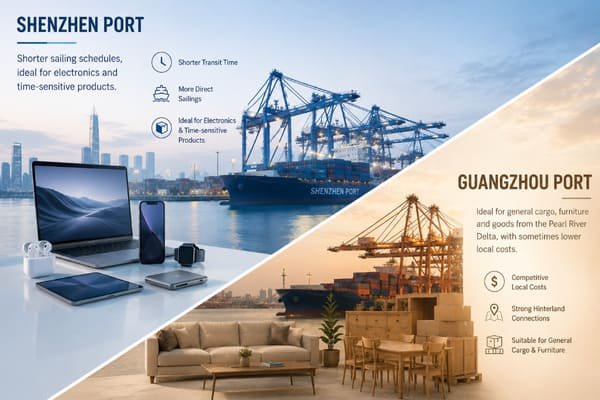
The choice between Shenzhen and Guangzhou really depends on where your supplier is located and what you are shipping. They are both world-class ports in the Pearl River Delta, but they have different strengths. I once worked with a client shipping high-end electronics. We chose Shenzhen because the factory was nearby and the frequent sailings to Port Klang meant they could keep their inventory lean. Another client was shipping bulky furniture. We used Guangzhou's Nansha port, which saved them on trucking costs from their factory in Foshan and offered competitive sea freight rates. It's about looking at the total cost, not just the ocean freight.
To help you decide, let's compare them directly.
Key Differences: Shenzhen vs. Guangzhou
| Feature | Port of Shenzhen (Yantian, Shekou, Chiwan) | Port of Guangzhou (Nansha) |
|---|---|---|
| Primary Cargo | Electronics, high-value goods, general merchandise4 | Furniture, building materials, industrial goods, general cargo5 |
| Location | Closer to manufacturing hubs like Dongguan and Shenzhen itself | Serves the western side of the Pearl River Delta (Foshan, Zhongshan) |
| Sailing Frequency | Very high, especially to major hubs like Port Klang | Good, but generally fewer sailings than Shenzhen |
| Cost | Can be slightly higher on local charges but very competitive for sea freight | Often has slightly lower local trucking and handling costs |
Ultimately, Shenzhen offers speed and frequency, which is critical for fast-moving goods. Guangzhou offers a cost-effective gateway for a vast industrial region, perfect for bulkier and less time-sensitive cargo.
Main Ports in Malaysia: Which Is the Best Destination?
Your container lands in Malaysia, but is it at the right port? The wrong choice means expensive and slow inland transport. Let's look at your options to save on last-mile costs.
Port Klang is Malaysia's main hub6, serving the capital, Kuala Lumpur, and the central region. Penang Port is the best choice for destinations in northern Malaysia7. Tanjung Pelepas is a major transshipment hub8 ideal for southern Johor or specific logistics strategies.
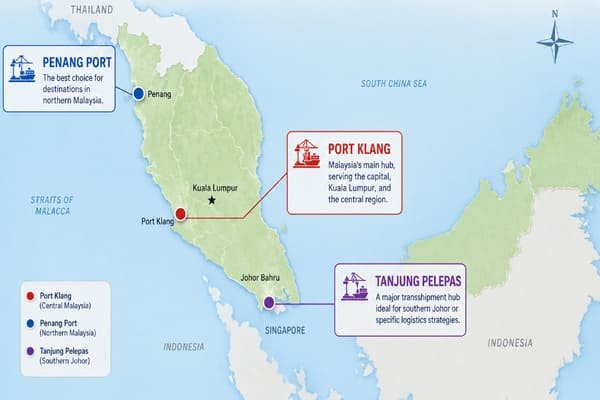
Your choice of arrival port in Malaysia is just as important as your departure port in China. The goal is to land your cargo as close as possible to its final destination to minimize costly and time-consuming domestic trucking. Most of the cargo we handle for our clients is destined for the Klang Valley, which is the commercial heart of Malaysia. For these shipments, Port Klang is the only logical choice. However, we had a project involving heavy machinery for a new factory near Kedah. Shipping to Port Klang would have meant a long, difficult journey by road. We routed the cargo directly to Penang Port, saving the client significant time and money on inland haulage. Thinking about the final delivery address from day one is a core part of our planning process.
Comparing Malaysia's Key Ports
Let's break down where each port excels.
| Port | Location & Primary Service Area | Best For... |
|---|---|---|
| Port Klang | Central region, near Kuala Lumpur | General consumer goods, electronics, industrial parts for the Klang Valley. The default choice for most shipments. |
| Penang Port | Northern region (Penang, Kedah, Perlis, Perak) | Shipments to northern industrial zones and cities. Reduces inland trucking time and cost significantly for these areas. |
| Tanjung Pelepas | Southern region, near Singapore | Transshipment, cargo for southern Johor (e.g., Johor Bahru), or companies using Singapore as a distribution hub. |
Choosing the right Malaysian port is about simple geography. Look at a map, find your customer's warehouse or the project site, and pick the closest major port. This simple step can have a huge impact on your total logistics cost.
Why Do Most Shipments from China Go to Port Klang?
Everyone seems to ship to Port Klang. Are you missing something if you choose another port? Understanding why it's so popular helps confirm if it's the right choice for you, too.
Most shipments go to Port Klang because it is Malaysia's largest port, located next to the capital, Kuala Lumpur, and the country's primary commercial and industrial zone9. This central location provides the best logistics infrastructure and distribution network for the entire country.
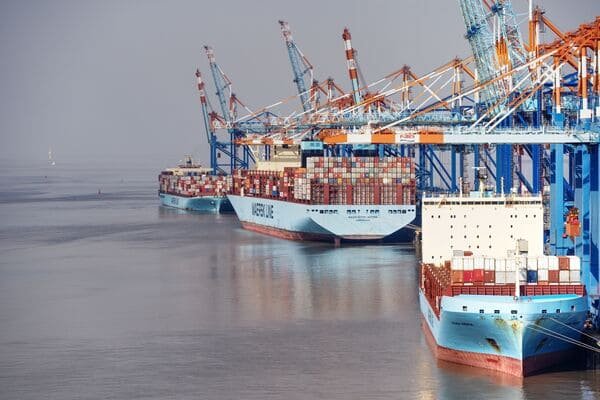
Port Klang's dominance isn't an accident. It's the engine of Malaysia's trade. Its sheer size and volume create a virtuous cycle. Because so many ships call at Port Klang, shipping lines offer more services and more competitive rates to fill them. This attracts even more cargo. For you as a shipper, this means more choice, better prices, and greater flexibility. The port is divided into two main terminals, Northport and Westport, both of which are highly efficient and equipped to handle all types of cargo, including our specializations like oversized (OOG) and dangerous goods (DG). The ecosystem of freight forwarders, trucking companies, and customs brokers centered around the port is unmatched in Malaysia, which makes the entire clearance and delivery process smoother and more reliable. Unless you have a specific reason to ship elsewhere, Port Klang is the safest and most efficient bet.
The Advantages of Port Klang
- Strategic Location: It serves the Klang Valley, the most populous and economically active region in Malaysia10.
- Superior Connectivity: It has the highest number of direct vessel calls from major Chinese ports, leading to shorter transit times and more reliable schedules.
- Competitive Rates: High cargo volumes lead to intense competition among carriers, which pushes down freight costs.
- Advanced Infrastructure: The port can handle the world's largest container ships11 and has specialized facilities for all cargo types, including hazardous materials and refrigerated containers.
For these reasons, over 80% of the shipments we manage12 from China to Malaysia are routed through Port Klang. It's the reliable, efficient, and cost-effective hub of the nation's logistics network.
How Do You Choose the Best Port Pair Based on Cargo Type?
Your cargo is unique. A standard shipping route might not be the most cost-effective or safest option. Let's match your specific cargo type to the perfect port combination for success.
For general goods and electronics, Shenzhen to Port Klang is standard. For bulk or agricultural goods from West Guangdong, consider Guangzhou to Port Klang. For project cargo, the port choice depends on equipment availability at the port and proximity to the final site.
This is where everything comes together. Choosing the optimal route is about combining your origin, destination, and cargo type into one smart decision. It’s not a one-size-fits-all answer. As a company that handles complex shipments, we do this analysis every day. For instance, we recently managed an oversized (OOG) shipment of manufacturing equipment. The final destination was in northern Malaysia. We chose to ship from Shenzhen to Penang Port. This minimized the challenging on-road transport in Malaysia and used a port pair familiar with handling special cargo. The key is to think through the entire journey, from factory door to final delivery, and identify the path of least resistance and lowest total cost.
Matching Cargo to Port Pairs
Here is a simple guide we use to help our clients make the initial decision.
| Cargo Type | Recommended China Port | Recommended Malaysia Port | Key Reason |
|---|---|---|---|
| Electronics, Fashion, Fast-Moving Goods | Shenzhen (Yantian/Shekou) | Port Klang | Speed and frequency are key. Shenzhen has the most sailings to the main consumer market hub. |
| Furniture, Building Materials, General Cargo | Guangzhou (Nansha) or Shenzhen | Port Klang | Balance of cost and service. Nansha is great if the factory is in the western Pearl River Delta. |
| Shipments for Northern Malaysia | Shenzhen or Guangzhou | Penang Port | Minimizes expensive inland trucking. Penang is well-equipped for industrial cargo destined for the north. |
| Project Cargo, OOG, Heavy Machinery | Depends on Factory & Site Location | Depends on Site Location | This is a custom solution. We analyze road access, crane availability, and permits to pick the best ports. |
If you are shipping standard goods in a container to the Kuala Lumpur area, Shenzhen to Port Klang is your go-to route. For anything else, a deeper look is required. This is where working with an experienced partner can save you from costly assumptions.
Conclusion
Choosing the right port pair from China to Malaysia optimizes your entire supply chain. While Shenzhen to Port Klang is common, your specific cargo and final destination are what truly matter.
"The evolution of Hong Kong's role in the Pearl River Delta ...", https://upcommons.upc.edu/bitstreams/428999cf-8e28-44eb-8de3-fc7520801d75/download. A source from a maritime analytics firm or a logistics research paper could provide data on sailing frequencies and average transit times, which are key indicators of route efficiency for time-sensitive supply chains. Evidence role: general_support; source type: research. Supports: The claim that the Shenzhen to Port Klang route is highly efficient for shipping.. ↩
"Pearl River Delta", https://en.wikipedia.org/wiki/Pearl_River_Delta. A report from a port authority or a maritime data provider can offer statistics on the number of vessel calls and scheduled services from Shenzhen and Guangzhou to major Southeast Asian ports, supporting the claim of higher frequency. Evidence role: statistic; source type: institution. Supports: The claim that Shenzhen has a higher frequency of sailings compared to nearby ports.. ↩
"Shenzhen vs Guangzhou Shipping Costs: Expert Freight ...", https://presou.com/shenzhen-vs-guangzhou-shipping-costs-guide/. A source such as a logistics industry survey or an economic analysis of the Pearl River Delta's port infrastructure could compare local charges like trucking from manufacturing zones and terminal handling fees, providing context for this cost difference. Evidence role: general_support; source type: research. Supports: The claim that local logistics costs associated with the Port of Guangzhou can be lower than those for Shenzhen.. ↩
"2025 Port Performance Freight Statistics Program: Annual ...", https://www.bts.gov/explore-topics-and-geography/2025-port-performance-freight-statistics-program-annual-report. An official report from the Port of Shenzhen or a trade data analysis from a government agency can provide a breakdown of cargo throughput by commodity, confirming the high volume of electronics and other high-value goods. Evidence role: statistic; source type: institution. Supports: The characterization of Shenzhen's primary cargo types.. ↩
"Port Performance Freight Statistics Program", https://www.bts.gov/ports. An official report from the Guangzhou Port Authority or a trade data analysis can detail the main categories of goods handled by the port, supporting the claim that it is a key hub for furniture, building materials, and industrial products. Evidence role: statistic; source type: institution. Supports: The characterization of Guangzhou's primary cargo types.. ↩
"The Container Port Performance Index 2025", https://openknowledge.worldbank.org/server/api/core/bitstreams/c22815ce-b747-4e58-892b-3f0f04dcf4d1/content. Statistics from the Malaysian Ministry of Transport or the Port Klang Authority can confirm its status as the country's largest port by container throughput (TEU), substantiating its role as the main maritime hub. Evidence role: statistic; source type: government. Supports: The claim that Port Klang is Malaysia's primary port.. ↩
"Northern Gateway Logistics Center - CEQAnet - CA.gov", https://ceqanet.lci.ca.gov/2021110379/4. A source from the Penang Port Commission or a report on the Northern Corridor Economic Region (NCER) can describe the port's function as the main logistics gateway for states like Penang, Kedah, Perlis, and northern Perak. Evidence role: general_support; source type: institution. Supports: The strategic importance of Penang Port for northern Malaysia.. ↩
"List of busiest container ports", https://en.wikipedia.org/wiki/List_of_busiest_container_ports. An official report from the Port of Tanjung Pelepas (PTP) or a global port ranking can provide statistics on its cargo volumes, highlighting the high percentage of transshipment traffic that defines its role as a key hub in the region. Evidence role: statistic; source type: institution. Supports: The claim that the Port of Tanjung Pelepas is a major transshipment hub.. ↩
"Economy of Malaysia", https://en.wikipedia.org/wiki/Economy_of_Malaysia. A publication from Malaysia's Department of Statistics or Ministry of Economy can provide data on the Klang Valley's contribution to national GDP and its concentration of population, manufacturing, and commercial activity. Evidence role: definition; source type: government. Supports: The identification of the Klang Valley as Malaysia's primary economic zone.. ↩
"List of cities and towns in Malaysia by population", https://en.wikipedia.org/wiki/List_of_cities_and_towns_in_Malaysia_by_population. Data from the Department of Statistics Malaysia can provide figures on population density and Gross Domestic Product (GDP) by region, confirming the Klang Valley's status as the nation's demographic and economic center. Evidence role: statistic; source type: government. Supports: The claim that the Klang Valley is Malaysia's most populous and economically active region.. ↩
"Container ship", https://en.wikipedia.org/wiki/Container_ship. A technical fact sheet or press release from the Port Klang Authority or its terminal operators (Westports and Northport) can specify the port's draft depth, quay length, and crane outreach, confirming its capability to accommodate Ultra Large Container Vessels (ULCVs). Evidence role: general_support; source type: institution. Supports: The claim that Port Klang has the infrastructure to service the world's largest container ships.. ↩
"Imports, Exports and Mirror Data with UN COMTRADE", https://wits.worldbank.org/wits/wits/witshelp/content/data_retrieval/T/Intro/B2.Imports_Exports_and_Mirror.htm. A source from a national statistics bureau or an international trade database could show the percentage of total import value or volume from China that is cleared through Port Klang, providing market-wide context for the author's specific experience. Evidence role: statistic; source type: government. Supports: The general trend of Port Klang being the dominant entry point for goods from China.. Scope note: This source would provide aggregate data for all Malaysian imports from China, not data specific to the author's logistics company. ↩