
Canton Fair 2026 Smart Logistics: Truck Booking, Cargo Handling & 76-Hour Turnarounds
Published: October 15, 2026
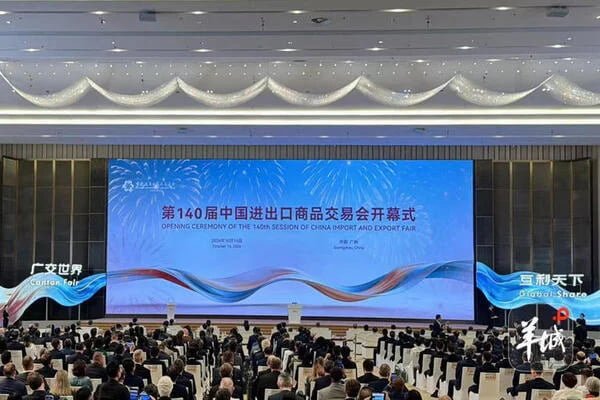 Moving exhibition goods to the Canton Fair involves more than arranging international freight. Once cargo reaches Guangzhou, exhibitors still need to coordinate delivery, vehicle access, unloading, booth installation and eventual removal.
For the 140th Canton Fair, running from October 15 to November 4, 2026, the organizers have expanded their digital logistics and traffic management services to improve coordination across the exhibition complex.
At a September 18 press conference, the China Foreign Trade Centre announced 16 digital and intelligent systems and 22 smart application scenarios. These include online logistics booking, real-time service tracking and vehicle scheduling to support two intensive 76-hour exhibition changeovers.1
For overseas exhibitors and freight forwarders, the important question is how these arrangements affect actual cargo delivery and collection.
1. What's New in Canton Fair 2026's Smart Logistics?
The 140th Canton Fair occupies approximately 1.55 million square meters of exhibition space and takes place in three phases:
| Phase | Exhibition Dates | Main Theme |
|---|---|---|
| Phase 1 | October 15–19 | Advanced Manufacturing |
| Phase 2 | October 23–27 | Quality Home Products |
| Phase 3 | October 31–November 4 | Better Life |
The two changeover periods fall on October 20–22 and October 28–30, according to the official Canton Fair schedule.2
During these intervals, outgoing exhibitors remove their displays while incoming exhibitors prepare booths for the next phase.
To coordinate these activities, the fair's smart logistics and traffic services integrate several functions:
- Online booking: Arrangements for logistics, exhibit handling and related services can be coordinated digitally.
- Real-time progress tracking: Users can follow the status of relevant logistics services.
- Vehicle scheduling: Trucks and other authorized vehicles can be managed through designated entry and traffic arrangements.
- Parking and access coordination: Vehicle movements and parking services are incorporated into the wider traffic management system.
These functions are intended to improve coordination, particularly during concentrated move-in and move-out periods.
However, the organizers have not published a verified figure showing how many hours or what percentage of logistics costs the new arrangements save.
2. Truck Booking Rules: What Logistics Providers Must Know
One of the clearest operational requirements for the 140th Canton Fair concerns outbound exhibition trucks.
According to the official September 26 notice on exhibitor and service-provider credentials, trucks collecting exhibition goods during dismantling must book their venue entry time in advance through the Smart Traffic system.3
This makes vehicle planning an important part of the move-out process.
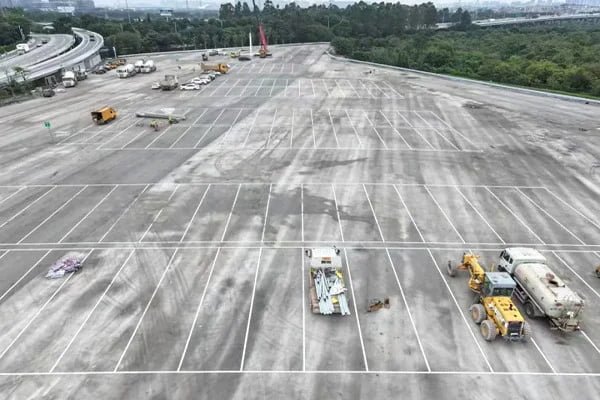
Truck permits and booking slots are different
The notice establishes several requirements:
- Vehicles entering the exhibition complex must hold the appropriate valid credentials.
- Truck permit applications should be submitted at least three days in advance.
- Move-out trucks must separately reserve an entry time through the Smart Traffic system.
- Authorized vehicles must use the entrances and areas specified on their permits unless they hold special all-area access authorization.
The fair also upgraded its vehicle credential system, introducing online payments for vehicle permits and digital invoicing.
Having a truck permit does not automatically mean that a move-out entry slot has been booked. Both arrangements should be confirmed with the responsible local service provider.
What should freight forwarders do?
International freight forwarders coordinating exhibition cargo should work with their Guangzhou delivery partners to verify:
- Which company is responsible for the vehicle permit and Smart Traffic booking.
- The approved entry time, gate and unloading or collection area.
- Whether the vehicle dimensions and cargo-handling equipment are suitable for the assigned delivery area.
- How the driver will communicate with the warehouse, booth team or exhibition handling provider.
For overseas companies without their own transportation teams in Guangzhou, working with an experienced local exhibition logistics provider can help prevent misunderstandings about venue access.
3. The 76-Hour Challenge: How Exhibition Changeovers Work
The 140th Canton Fair includes two officially described 76-hour exhibition changeovers:
First changeover: Phase 1 ends on October 19, with preparations for Phase 2 taking place October 20–22.
Second changeover: Phase 2 ends on October 27, with preparations for Phase 3 taking place October 28–30.
The organizers have identified smart logistics and traffic management as important support for completing these operations.1
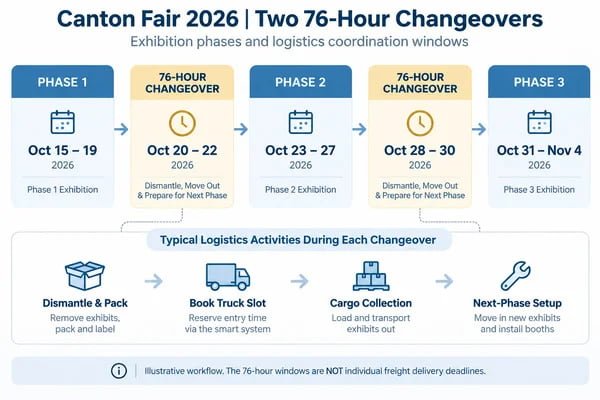
Figure: The two official changeover windows and an illustrative exhibition logistics workflow. The diagram does not represent individual vehicle appointment slots.
What happens during a changeover?
A typical exhibition turnover involves several interconnected operations:
Dismantling and packing: Outgoing exhibitors disassemble displays, protect reusable equipment and prepare cargo for collection.
Cargo collection: Handling teams move packed goods to designated collection points while authorized trucks arrive according to their permitted schedules.
Venue turnover: Booth structures, equipment and remaining materials are removed or handled as required, allowing the next exhibition phase to prepare its space.
New cargo delivery and installation: Incoming exhibits are brought into the venue, unloaded and installed before the next phase opens.
These activities do not necessarily happen in a fixed sequence across the entire venue. Different halls, exhibitors and service providers may operate simultaneously.
The logistical challenge is therefore not simply speed. It is coordinating cargo, equipment, personnel and vehicle movements within a limited period.
Why does digital scheduling matter?
Truck appointments help organizers distribute vehicle arrivals across available operating windows instead of allowing everyone to arrive at once.
Progress tracking can also help service providers coordinate cargo movement and handling resources.
For freight forwarders, better visibility into these operations can support more realistic collection planning and reduce avoidable mismatches between vehicle arrival and cargo readiness.
The 76-hour figure refers to the overall phase-changeover operation, not a guarantee that an individual shipment will be moved, cleared or dispatched within 76 hours.
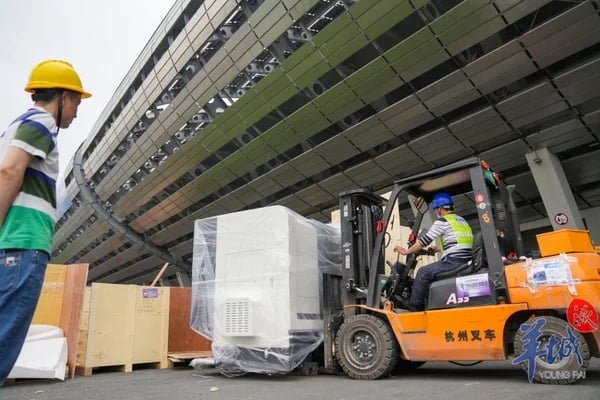
4. From Port to Exhibition Hall: The Last-Mile Logistics Challenge
International exhibitors often focus on getting their goods to Guangzhou by air or sea.
But port arrival is only one milestone.
Consider an overseas equipment manufacturer shipping demonstration machinery to the Canton Fair. After the shipment has completed the necessary customs procedures, several arrangements may still be required:
- Collect the cargo from the airport terminal, seaport or relevant logistics facility.
- Confirm the delivery address, booth information and handling arrangements.
- Coordinate local transportation with the designated exhibition receiving and handling services.
- Verify applicable vehicle permits, access windows and loading restrictions.
- Complete the handover, unloading and installation process.
For large machinery, fragile equipment or cargo requiring lifting equipment, these arrangements may need additional planning.
A shipment could be customs-cleared but still miss its intended installation window if the exhibition team has not confirmed delivery acceptance or site access.
Customs release and exhibition-hall delivery should therefore be treated as separate operational milestones.
This distinction is especially important for freight forwarders organizing time-sensitive exhibition shipments.
5. Practical Logistics Checklist for Overseas Exhibitors
| Stage | Recommended Action |
|---|---|
| Before shipping | Confirm exhibition phase, delivery deadline, consignee instructions and cargo dimensions |
| Before local delivery | Check customs release, site acceptance arrangements and the appointed handling provider |
| Before venue entry | Confirm permits, entry gate, approved time window and unloading requirements |
| During the exhibition | Retain packing materials and identify goods requiring special removal procedures |
| Before dismantling | Confirm the truck permit, mandatory Smart Traffic booking and cargo collection plan |
| After the exhibition | Arrange domestic delivery, overseas return transport or other permitted handling of the goods |
Two additional precautions are useful.
First, do not schedule freight collection solely around the exhibition's published closing time. Cargo dismantling, packing, vehicle access and site-release arrangements must also be considered.
Second, decide early who is responsible for each handover. The international freight forwarder, local carrier, exhibition handling provider and exhibitor may be different companies.
A clear division of responsibility can prevent unnecessary waiting or cargo being left without an agreed collection arrangement.
6. What Can International Logistics Companies Learn?
The Canton Fair's logistics arrangements illustrate a wider challenge in exhibition supply chains: international transportation and on-site delivery must be planned together.
Digital tools can support the coordination of vehicles, facilities and cargo-handling services, but they do not eliminate the need for accurate information or reliable local execution.
For freight forwarders, three lessons stand out:
- Visibility matters: Understanding when cargo is ready and when the venue can accept or release it is as important as tracking the international shipment.
- Access requirements matter: Local permit and vehicle-booking procedures can determine whether a planned collection actually takes place.
- Post-show planning matters: Re-export, domestic delivery or other approved cargo handling should be arranged before the exhibition ends.
The fair has also expanded its Trade Services Exhibition Area to include logistics and warehousing services, reflecting the growing importance of logistics support in international trade.4
7. Frequently Asked Questions
Q1. Do freight trucks need advance booking at Canton Fair 2026?
Yes, trucks entering the venue for exhibition dismantling and cargo collection must reserve an entry time through the Smart Traffic system. They must also comply with the applicable vehicle permit requirements. Truck permit applications should be submitted at least three days in advance.
Q2. Does the 76-hour changeover mean cargo can be delivered within 76 hours?
No. The two 76-hour periods refer to the fair's overall exhibition changeover operations. They are not guaranteed transportation, customs clearance or delivery times for individual shipments.
Q3. Can overseas exhibitors arrange their own trucks for booth delivery?
They should first verify the fair's vehicle access requirements, appropriate permits and cargo-handling arrangements with the organizer or appointed local logistics provider. Using an independent carrier does not exempt the shipment from venue traffic, access or handling rules.
Conclusion: Smart Logistics Starts Before the Truck Arrives
The 140th Canton Fair demonstrates how digital logistics services and scheduled vehicle access can support the complex movement of exhibition cargo.
Its smart logistics system and mandatory move-out truck appointments are particularly relevant to exhibitors managing tight delivery and collection schedules.
Yet digital scheduling is only part of the solution. Accurate shipment information, coordinated local delivery and early post-show planning remain essential.
For international exhibitors, successful exhibition logistics begins well before the truck reaches the exhibition entrance.
Planning Exhibition Cargo or International Shipments?
From international sea and air freight to shipment documentation and transport coordination, Deeplinker helps businesses plan cross-border shipping arrangements and connect with appropriate logistics services.
Explore Deeplinker for international freight solutions and shipping support.
References
Operational note: Venue access and handling procedures may vary by exhibition area, vehicle type and service arrangement. Confirm detailed requirements with the fair organizer or authorized service providers before scheduling cargo movements.
Ministry of Commerce of China — [Press Conference on the 140th China Import and Export Fair](https://interview.mofcom.gov.cn/detail/202609/ff808081a0bd001901a0bdb482130008.html), September 18, 2026. Details of 16 digital systems, 22 smart scenarios, vehicle scheduling and two 76-hour changeovers. ↩
Canton Fair — [Official Fair Dates and Exhibition Information](https://www.cantonfair.org.cn/about?pageCode=33414c3a293b4349aa5c5dc60dfb1b42), 2026. ↩
Canton Fair — [Notice on Credentials for Exhibitors and Service Providers at the 140th Canton Fair](https://www.cantonfair.org.cn/content-detail?id=65d6b41c858a4c59a021512259cf3a03), September 26, 2026. ↩
Canton Fair — [Trade Services Exhibition Area Announcement](https://www.cantonfair.org.cn/content-detail?id=a9514de6fc244f6d9329a17392774ee9), September 4, 2026. ↩