
Are you tired of unpredictable shipping delays and rising costs? The China-Turkey rail freight route offers a stable and efficient alternative, balancing speed with affordability for your supply chain.1
Yes, the rail freight route from China to Turkey via the Caspian Sea is a faster, safer, and more reliable option than traditional sea freight2. It offers a predictable transit time of around 20-25 days, avoiding common sea port congestion and providing a secure, land-based alternative.
In today's logistics world, things change fast. Delays at sea ports and unstable shipping schedules can really hurt a business. I've seen clients struggle with these problems for years. That’s why more people are looking for better options. The Trans-Caspian rail corridor is becoming a very popular choice.3 It gives you a strong balance between transit time and cost, especially for shipping to Turkey. It’s a practical solution that helps you keep your delivery promises.
China to Turkey Rail Route & Transit Time Explained?
Planning your shipments is hard when you don't know the exact route or timing. This uncertainty can cause big problems for your business, delaying everything down the line.
The route starts in China, travels through Kazakhstan, crosses the Caspian Sea by vessel4, and continues by rail through Azerbaijan and Georgia to Turkey. This multimodal journey typically takes 20-25 days, making it a great middle ground between slow sea freight and expensive air freight.5
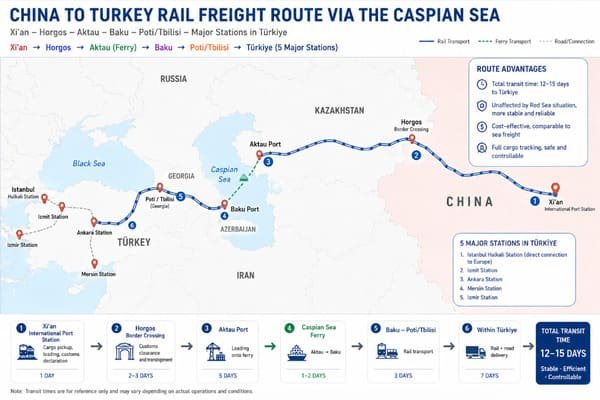
Let's break down the journey so you can see exactly how your cargo moves. This isn't just one long train ride; it's a carefully coordinated multimodal path that we manage every step of the way. My team and I have guided countless shipments along this corridor, and it has proven to be incredibly resilient.
The Journey Step-by-Step
The path is designed to be efficient and avoid many of the chokepoints that affect other routes. It's a combination of rail and a short sea leg across the Caspian.
| Stage | Route Segment | Mode | Estimated Time | Key Notes |
|---|---|---|---|---|
| 1 | China (e.g., Xi'an) to Kazakhstan (Aktau Port) | Rail | 8-10 days | Crosses the China-Kazakhstan border at Khorgos. |
| 2 | Aktau Port to Azerbaijan (Baku Port) | Sea | 2-3 days | A short and efficient ferry crossing of the Caspian Sea. |
| 3 | Baku to Georgia/Turkey Border | Rail | 3-5 days | Utilizes the Baku-Tbilisi-Kars (BTK) railway line. |
| 4 | Final Delivery in Turkey | Rail/Truck | 2-4 days | Cargo is moved from the border to its final destination. |
This route’s total transit time of 20-25 days is a huge advantage.67 It provides a level of predictability that is hard to find with sea shipping right now. We handle all the transfers between rail and sea, so the process is smooth for you.
Flexible Rail Freight Solutions Tailored to Your Needs?
Every business has different shipping needs, and one standard solution doesn't work for all. Using the wrong service can lead to damaged goods or unexpectedly high costs.
This rail route offers flexible options for different cargo types. We can handle Full Container Loads (FCL) for large shipments and Less than Container Loads (LCL) for smaller ones. We also manage specialized cargo, ensuring your specific needs are met.8
Your cargo is unique, and your shipping solution should be too. Whether you're a large company shipping dozens of containers or a small e-commerce seller sending a few pallets, this route can be adapted. I once worked with a client who needed to ship delicate manufacturing equipment. They were worried about damage during a long sea voyage. We used the rail option with special handling, and their equipment arrived in perfect condition and ahead of schedule. It's all about matching the service to the shipment.
Matching the Service to Your Shipment
We offer several options to make sure your cargo is handled correctly and cost-effectively.
| Service Type | Best For | Key Benefits |
|---|---|---|
| Full Container Load (FCL) | Businesses with enough cargo to fill a 20ft or 40ft container. | More secure as the container is sealed at your factory; often faster as it's a single unit. |
| Less than Container Load (LCL) | Small to medium businesses, e-commerce sellers, or trial shipments. | Cost-effective as you only pay for the space you use; great for inventory management. |
| Specialized Cargo | Oversized machinery, dangerous goods (DG), temperature-sensitive products. | Requires expert handling, which we provide; ensures safety and compliance on the entire route. |
With LCL, we consolidate your goods with other shipments heading to the same region, which saves you a lot of money. For FCL, you get the entire container to yourself. And for complex shipments, like the hazardous chemicals or large project cargo we often handle at DeepLinker, our expert team plans every detail.9 We ensure all customs paperwork and safety protocols are perfect for a smooth transit.
Rail vs Sea Freight: Why More Shippers Are Switching?
Sea freight is often slow, and the schedules are unreliable. These constant delays can disrupt your entire supply chain and lead to unhappy customers waiting for their products.
Rail freight gives you a faster and more predictable alternative. Shippers are switching to the China-Turkey rail route because it provides an excellent balance of speed and cost. It's much faster than sea freight and far cheaper than air, offering the reliability businesses need today.
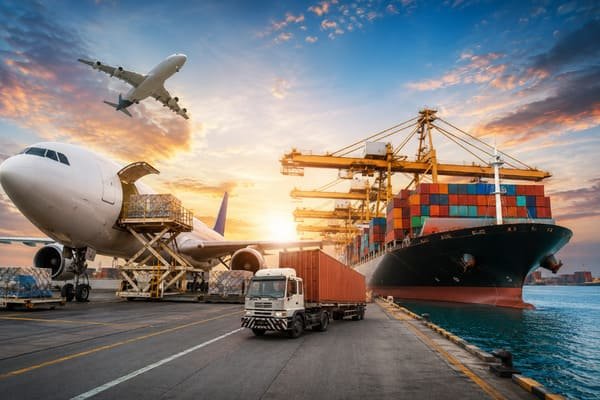
The choice between rail and sea used to be simple: sea was cheap and slow, while rail was a niche, faster option. But things have changed. With port congestion, canal blockages, and blank sailings, the "cheap" sea freight option often comes with hidden costs from delays.10 A client of mine, a German retail chain owner named David, can't afford to have his new product line arrive late. For him, the predictability of a 25-day rail transit is far more valuable than the potential savings of a 45-day sea journey that might get delayed. He made the switch and hasn't looked back.
A Head-to-Head Comparison
Let's look at the facts. When you place rail and sea side-by-side, the advantages of the Trans-Caspian route become clear for many types of cargo.
| Feature | Rail Freight (Trans-Caspian) | Sea Freight |
|---|---|---|
| Transit Time | 20-25 days | 35-45+ days |
| Reliability | High. Schedules are fixed and less affected by weather or port issues. | Low to Medium. Prone to port congestion, customs delays, and weather disruptions. |
| Cost | Medium. More expensive than sea but significantly cheaper than air. | Low. Generally the cheapest option for bulk goods. |
| Security | High. Fewer handling points and sealed containers reduce risk of damage and theft. | Medium. More touchpoints during loading/unloading increase risk. |
| Flexibility | Good. FCL, LCL, and specialized cargo options are available. | High. Can handle almost any type of cargo, but with longer lead times. |
The key takeaway here is reliability. The rail route follows a set path with set schedules. It bypasses the world's most congested sea lanes and ports. This means you can plan your inventory, production, and sales with much greater confidence. For businesses where timing is critical, this stability is a game-changer.
Is This Route Right for Your Cargo?
Choosing the wrong shipping route can be a very expensive mistake. It can cause you to miss market deadlines, lose sales, and damage your brand's reputation.
Let's determine if this rail corridor fits your specific needs. This route is perfect for time-sensitive or high-value goods that need to arrive faster than sea freight allows but don't warrant the high cost of air freight.
Deciding on the best logistics strategy is about weighing your priorities. Is speed the most important thing? Or is it cost? Or maybe security? The China-Turkey rail route is not a one-size-fits-all answer, but it is the perfect solution for a growing number of businesses. If you're shipping low-value, bulk commodities and have a flexible timeline, traditional sea freight might still be your best bet. However, if you're in a competitive market where getting your product to customers quickly and reliably gives you an edge, then this route is definitely for you.
Who Benefits Most?
This route is particularly well-suited for certain types of products and businesses.
Ideal Cargo Types:
- High-Value Electronics: Where speed to market and security are critical.
- Automotive Parts: For just-in-time manufacturing schedules.11
- Fashion & Apparel: To quickly respond to fast-changing trends.
- E-commerce Goods: For faster inventory replenishment and better customer satisfaction.
- Industrial Components: When project deadlines are tight.
Ideal Business Profiles:
- E-commerce Sellers: Who need to keep popular items in stock on platforms like Amazon or their own Shopify store.
- Retail Chains: That require a steady and predictable flow of goods to their stores.
- Manufacturers: Who depend on reliable delivery of parts to keep production lines running.
- Distributors: Serving markets in Turkey, the Caucasus, and Eastern Europe who want to reduce lead times.12
If your business fits one of these profiles, the Trans-Caspian rail route could significantly improve your supply chain. It helps you reduce your inventory holding costs and react faster to market demand.
Conclusion
The China-Turkey rail route is a powerful alternative to sea freight. It offers a competitive mix of speed, cost, and reliability that can help your business thrive in a tough market.
Rail freight transport — the use of railways to move cargo, offering a balance of speed, cost, and reliability — *Wikipedia*: https://en.wikipedia.org/wiki/Rail_freight_transport ↩
Middle Trade and Transport Corridor — analysis of the trans-Caspian route linking China, Central Asia, and Europe — *World Bank*: https://www.worldbank.org/en/region/eca/publication/middle-trade-and-transport-corridor ↩
Middle Trade and Transport Corridor overview — *World Bank*: https://www.worldbank.org/en/region/eca/publication/middle-trade-and-transport-corridor ↩
Trans-Caspian International Transport Route — a multimodal corridor crossing the Caspian Sea connecting China to Europe via Central Asia and the Caucasus — *Wikipedia*: https://en.wikipedia.org/wiki/Trans-Caspian_International_Transport_Route ↩
Multimodal transport — the movement of goods using two or more modes of transport under a single contract — *Wikipedia*: https://en.wikipedia.org/wiki/Multimodal_transport ↩
Khorgos — a major dry port and border crossing on the China-Kazakhstan frontier, a key hub of the corridor — *Wikipedia*: https://en.wikipedia.org/wiki/Khorgos ↩
Baku–Tbilisi–Kars railway — a regional rail link connecting Azerbaijan, Georgia, and Turkey — *Wikipedia*: https://en.wikipedia.org/wiki/Baku%E2%80%93Tbilisi%E2%80%93Kars_railway ↩
Less than container load (LCL) — a shipment that does not fill an entire container and is consolidated with other cargo — *Wikipedia*: https://en.wikipedia.org/wiki/Less_than_container_load ↩
Dangerous goods — materials that pose risks to health, safety, or property and require special handling during transport — *Wikipedia*: https://en.wikipedia.org/wiki/Dangerous_goods ↩
Cargo ship — a vessel that carries goods and materials between ports; sea schedules are subject to blank sailings and congestion — *Wikipedia*: https://en.wikipedia.org/wiki/Cargo_ship ↩
Just-in-time manufacturing — a production strategy that aligns raw-material orders with production schedules to reduce inventory — *Wikipedia*: https://en.wikipedia.org/wiki/Just-in-time_manufacturing ↩
Lead time — the total time between the initiation and completion of a process, such as order to delivery — *Wikipedia*: https://en.wikipedia.org/wiki/Lead_time ↩