
Are you confused by international shipping terms? This confusion can lead to unexpected costs and delays, hurting your bottom line and stalling your inventory. Understanding the difference is your first step.
DDP (Delivered Duty Paid) means the seller handles all costs and risks, including import duties, until the goods reach your door.1 DDU (Delivered Duty Unpaid) means you, the buyer, are responsible for paying import duties, taxes, and customs fees upon arrival in your country.2
I've been in the logistics game for a long time, and the DDP vs. DDU question comes up almost every day. It's one of the most critical decisions an importer has to make, and getting it wrong can be painful. To really help you choose the right path for your business, we need to break down what each of these terms actually means for you, your money, and your time. Let's dive into the details so you can ship with confidence.
What is DDU?
Worried about hidden fees when your goods arrive? DDU puts the responsibility for import duties and taxes on you, the buyer, which can lead to surprise bills and frustrating delays.
DDU, or Delivered Duty Unpaid, means the seller delivers the goods to the destination country, but their job ends before customs clearance3. You, the importer, must handle and pay for all import duties, taxes, and customs fees to get your cargo released and delivered.
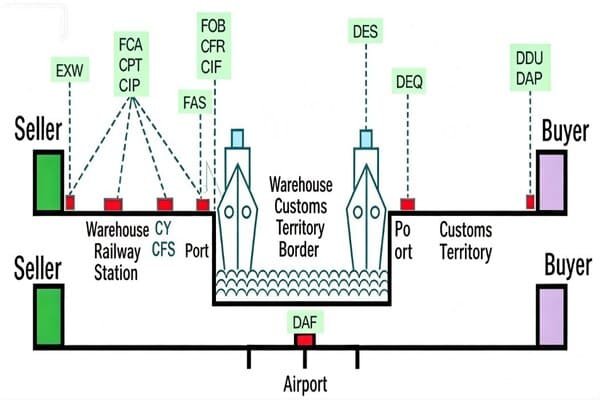
When you choose DDU, you're taking a more hands-on role. I remember one of my first experiences importing a batch of outdoor gear under DDU terms. I thought I had scored a great deal from the supplier because the initial shipping quote was so low. But once the container arrived in Hamburg, Germany, the real work began. The shipping agent called me and said the goods were waiting for customs clearance. I had to quickly find a customs broker4, provide them with all the necessary paperwork, and then wait for the customs office to assess the duties and taxes. The final bill was a surprise, and the scramble to get it paid delayed my products from reaching my warehouse by a week. This is a classic DDU scenario. While you get more control, you also take on all the risks of the import process.
Your responsibilities under DDU include:
- Arranging Customs Clearance: You must hire a customs broker or have the knowledge to clear the goods yourself.5
- Paying All Import Fees: This includes import duties, VAT/GST, and any other local taxes.6
- Handling Inspections: If customs decides to inspect your cargo, you are responsible for any associated costs and delays.
- Arranging Final Delivery: You need to organize transport from the port or airport to your final destination.
What is DDP?
Tired of dealing with customs paperwork and unexpected import fees? DDP shipping handles everything for you. The seller takes care of all costs and risks until the goods reach your door.
DDP, or Delivered Duty Paid, is an agreement where the seller assumes all responsibilities, risks, and costs associated with the entire shipping journey.7 This includes export fees, international transport, insurance, customs clearance, and payment of all import duties and taxes in your country.
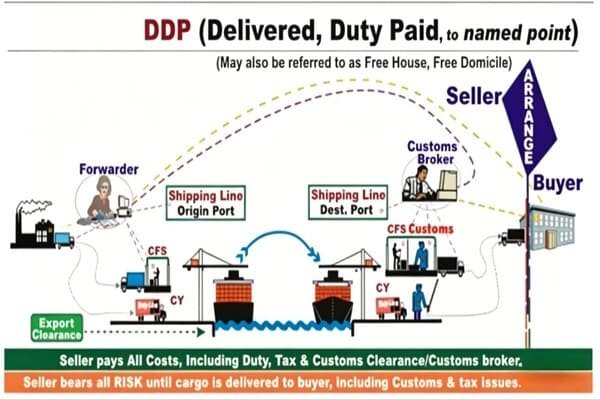
Think of DDP as the ultimate "white-glove" shipping service. For the importer, it's the most straightforward and hands-off option available. The price you get from your supplier or freight forwarder is the final price you pay to have the goods on your doorstep. There are no surprise customs bills or frantic calls to find a broker. At my company, Deeplinker, we specialize in making DDP shipping seamless for our clients. We act as the single point of contact, managing the entire process from a factory in China to a warehouse in the United States. Our team handles the complex customs regulations and paperwork, so our clients can focus on selling their products, not on logistics headaches.
The seller's responsibilities under DDP are extensive:
- All Transportation Costs: From their factory to your named destination.
- Export and Import Clearance: Handling all customs formalities in both countries.
- Payment of All Duties & Taxes: The seller pays any import duties and VAT/GST8 on your behalf.
- All Risks: The seller is responsible for the cargo until you receive it.
This all-inclusive approach is why many e-commerce sellers and businesses new to importing prefer DDP. It turns a variable, complex cost into a fixed, predictable one.
How do the costs and responsibilities really stack up between DDP and DDU?
Choosing the wrong shipping term can destroy your profit margins. DDP and DDU split costs and risks very differently, and understanding this split is critical before you sign any contract with a supplier.
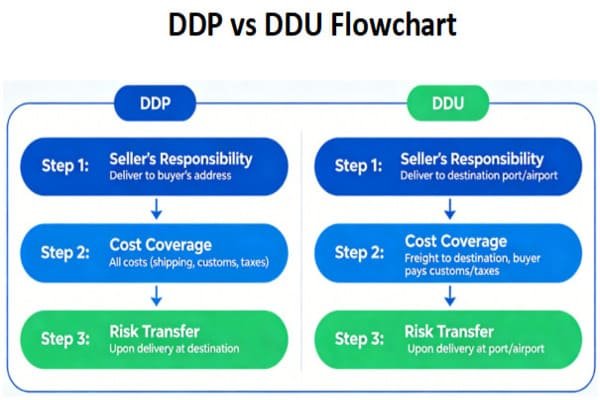
With DDP, the seller pays for everything, including import duties and final delivery. With DDU, the risk and cost transfer to you, the buyer, once the goods arrive in the destination country, right before customs clearance. The main difference is who handles the import process.9
The clearest way to see the difference is to lay it out side-by-side. The critical point of transfer happens at the border of the destination country. With DDU, the seller gets the goods to the border, and then it becomes your problem.10 With DDP, the seller gets the goods across the border and to your door. For an importer like David, a retail chain buyer in Germany, this choice is huge. A DDU shipment might look cheaper initially, but a customs delay could mean empty shelves and lost sales. A DDP shipment costs more upfront, but it guarantees the product arrives on a predictable schedule and budget, which is often more valuable.
Here is a simple breakdown of who is responsible for what:
| Task / Responsibility | DDU (Delivered Duty Unpaid) | DDP (Delivered Duty Paid) |
|---|---|---|
| Export Formalities | Seller | Seller |
| International Freight | Seller | Seller |
| Cargo Insurance | Seller | Seller |
| Arrival at Destination Port | Seller | Seller |
| Import Customs Clearance | Buyer | Seller |
| Import Duties & Taxes | Buyer | Seller |
| Final "Last-Mile" Delivery | Buyer | Seller |
What are the real-world pros and cons of DDU and DDP for an importer?
Eager to simplify your shipping but worried about overpaying? DDP offers convenience at a price, while DDU gives you control but adds complexity. Choosing wisely depends on your business needs and experience level.
The main pro for DDP is convenience and total cost certainty, but its downside can be a higher price and less control. For DDU, the main pro is having more control and potential cost savings, but it comes with far more risk and personal responsibility for you as the importer.
I've seen clients thrive with both options, but they understood the trade-offs. A new Shopify seller importing for the first time should almost always start with DDP. The peace of mind is worth the extra cost. On the other hand, a large manufacturing company with its own logistics department and established customs brokers in the U.S. might save thousands by managing their own DDU shipments. There is no single "best" answer, only what is best for your specific situation. Let's break down the advantages and disadvantages of each to make it clearer.
Pros and Cons of DDU (Delivered Duty Unpaid)
- Pros:
- More Control: You can use your own trusted customs broker, who may offer better service or rates.
- Cost Transparency: You see exactly what you are paying for customs duties and taxes, as it's a separate bill.
- Potential Savings: If you are good at managing logistics, you might be able to handle the import process for less than what a seller would charge for DDP.
- Cons:
- High Risk: You are responsible for any issues at customs, including delays, inspections, and fines.
- Unexpected Costs: The final duty and tax amount can be a surprise, making budgeting difficult.
- More Work: It requires you to actively manage the import process, taking time away from other parts of your business.
Pros and Cons of DDP (Delivered Duty Paid)
- Pros:
- Hassle-Free: A true "door-to-door" service. You don't have to worry about customs, duties, or final delivery.
- Budget Certainty: The price quoted is the final price paid. This is perfect for businesses that need predictable costs.
- Buyer Protection: The seller is responsible for the goods until they are delivered to you. If anything gets lost or damaged, it's their problem.
- Cons:
- Higher Cost: Sellers often add a buffer to the DDP price to cover their risks, so it can be more expensive than DDU.11
- Less Transparency: The duties and taxes are bundled into the total price, so you don't see the exact cost breakdown.
- Reliance on Seller: You are depending on the seller and their chosen freight forwarder to handle everything correctly.
So, how do I decide whether to choose DDU or DDP for my business?
Making the wrong shipping choice can stall your entire supply chain. DDU and DDP are suited for different importers and situations. Matching the right term to your shipment is crucial for success.
You should choose DDP if you are a new importer, value convenience and budget certainty, or are shipping to a complex market. Choose DDU if you are an experienced importer with a trusted local customs broker and want full control over the process and costs.

The right choice comes down to a simple question: where do you want to spend your time and take your risks? Do you want to be a logistics expert, or do you want to focus on growing your business? For most of our clients, especially brand owners, e-commerce sellers, and retail buyers, the answer is clear. They want a reliable partner to handle the complexities of global shipping. That's why we've built our DDP services at Deeplinker to be a complete, hassle-free solution. We provide the stability and transparency they need to manage their supply chain effectively. Your answer will depend on your own resources and priorities.
Choose DDP when:
- You are new to importing and want the simplest, lowest-risk option.
- You are shipping high-value products and prefer a single party to be responsible for the entire journey.
- You prioritize convenience and predictable, all-in costs for easy budgeting.
- You are an e-commerce seller shipping directly to a fulfillment center like Amazon FBA12, where a smooth, cleared delivery is mandatory.
- You are shipping to a country where you have no experience with local customs regulations.
Choose DDU when:
- You are an experienced importer with a strong logistics team.
- You have an established, trusted relationship with a customs broker in the destination country.
- You want full transparency and believe you can manage the import process more cost-effectively yourself.
- You are shipping to your own warehouse or facility and have the resources to handle final delivery.
Conclusion
In short, DDP offers a hassle-free, all-inclusive service, while DDU gives you more control but also more responsibility. Your choice depends on your experience, risk tolerance, and business needs.
"Know Your Incoterms - International Trade Administration", https://www.trade.gov/know-your-incoterms. The ICC Incoterms rules define Delivered Duty Paid as assigning the seller responsibility for delivery to the named destination, including export and import clearance and payment of duties and taxes. Evidence role: definition; source type: institution. Supports: DDP places the main delivery costs, risks, customs clearance, and import-duty responsibilities on the seller until delivery at the named destination. Scope note: Incoterms allocate costs, risks, and formal obligations between contracting parties; they do not by themselves determine customs-law liability in every jurisdiction. ↩
"Know Your Incoterms - International Trade Administration", https://www.trade.gov/know-your-incoterms. Historical Incoterms materials define Delivered Duty Unpaid as delivery by the seller without clearing the goods for import or paying import duties, leaving those charges to the buyer. Evidence role: historical_context; source type: institution. Supports: Under DDU, the buyer is responsible for import duties, taxes, and customs-related fees after arrival. Scope note: DDU was used in earlier Incoterms but is not a current Incoterms 2020 rule; the closest current terms are commonly discussed as DAP or DPU depending on the delivery arrangement. ↩
"[DOC] INCOTERMS 2000 Chart of Responsibility - Procurement", https://procurement.uark.edu/_resources/documents/Import_Purchases_and_Procedures.docx. Incoterms guidance for DDU states that the seller delivers the goods to the destination without import clearance, while the buyer completes import formalities and pays duties and taxes. Evidence role: definition; source type: institution. Supports: In a DDU arrangement, the seller’s obligation does not include import customs clearance. Scope note: The wording is a simplified summary; exact obligations depend on the named place and the version of Incoterms incorporated into the contract. ↩
"Customs broking", https://en.wikipedia.org/wiki/Customs_broking. Reference overview of customs brokers, licensed professionals who prepare and submit documentation to clear imported goods through customs. Evidence role: definition; source type: reference. Supports: Under DDU, the buyer typically engages a licensed customs broker to handle import clearance formalities. ↩
"Do I need a Customs Broker to clear my goods?", https://www.help.cbp.gov/s/article/Article-1135?language=en_US. Official U.S. Customs and Border Protection guidance explaining when importers must engage a licensed customs broker to clear imported goods. Evidence role: requirement; source type: institution. Supports: Under DDU, the buyer must arrange customs clearance, either by hiring a customs broker or clearing the goods themselves. ↩
"How can I find out how much duty/tax I will have to pay on my imported goods?", https://www.help.cbp.gov/s/article/Article-1225?language=en_US. Official CBP guidance on determining import duties and taxes payable on imported merchandise. Evidence role: mechanism; source type: institution. Supports: The buyer under DDU is responsible for paying import duties, taxes, and other assessed fees on arrival. ↩
"Know Your Incoterms - International Trade Administration", https://www.trade.gov/know-your-incoterms. The ICC Incoterms rules define DDP as the term placing maximum obligation on the seller, covering transport, insurance, export and import clearance, and payment of duties and taxes. Evidence role: definition; source type: institution. Supports: Under DDP, the seller assumes all costs and risks of the shipping journey through delivery at the named destination. ↩
"Value-added tax", https://en.wikipedia.org/wiki/Value-added_tax. Reference definition of VAT (and comparable GST), a consumption tax commonly levied on imported goods at the destination country. Evidence role: definition; source type: reference. Supports: Import charges under both DDU and DDP include VAT/GST assessed by the destination country. ↩
"DDP or DDU: Which Shipping Option Is Right for You?", https://www.dhl.com/discover/en-us/global-logistics-advice/import-export-advice/ddp-or-ddu-shipping-options. Logistics-industry guidance from DHL comparing DDP and DDU and explaining that the core distinction is which party handles the import clearance and duties. Evidence role: comparison; source type: industry. Supports: The main practical difference between DDP and DDU is who manages the import process and bears the associated costs. ↩
"Know Your Incoterms - International Trade Administration", https://www.trade.gov/know-your-incoterms. Incoterms materials confirm that under DDU-type delivery the seller's responsibility ends at the destination before import clearance, transferring further obligations to the buyer. Evidence role: mechanism; source type: institution. Supports: Under DDU, cost and risk transfer to the buyer once goods reach the destination country, just before customs clearance. ↩
"Know Your Incoterms - International Trade Administration", https://www.trade.gov/know-your-incoterms. Incoterms guidance notes that assuming full clearance and duty obligations increases the seller's cost and risk exposure under DDP. Evidence role: analysis; source type: institution. Supports: Because DDP shifts all import risk and cost to the seller, sellers commonly build a buffer into the DDP price, making it more expensive than DDU. ↩
"Fulfillment by Amazon (FBA)", https://en.wikipedia.org/wiki/Fulfillment_by_Amazon. Reference overview of Amazon FBA, a fulfillment service requiring inventory to be delivered fully cleared to Amazon warehouses. Evidence role: context; source type: reference. Supports: E-commerce sellers shipping to Amazon FBA need cleared, duty-paid delivery, which DDP provides. ↩