

Last reviewed: 20 October 2026
For Chinese companies selling batteries and energy storage products into Europe, 2026 is an important preparation year. However, there is no single deadline when every requirement under the EU Batteries Regulation becomes mandatory.
The framework is Regulation (EU) 2023/1542, with obligations introduced in stages. It covers batteries across five categories—portable, starting/lighting/ignition (SLI), light means of transport (LMT), electric vehicle (EV), and industrial—including batteries incorporated into products. Its scope is not limited to batteries manufactured in Europe. European Commission: Batteries overview
For exporters, the practical task is to connect product compliance, supply-chain information and shipment planning. A delivery schedule should reflect which requirements already apply, which begin in 2027, and which still depend on further EU legislation.
What is already applicable in 2026?
The principal conformity-assessment and economic-operator provisions have applied since 18 August 2024, subject to Article 96’s exception. Manufacturers need applicable conformity assessment, technical documentation, an EU declaration of conformity and CE marking. Chapter VIII’s waste-battery and extended producer responsibility (EPR) rules, and separate-collection marking, apply from 18 August 2025. Regulation (EU) 2023/1542, Articles 13, 38 and 96
These obligations should already be part of shipment preparation. Waiting for the battery passport deadline is not an appropriate starting point for reviewing existing compliance.
The following are the main upcoming milestones:
| Topic | Position relevant to exporters |
|---|---|
| New general-information and specified capacity/duration labels | Conditional implementation; August 2026 is not an unconditional start date. |
| Carbon-footprint declarations | Category-specific deadlines depend on supporting EU acts. |
| Battery passports | 18 February 2027 for EV batteries, LMT batteries and industrial batteries above 2 kWh. |
| Battery due diligence | 18 August 2027, for operators within scope. |
The Commission’s battery-passport announcement confirms the passport date and categories. The due-diligence postponement is enacted in Regulation (EU) 2025/1561. The conditional labelling and carbon-footprint dates require closer attention.
Labelling: why “mandatory from August 2026” is incomplete
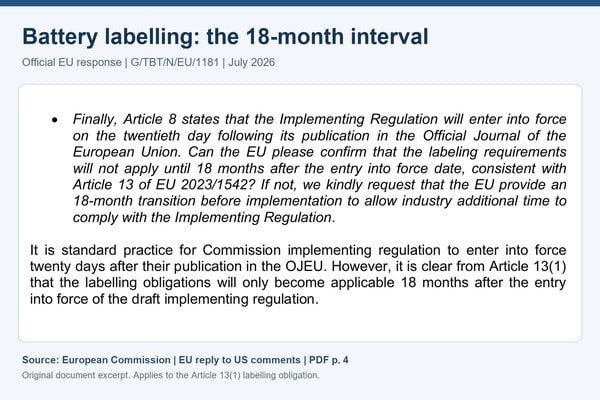
Article 13(1)–(3) uses the later of 18 August 2026 and 18 months after the relevant implementing act enters into force. Regulation (EU) 2023/1542, Article 13
The Commission’s notification G/TBT/N/EU/1181, dated 22 December 2025, concerns draft labelling specifications. In its response to US comments, published on the notification page in July 2026, the EU confirms the 18-month implementation interval for the Article 13(1) obligations. A consultation draft is not evidence that final requirements have entered into force. Official notification and supporting documents
The official materials verified for this article do not establish a final Official Journal publication and resulting application date for these specifications. Exporters should therefore avoid announcing a definitive replacement date based solely on the August 2026 date in the original timetable.
For packaging teams, the sensible approach is to prepare editable artwork and controlled product data now, while checking the final act before authorising a large production run.
Carbon footprint: prepare the data without inventing a fixed deadline
For rechargeable industrial batteries above 2 kWh, excluding those with exclusively external storage, Article 7(1) sets the declaration deadline at the latest of 18 February 2026 and 18 months after the relevant delegated and implementing acts enter into force. Regulation (EU) 2023/1542, Article 7
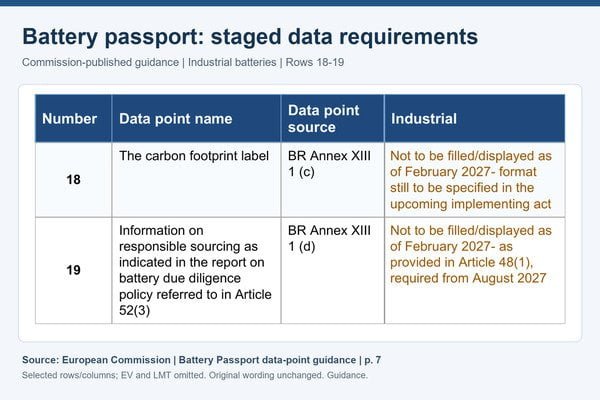
The Commission’s published passport guidance identifies carbon-footprint declaration and label fields as not required at the February 2027 passport launch, explaining that implementing formats remain forthcoming. This supports treating carbon-footprint implementation separately from the passport deadline. Digital Batteries Passport: data points by category, rows 17–18
For manufacturers, this is a reason to organise evidence early. A useful internal preparation programme can identify:
- Which factory and production process supply each battery model.
- Who holds energy-consumption and material-input records.
- How supplier information is checked and updated.
- How design or sourcing changes affect existing calculations.
These are preparation recommendations. They are not a claim that every shipment must already carry a carbon-footprint certificate. Customer requests for environmental information should also be distinguished from the applicable statutory deadline.
Battery due diligence: the deadline moved to August 2027
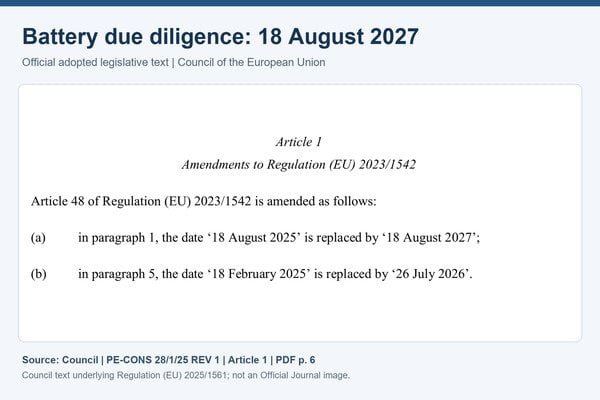
Regulation (EU) 2025/1561 changed the battery due-diligence application date from 18 August 2025 to 18 August 2027. This is an enacted amendment, rather than a proposed extension. Regulation (EU) 2025/1561, Article 1
The Council explains that the postponement gives businesses and verification bodies additional preparation time. The underlying framework addresses supply-chain policies, verification, audits and public reporting. Council of the EU: adoption announcement
Applicability remains subject to Article 47’s scope and exemptions. Current regulation, Article 47
Chinese suppliers can use the remaining preparation period to agree with their EU customers who will request, validate and maintain sourcing evidence. A customer may seek information before its own legal deadline because supplier mapping and verification take time.
Such requests should identify their purpose. A buyer’s questionnaire, a contractual condition and a statutory reporting obligation are different things.
Battery passports: build the information process before February 2027
From 18 February 2027, the passport requirement covers EV batteries, LMT batteries and industrial batteries with capacity greater than 2 kWh when placed on the market or put into service. The Commission’s August 2026 announcement confirms this scope. Commission battery-passport guidance announcement
The broader QR-code requirement also starts on that date; passport coverage is narrower. Regulation (EU) 2023/1542, Article 13(6)
Implementation has progressed beyond early proposals. Implementing Regulation (EU) 2026/1778 establishes arrangements for the digital product passport registry and expressly includes battery passports. DPP Registry Implementing Regulation
However, not every passport field becomes mandatory simultaneously. The Commission’s category-by-category guidance distinguishes required, conditional and later-applicable information. It is implementation guidance, not an additional law. Commission guidance announcement
For an exporter, a useful pilot is to select one finished battery model and trace its information from production through delivery:
- Agree who is responsible for the passport.
- Identify the finished battery and its associated records.
- Assign an owner to each applicable data field.
- Test the link between the physical identifier and the correct digital record.
- Define how later corrections and lifecycle updates will be handled.
This helps expose gaps that a QR-code artwork exercise alone would miss.
What this means for energy storage exporters
Stationary battery energy storage systems are industrial batteries under Article 3(15). Article 12 requires safety evidence, while Article 10(1) requires performance documentation for covered batteries. Regulation (EU) 2023/1542, Articles 3, 10 and 12
For passport planning, the configuration matters. Commission-published FAQs explain that independently functioning batteries and an integrated system sharing essential components can require different assessments. The finished battery must be identified case by case. Battery Passport FAQ, section 3
Before quoting a project, exporters should therefore document the proposed configuration: cells, modules, independently functioning packs or a completed storage system. Agree this description with the customer’s engineering and compliance teams so that the commercial specification, technical evidence and shipment description remain consistent.
Practical logistics implications for China–EU shipments
Keep market compliance and transport acceptance aligned
A battery’s EU product-compliance documentation does not settle its transport arrangements.
For sea freight, the IMO confirms that the IMDG Code 2024 Edition, incorporating Amendment 42-24, became mandatory on 1 January 2026. Classification, packaging and consignment preparation must be checked against the applicable transport rules. IMO: IMDG Code
Before booking, give the logistics provider a consistent description of the chemistry, configuration, capacity, weight, condition and packaging. Ask it to confirm the requirements for the actual route and transport mode, including onward delivery.
Use a shipment-specific document matrix
The following is a recommended coordination tool, not a universal legal document list.
| Workstream | Examples to review | What determines the final requirement? |
|---|---|---|
| Product compliance | Declaration of conformity, technical-file access, applicable test evidence, instructions and markings | Product category, operator role and applicable legislation |
| Dangerous-goods transport | Classification, relevant UN 38.3 evidence, packaging information and transport declarations | Battery configuration, condition, mode, exemptions and carrier acceptance |
| Commercial and customs preparation | Invoice, packing list, commodity description, valuation and origin information | Transaction, customs procedure and destination |
| EPR coordination | Responsible entity, destination-country registration and take-back arrangements | Sales structure and national implementation |
| Passport preparation | Identifier mapping, applicable data and responsibility for updates | Passport scope and implementation stage |
Record whether each item must accompany the goods, be supplied to a particular party, or simply remain available for inspection. Do not automatically describe an SDS, laboratory report, supplier questionnaire or carrier form as a document required by the Batteries Regulation for every consignment.
Assign responsibilities before agreeing delivery commitments
Use one responsibility sheet covering the manufacturer, importer, distributor, EPR arrangements, passport operator and logistics provider.
For national waste-battery implementation, the Commission publishes a list of designated competent authorities. This provides a starting point for destination-specific checks. Commission batteries page, “Implementation”
Resolve open questions before dispatch: who approves labels, who can retrieve technical evidence, who corrects a mismatched model number, and who responds if a shipment or warehouse intake is queried?
Avoid inventing a new customs-document requirement
The Commission-published September 2026 FAQ distinguishes battery-passport registration from entering its registration identifier in an electronic customs declaration: it states that the latter is not required for battery passports. Battery Passport FAQ, question 4.1
This is a useful reason to check battery-specific rules before copying a generic digital-product-passport checklist.
Frequently asked questions
Does the EU Batteries Regulation apply to batteries made in China?
Yes. Origin does not remove a battery from the framework when it is placed on the EU market. Classification and the applicable obligation determine the detailed requirements. European Commission overview
Does every battery need a passport in 2026?
No. The covered categories have a February 2027 passport deadline. Exporters should use 2026 to prepare their data and operating processes. Commission passport guidance announcement
Can a Chinese manufacturer help maintain a passport?
Yes. Commission-published guidance describes written authorisation for another operator, including a non-EU manufacturer, to perform passport tasks. That arrangement does not transfer the responsible operator’s ultimate responsibility. Battery Passport FAQ, section 2
Should exporters wait until every implementing detail is final?
No. Start with stable work: product classification, consistent model information, named data owners, supplier engagement and shipment planning. Update the final compliance checklist when the relevant adopted acts establish the remaining details.
Is there one mandatory “EU battery export document pack”?
A single generic pack is a poor basis for planning. Build the document matrix around the battery, the transaction, the responsible parties and the transport route. Distinguish legal requirements from buyer specifications and carrier acceptance conditions.
Conclusion
For Chinese battery and energy storage exporters, the strongest preparation strategy in 2026 is to turn regulatory dates into specific operational responsibilities.
Review existing compliance, prepare for the February 2027 passport deadline, organise sourcing evidence ahead of the August 2027 due-diligence date, and track conditional labelling and carbon-footprint requirements against their final EU acts.
For your next China–EU battery shipment, bring the product specification, destination, sales structure and intended delivery date into the logistics discussion early. That gives engineering, compliance, purchasing and transport teams time to resolve gaps before the cargo is ready to leave.
References
- Regulation (EU) 2023/1542 — consolidated version dated 13 August 2026. Reading aid; the Official Journal acts are legally authoritative.
- Regulation (EU) 2025/1561 — battery due-diligence postponement.
- Implementing Regulation (EU) 2026/1778 — digital product passport registry.
- European Commission — Batteries overview and implementation resources.
- European Commission — labelling draft notification G/TBT/N/EU/1181 and EU responses.
- European Commission — battery-passport guidance announcement, 21 August 2026.
- Digital Batteries Passport — data points by category.
- Commission-published Battery Passport FAQ — September 2026 edition. Supporting guidance with an author-view disclaimer; not binding legislation.
- Council of the EU — due-diligence postponement adopted, 18 July 2025.
- International Maritime Organization — IMDG Code. Separate transport framework.