

Are you shipping chemicals to the EU? The rules are changing. Ignoring this mandatory shift can lead to blocked shipments, fines, and major supply chain problems.
EU CLP 2026 is a major update to the EU's chemical classification and labeling rules. It adds new hazard classes1 for chemicals that disrupt hormones or persist in the environment. This requires you to update your Safety Data Sheets (SDS) and labels by specific deadlines to stay compliant.
This isn't just a minor paperwork update; it's a fundamental change in how we must handle chemical products for the EU market2. The deadlines are approaching faster than you think, and waiting until the last minute will create unnecessary risk and cost for your business. Let's break down exactly what's changing, who it affects, and what you need to do to prepare.
What Exactly Is the EU CLP 2026 Update?
Confused by all the talk about "CLP 2026"? It can feel like another complex regulation designed to complicate your business. But its goal is simple: better safety.
EU CLP 20263 is a significant amendment to the Regulation on Classification, Labelling and Packaging (CLP). It introduces new hazard classes for endocrine disruptors and persistent chemicals. This makes it mandatory to update your Safety Data Sheets (SDS)4 and product labels to reflect these new classifications.
This update, officially known as Commission Delegated Regulation (EU) 2023/707, aims to close gaps in how we identify long-term chemical risks5. For years, the focus has been on immediate dangers like flammability or acute toxicity. Now, the EU is targeting substances with more subtle, chronic effects on health and the environment. This means we, as shippers and suppliers, have to provide more detailed information to everyone down the supply chain. The core changes force us to re-evaluate our products against new scientific criteria6. It's a proactive step by the EU to better protect its citizens and ecosystems from previously unregulated chemical properties.
| Aspect | Pre-2026 CLP Focus | Post-2026 CLP Focus |
|---|---|---|
| Hazard Scope | Physical, Acute Health, Environmental | Adds Endocrine Disruption, Persistence |
| Scientific Basis | Established toxicity & hazard data | Expanded with new scientific criteria |
| Shipper Impact | Standard SDS & Labels | Mandatory updates to SDS & Labels |
What Are the 4 New Hazard Classes in CLP?
Worried about having to reclassify all of your products? The new hazard classes sound technical and intimidating, but they are straightforward once you understand their purpose.
The CLP update adds four new hazard categories. These are: Endocrine Disruptors7 (ED) for human health, Endocrine Disruptors7 (ED) for the environment, and classes for Persistent, Bioaccumulative and Toxic (PBT8) or very Persistent and very Bioaccumulative (vPvB9) substances, and Persistent, Mobile and Toxic (PMT10) or very Persistent and very Mobile (vPvM) substances.
These new classifications address long-term risks that were not explicitly covered before. Let's look at each one.
1. Endocrine Disruptors (ED)
These are chemicals that interfere with the hormone systems of humans or animals. The CLP now splits them into two distinct groups:
- ED HH: Endocrine Disruptors for human health. (Category 1: known/presumed, Category 2: suspected).
- ED ENV: Endocrine Disruptors for the environment. (Category 1: known/presumed, Category 2: suspected).
2. PBT and vPvB Substances
This group covers chemicals that are a long-term environmental concern because they don't break down easily.
- PBT: Persistent, Bioaccumulative, and Toxic. They stay in the environment, build up in living organisms, and are harmful.
- vPvB: very Persistent and very Bioaccumulative. These are even more persistent and bioaccumulative, posing a significant risk over time.
3. & 4. PMT and vPvM Substances
This group is particularly concerned with protecting drinking water sources.
- PMT: Persistent, Mobile, and Toxic. These substances persist, travel easily through water and soil, and are toxic.
- vPvM: very Persistent and very Mobile. They pose a higher risk of contaminating water sources due to their extreme persistence and mobility.
What Are the Exact Deadlines for CLP 2026?
Are you unsure when you need to be compliant? Missing a deadline is not an option, as it can stop your shipments at the border and lead to penalties.
For new substances, the deadline is May 1, 2025. For existing substances already on the market, you have until November 1, 2026. For new mixtures, the date is May 1, 2026, and for existing mixtures, you have until May 1, 2028, to comply.
The deadlines are staggered to give the industry time to adapt, but the clock is ticking, especially for substances. It's important to understand the difference between a "substance" (a single chemical, like acetone) and a "mixture" (a product containing multiple chemicals, like paint). I've seen many clients in my years in logistics wait until the last few months to handle regulatory changes, and it always creates a costly scramble. The deadline for existing substances—November 1, 2026—is the most critical one for most businesses exporting to the EU right now. You need to start the process of reviewing and reclassifying your products today to avoid a bottleneck as the date approaches.
| Product Type | Status | Compliance Deadline |
|---|---|---|
| Substances | New (placed on market after May 1, 2025) | May 1, 2025 |
| Substances | Existing (on market before May 1, 2025) | November 1, 2026 |
| Mixtures | New (placed on market after May 1, 2026) | May 1, 2026 |
| Mixtures | Existing (on market before May 1, 2026) | May 1, 2028 |
What Exact SDS Changes Are Needed for EU CLP 2026?
Is updating your Safety Data Sheets a massive project? You might think you have to rewrite every document from scratch, but the changes are focused on specific, key sections.
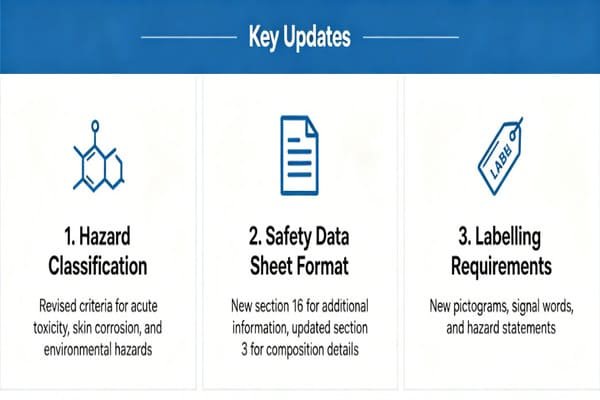
You must update your Safety Data Sheets (SDS) to include the new hazard classifications. This primarily means revising Section 2 (Hazards Identification), Section 11 (Toxicological Information), Section 12 (Ecological Information), and Section 15 (Regulatory Information) to reflect any new classifications that apply.
The goal of an SDS is to provide clear, comprehensive safety information. This update makes that information even more detailed. Here is a breakdown of the sections you'll need to focus on:
- Section 2: Hazards Identification: This is the most visible change. If your product falls into a new hazard class, you must state it here. For example, you might add "Endocrine disruptor for human health - Category 1." You will also add the new required hazard statements.
- Section 3: Composition/Information on Ingredients: If an ingredient in your mixture is classified under the new rules, you must list that classification here.
- Section 11 & 12: Toxicological and Ecological Information: These sections need to contain the data that justifies your classification. You can't just claim a product is an endocrine disruptor; you need to reference the scientific evidence. This is often the most challenging part of the update.
- Section 15: Regulatory Information: This section must be updated to confirm that the substance or mixture has been assessed according to the new CLP regulations.
Remember, this isn't just a copy-and-paste job. It requires a technical review of your product's properties.
What Labeling Updates Are Required by CLP 2026?
Are your current product labels now outdated? The thought of redesigning and reprinting labels for your entire product line can be a daunting one, but the new rules are very specific.
Your product labels must be updated with new EU Hazard (EUH) statements that correspond to the new hazard classes. For example, EUH380 for an Endocrine Disruptor (human health). While no new pictograms were added, these statements are mandatory and must appear on your product labels.
The label is the first piece of safety information a user sees, so getting it right is critical. The main change is the addition of several new EUH statements. These must be included on the label if your product is classified under one of the new hazard classes. While there are no brand-new GHS pictograms for these hazards, existing pictograms (like the health hazard or environmental hazard pictograms) may still be required depending on the classification. You also need to ensure the label continues to meet all other CLP requirements for language, font size, and placement.
Here are some of the key new statements:
- EUH380: May cause endocrine disruption in humans.
- EUH381: Suspected of causing endocrine disruption in humans.
- EUH430: May cause endocrine disruption in the environment.
- EUH441: Is persistent, bioaccumulative and toxic (PBT).
- EUH451: Is very persistent and very mobile (vPvM).
Who Exactly Needs to Comply with EU CLP 2026?
Do you think this new rule doesn't apply to your business? Assuming you are exempt is a costly mistake to make when your shipment is held at customs.
The EU CLP 2026 changes affect any company that manufactures, imports, or distributes chemical substances or mixtures into the European Union. This includes non-EU manufacturers, EU importers, private label owners, and anyone who places these products on the EU market.
This regulation has a very broad reach, covering nearly the entire supply chain. I once worked with a US-based e-commerce seller who assumed their supplier in China was handling all EU compliance. When their shipment arrived in Germany, it was held by customs because the SDS and labels were not updated. It was a painful lesson that the responsibility ultimately falls on the entity placing the product on the market.
Here’s who needs to take action:
- Manufacturers: Whether you are based inside or outside the EU, if you produce chemicals or mixtures destined for the EU, you are responsible for the initial classification.
- Importers: If you are the company in the EU bringing the goods in, you are legally responsible for ensuring they are fully compliant with CLP.
- Downstream Users: This includes distributors, wholesalers, and retailers. You must ensure the products you sell have the correct, updated labels and are accompanied by a compliant SDS.
- Private Label Companies: If you put your brand name on a product, you take on the legal responsibilities of the manufacturer, including CLP compliance.
What's a 5-Step Plan to Meet the CLP 2026 Deadlines?
Feeling overwhelmed by everything you need to do? It's easy to get lost in the regulatory details and not know where to begin. Here is a simple, 5-step action plan to guide you.
First, inventory all products you ship to the EU. Second, gather data to assess them against the new hazard criteria. Third, update all your SDS and labels. Fourth, train your team on the changes. Finally, communicate with your entire supply chain to ensure a smooth transition.
Breaking down the process into manageable steps makes compliance much less intimidating. Here is a practical plan you can start implementing today.
- Inventory Your Products: Create a complete list of every substance and mixture you sell in the EU. Don't forget to include products that you might not think of as "chemicals," like cleaners, coatings, or adhesives. Prioritize this list based on sales volume or potential risk to focus your efforts.
- Gather Data & Re-classify: This is the most technical step. You need to collect toxicological and ecological data for your products and their ingredients to assess them against the new criteria for ED, PBT, and PMT. This may require contacting your raw material suppliers or working with a regulatory consultant.
- Update SDS & Labels: Once you have re-classified your products, you must systematically update all your documentation. Use a template or software to ensure consistency. This is the time to check that all other label and SDS information is also current and correct.
- Train Your Team: Your compliance, logistics, and sales staff all need to understand these changes. They should know what the new hazard statements mean and how to answer questions from customers or authorities.
- Communicate with Your Supply Chain: Inform your distributors and customers about the upcoming changes. Provide them with the updated SDS in advance. A proactive approach prevents confusion and ensures that everyone is prepared for the transition.
Conclusion
The EU CLP 2026 update is a major but manageable change. By acting now—reviewing products, updating documents, and planning ahead—you can ensure your EU shipments remain compliant and avoid disruptions.
Discover the new hazard classes to understand how they impact your chemical products. ↩
Learn how to navigate compliance for successful entry into the EU market. ↩
Understanding EU CLP 2026 is crucial for compliance and avoiding penalties in chemical shipping. ↩
Learn the essential updates needed for SDS to ensure compliance with the new regulations. ↩
Understanding these risks is essential for compliance and protecting public health. ↩
Understanding these criteria is vital for accurate classification and compliance. ↩
Explore the significance of Endocrine Disruptors in chemical safety and regulation. ↩
Understanding PBT is vital for compliance and environmental safety in chemical shipping. ↩
Learn about vPvB substances to ensure your products meet the new safety standards. ↩
Understanding PMT is essential for compliance and protecting water sources from contamination. ↩