

Struggling with unpredictable shipping costs from China? New carbon charges are making freight bills confusing and expensive. Understanding them is key to protecting your budget.
The EU Emissions Trading System (EU ETS) adds a carbon surcharge to your freight rate. Carriers must buy allowances for their CO2 emissions on China-EU routes.1 They pass this cost to you, and it will increase as the regulation fully phases in by 2026.
I've been in logistics for over 20 years, and I've seen many new surcharges come and go. But the EU ETS is different. It's not just another fee; it's a fundamental change in how shipping costs are structured. Many of my clients are surprised when they see this new line item on their invoices. They thought they had a great rate, but the final cost was much higher. That’s why I want to break down what this means for your business. We need to look at how this will unfold, especially as we get closer to 2026, so you can plan ahead and avoid any costly surprises.
Why does EU ETS Matter for China–EU Shipping in 2026?
Ignoring new regulations seems easy, until they hit your bottom line. The EU ETS expansion in 2026 will significantly impact your shipping budget if you are not prepared.
In 2026, the EU ETS will require carriers to pay for 100% of their reported emissions on voyages between China and the EU. This is a big jump from the 40% covered in 20242, meaning the carbon surcharge on your freight will become much more significant.
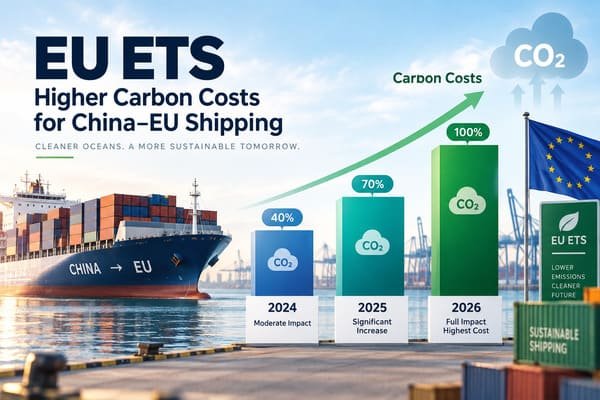
The EU ETS isn't being introduced all at once. It's a gradual process, which is why you need to pay attention now. In 2024, carriers only had to account for 40% of their emissions. In 2025, that number jumps to 70%. By 2026, it will be the full 100%. This steady increase means that the surcharge you see today is only a fraction of what it will be. Furthermore, from 2026, the regulation expands to include other greenhouse gases like methane (CH4) and nitrous oxide (N2O).3 These gases are even more potent than CO2, and their inclusion will add another layer of cost. For anyone importing goods from China to the EU, this isn't a temporary fee. It's a permanent and growing part of your shipping costs that must be factored into your pricing and financial planning.
| Year | Emission Coverage | Included Gases | Expected Impact on Surcharges |
|---|---|---|---|
| 2024 | 40% | CO2 | Moderate |
| 2025 | 70% | CO2 | Significant Increase |
| 2026 | 100% | CO2, CH4, N2O | Full Impact, Highest Cost |
How does EU ETS Add Costs to Your China–EU Freight Quote?
Is your latest freight quote much higher than you expected? Hidden EU ETS fees can inflate your final bill without a clear explanation, making it hard to see the real cost.
Carriers must buy carbon credits, called EU Allowances (EUAs), to cover their ships' emissions. They calculate the cost of these credits and pass it on to you as an "ETS Surcharge," usually priced per container (TEU) based on the route and current EUA market price.
The process is fairly direct. A shipping line calculates the total emissions for a specific voyage, for instance from Shanghai to Hamburg. Based on the regulation's phase-in rate (e.g., 70% in 2025), they determine the volume of emissions they must pay for. Then, they buy the corresponding number of EUAs from the open market, where prices change daily. This total cost is then divided among all the containers on the ship, and you see it as a surcharge on your bill. What I find interesting is how this creates a new competitive factor. A carrier with a fleet of new, fuel-efficient vessels will have lower emissions per container. This means they need to buy fewer EUAs and can offer a lower ETS surcharge. Suddenly, choosing a "greener" carrier isn't just about environmental responsibility; it's a smart financial decision that can directly lower your shipping costs.
Why can EU ETS Charges Change Between Shipments?
Did you notice your shipping cost from last month is different from today's quote? This constant change makes budgeting for your business feel like a guessing game.
The primary reason for the change is the fluctuating market price of EU Allowances (EUAs), which work like stocks. On top of that, carriers may use different vessels or routes for your shipments, each with a unique emissions profile, leading to different charges every time.
I always tell my clients to think of the EUA price like the price of gasoline—it changes daily based on supply, demand, and market sentiment. This is the biggest driver of volatility in your ETS surcharge. A carrier might quote you a price today, but if the EUA price spikes tomorrow, the final charge could be higher. This is why it is so important to ask how long a quote is valid. Beyond the market price, other factors contribute to the variability. The specific ship your container travels on makes a huge difference. An older, less efficient ship burns more fuel and creates more emissions4, resulting in a higher surcharge than a modern, eco-friendly vessel. Even a slight change in the shipping route to avoid bad weather or port congestion can alter the total fuel consumed and, therefore, the emissions. Because of these moving parts, carriers often update their ETS surcharge formulas on a quarterly or even monthly basis.
EU ETS vs. FuelEU Maritime: What should Shippers Know?
Just when you think you understand EU ETS, another regulation shows up. FuelEU Maritime is also coming, and it will add another layer of costs and complexity to your shipping.
EU ETS makes you pay for emissions through a direct surcharge. FuelEU Maritime, starting in 2025, forces ships to use cleaner fuels.5 If they don't comply, they face penalties, and those penalties will also be passed on to you as a separate fee.
It's easy to get these two regulations confused, but they tackle the emissions problem from different angles. Think of it this way: EU ETS is a "tax" on pollution, making it expensive to emit carbon. FuelEU Maritime is a "rule" that mandates a gradual shift to cleaner energy sources for ships. They work together. EU ETS creates a financial incentive to reduce emissions, while FuelEU Maritime dictates how that reduction should happen by targeting the fuel itself. For you, the shipper, this means you need to be prepared for two potential new surcharges on your invoice. One for the emissions your shipment produces (ETS) and another if the ship itself isn't using fuel that's clean enough to meet the new standards (FuelEU). It's not a choice between one or the other; both will impact your total freight costs in the coming years.
| Feature | EU ETS (Emissions Trading System) | FuelEU Maritime |
|---|---|---|
| Main Goal | To put a price on carbon pollution. | To promote the use of cleaner marine fuels. |
| How It Works | Carriers buy allowances for CO2 emitted. | Ships must meet targets for lower fuel emissions. |
| Cost to You | A direct surcharge on your invoice. | A penalty fee passed on if the ship fails to comply. |
| Start Date | 2024 | 2025 |
How can Importers Budget for EU ETS Shipping Costs?
Are you struggling to create a reliable budget for your imports? Unexpected shipping fees are likely eating into your profit margins with every container you move from China to Europe.
To budget accurately, always demand an all-in freight quote with a clear breakdown of the ETS surcharge. Partner with a transparent forwarder who can explain these costs and help you compare offers based on the total landed cost.
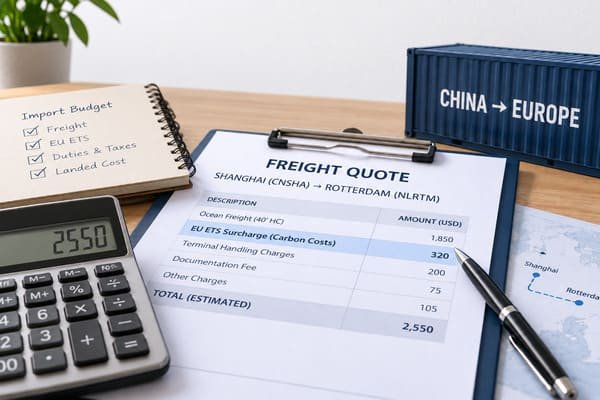
Taking control of your budget in this new environment is possible, but it requires a more proactive approach. First, never accept a quote that hides fees. Ask for the ETS surcharge to be a separate line item. This transparency is non-negotiable. Second, always ask your forwarder, "How long is this quote valid?" The ETS component can change quickly, so locking in a rate, even for a short period, provides certainty. Third, work with a partner who understands this landscape. At Deeplinker, we constantly track which carriers have the most efficient fleets because we know that translates to lower ETS costs for our clients. Fourth, get out of the habit of comparing base ocean freight rates. A low ocean rate is often a lure, with high surcharges added later. Always compare the "all-in" price. Finally, for your own long-term financial planning, I recommend adding a small buffer—maybe 5-10%—to your estimated shipping costs to absorb any sudden spikes in the carbon market. This isn't being pessimistic; it's being a smart business owner.
Conclusion
The EU ETS is changing the shipping industry. To manage your freight costs effectively, you must understand these charges, demand transparency from partners, and plan for this new reality.
FAQ
Is EU ETS a fixed carbon tax per container?
No. EU ETS is not a fixed carbon tax charged at the same rate for every container. The surcharge passed on to shippers can vary depending on factors such as the shipping line, trade route, vessel emissions, EUA prices, and the carrier's calculation method. Therefore, the EU ETS charge may change between different bookings.
Does EU ETS apply to shipments from China to Europe?
Yes. For voyages between a non-EU port and an EU port, such as Shanghai to Rotterdam, 50% of the voyage emissions are generally covered by the EU ETS. Voyages between two EU ports are subject to 100% coverage. This is why China–EU ocean freight quotations may include an EU ETS or emissions-related surcharge.
Why do different shipping lines charge different EU ETS surcharges?
Shipping lines calculate and pass on their EU ETS compliance costs differently. The final surcharge can be affected by vessel efficiency, fuel consumption, routing, EUA prices, and each carrier's pricing methodology. As a result, two carriers serving the same China–Europe trade lane may quote different emissions-related charges.
"FAQ – Maritime transport in EU Emissions Trading System (ETS)", https://climate.ec.europa.eu/areas-action/transport-decarbonisation/reducing-emissions-shipping-sector/faq-maritime-transport-eu-emissions-trading-system-ets_en. EU rules for maritime EU ETS require shipping companies to surrender allowances for verified emissions from voyages involving EU ports, including a share of emissions from voyages between EU and non-EU ports. Evidence role: general_support; source type: government. Supports: Carriers serving China–EU routes face allowance obligations for covered CO2 emissions under the maritime EU ETS.. Scope note: For extra-EU voyages such as China–EU, EU ETS generally covers 50% of voyage emissions rather than the entire voyage, so the support is contextual and may qualify the article’s wording. ↩
"Reducing emissions from the shipping sector - Climate Action", https://climate.ec.europa.eu/areas-action/transport-decarbonisation/reducing-emissions-shipping-sector_en. The European Commission states that the maritime ETS is phased in beginning with 40% of verified emissions for 2024, followed by higher percentages in later years. Evidence role: historical_context; source type: government. Supports: The maritime EU ETS covered 40% of verified emissions in 2024.. ↩
"Reducing emissions from the shipping sector - Climate Action", https://climate.ec.europa.eu/areas-action/transport-decarbonisation/reducing-emissions-shipping-sector_en. EU maritime emissions rules indicate that methane and nitrous oxide are added to the scope of monitored and covered greenhouse gases from 2026, extending the regime beyond carbon dioxide. Evidence role: historical_context; source type: government. Supports: From 2026, maritime emissions regulation expands to include methane and nitrous oxide in addition to CO2.. Scope note: The source supports the inclusion of additional gases, but the resulting cost impact depends on vessel technology, fuel type, and reported emissions. ↩
"Keys to Energy-Efficient Shipping", https://www.worldbank.org/en/topic/infrastructure/publication/energy-efficient-in-shipping. The International Maritime Organization and maritime energy-efficiency literature link ship fuel consumption to greenhouse-gas emissions, meaning lower fuel efficiency generally results in higher emissions for comparable transport work. Evidence role: mechanism; source type: institution. Supports: Less fuel-efficient ships generally consume more fuel and emit more greenhouse gases for a given transport task.. Scope note: Actual emissions also depend on speed, cargo load, fuel type, weather, and route, so vessel age alone is not a complete predictor. ↩
"Decarbonising maritime transport – FuelEU Maritime", https://transport.ec.europa.eu/transport-modes/maritime/decarbonising-maritime-transport-fueleu-maritime_en. European Commission information on FuelEU Maritime states that the regulation applies from 2025 and sets limits on the greenhouse-gas intensity of energy used on board ships, encouraging uptake of renewable and low-carbon fuels. Evidence role: historical_context; source type: government. Supports: FuelEU Maritime begins in 2025 and is designed to drive the use of lower-emission marine energy.. Scope note: The regulation sets GHG-intensity requirements rather than literally mandating a single specified fuel for all ships. ↩