
Dreading the 2026 peak season shipping chaos from China? Skyrocketing costs and delays threaten your profits. Here’s how you can navigate it smoothly and secure your inventory on time.
Successfully navigating the 2026 peak season from China to the US means planning backward from your delivery date. Book container space early, confirm all surcharges and cut-offs, and maintain flexible sailing options. This proactive approach ensures timely arrival and avoids unexpected costs, prioritizing reliability over just the lowest rate.
It's about more than just finding a container. The real challenge is orchestrating everything from production to final delivery. For companies I work with, the main goal is getting products to the US market for huge sales events like Black Friday and Christmas. Let's break down exactly what you need to know to win this peak season.
When Is the 2026 US Shipping Peak Season?
Unsure when the 2026 US shipping peak season starts? Guessing wrong means facing sold-out capacity and crazy prices. Here are the key dates you must know to plan ahead.
The 2026 US peak shipping season typically runs from August to October.1 This period sees a surge in demand as businesses stock up for major holidays like Black Friday, Cyber Monday, and Christmas.2 However, it's wise to expect an earlier start, possibly late June, due to market volatility.3

The traditional peak season is August to October, but I've seen it start creeping earlier every year. In my experience, smart shippers start feeling the pressure as early as late June. Why? It's all about planning for major retail events. You have the back-to-school rush in late summer, then Halloween, followed by the giants: Thanksgiving, Black Friday, and Christmas. To get products on shelves for these dates, they must leave China months in advance. You have to account for production time, ocean transit, customs clearance, and final delivery. This entire chain gets clogged. Thinking backward from the sale date is the only way to succeed. Here's a rough timeline to help you visualize it.
| Event | In-Store/Online Date | Recommended China Departure |
|---|---|---|
| Back-to-School | Mid-August | Late May - Early June |
| Halloween | October 31 | July |
| Black Friday | Late November | August - Early September |
| Christmas | December 25 | September |
This isn't just about booking a vessel; it's about making sure your entire supply chain is synchronized to hit these crucial deadlines.
What Peak Season Surcharges Should Shippers Expect?
Worried about surprise shipping fees destroying your budget? Hidden surcharges during peak season can wipe out your profits. Here’s a breakdown of the extra costs you need to anticipate.
Shippers should primarily expect the Peak Season Surcharge (PSS), a direct fee carriers add per container due to high demand. Also, be prepared for a General Rate Increase (GRI), which can be applied at any time. Other potential costs include congestion surcharges and equipment imbalance fees.

The most common surprise is the Peak Season Surcharge (PSS). Carriers implement this to manage the high demand, and it can add several hundred dollars per container. But that's not all. You also have the General Rate Increase (GRI), which carriers can announce with short notice. I've seen GRIs add $500 to $1000 per container overnight. Beyond these, port congestion can lead to a Port Congestion Surcharge. And when containers are in high demand in China but scarce in the US, you might see an Equipment Imbalance Surcharge. It’s crucial to ask your freight forwarder for a detailed, all-inclusive quote that clearly lists all potential surcharges. Don't just look at the base ocean freight rate; you need the full picture.
| Surcharge Type | What It Covers | When It Applies |
|---|---|---|
| Peak Season Surcharge (PSS) | High demand during peak season | August - October (or earlier) |
| General Rate Increase (GRI) | Overall market rate adjustments | Can be announced anytime |
| Congestion Surcharge | Delays at destination ports | When ports are overwhelmed |
| Equipment Imbalance Fee | Container shortages at origin | High export volume periods |
How Early Should You Book Containers from China?
Scared of missing your shipping window from China? Waiting too long means no container space or paying extreme rates. Here’s the ideal timeline for booking your peak season shipment.
For the 2026 peak season, you should book your container space at least 4 to 6 weeks in advance of your cargo-ready date. During the most intense periods, like August and September, booking 8 weeks ahead is even safer. This secures capacity and often locks in better rates.
Booking 4-6 weeks early isn't just a suggestion; it's a necessity. From my experience helping clients like David in Germany, the ones who succeed are those who plan backward. Start with your 'must-have-by' date in the US warehouse. Then subtract time for customs clearance (5-10 days), ocean transit (20-40 days), port dwell time, and ground transport in China. Suddenly, your 'cargo ready' date is much earlier than you think. Booking early does more than secure a spot on a vessel. It helps avoid getting your cargo 'rolled'—bumped to a later sailing because the ship is overbooked. It also gives your forwarder time to arrange trucking from the factory to the port, which also gets congested. Think of it like this:
- Delivery Date in US: December 1st
- Customs & US Trucking: Subtract 1-2 weeks
- Ocean Transit: Subtract 4-5 weeks
- Port Cut-off in China: This is your critical booking deadline, likely in early October.
This simple math shows why you need to be talking to your logistics partner in August for a December delivery.
The Hidden Peak-Season Costs: Demurrage, Detention & Storage?
Your shipment arrived, but now you face huge daily fees? Demurrage and detention costs can quickly exceed your freight budget. Here’s how to understand and avoid these charges.
Demurrage fees are charged for leaving a container at the port terminal beyond the allotted free time. Detention is charged for holding onto the carrier's container outside the terminal for too long.4 Storage fees apply if cargo remains at a warehouse or CFS past its free period.

These three fees are the silent killers of a logistics budget. I've seen clients get bills for thousands of dollars because of a simple delay. Demurrage happens when your container is stuck at the port—maybe due to a customs inspection or because your trucker is late. After a few free days, the port starts charging you daily. Detention is the opposite; it's when you've picked up the container but haven't returned the empty one on time. Storage is similar to demurrage but applies to cargo at a warehouse or Container Freight Station (CFS), especially for LCL shipments. The key to avoiding these is proactive coordination. Ensure your customs paperwork is flawless for quick clearance. Have your trucking arranged well before the vessel arrives. A good logistics partner like DeepLinker can help manage this entire process.
| Fee | Where it Occurs | Why it's Charged |
|---|---|---|
| Demurrage | Port Terminal | Full container not picked up in time |
| Detention | Outside Port | Empty container not returned in time |
| Storage | Warehouse/CFS | Cargo not moved out in time |
2026 Peak Season Shipping Checklist?
Overwhelmed by all the peak season shipping details? Missing one step can cause massive delays and costs. Use this simple checklist to ensure a smooth and successful shipment.
Your 2026 peak season checklist should include: confirming your required US delivery date, booking vessel space 6-8 weeks early, getting an all-in quote detailing all surcharges, preparing customs documents in advance, and arranging final-mile delivery before the vessel docks. This covers the most critical points.
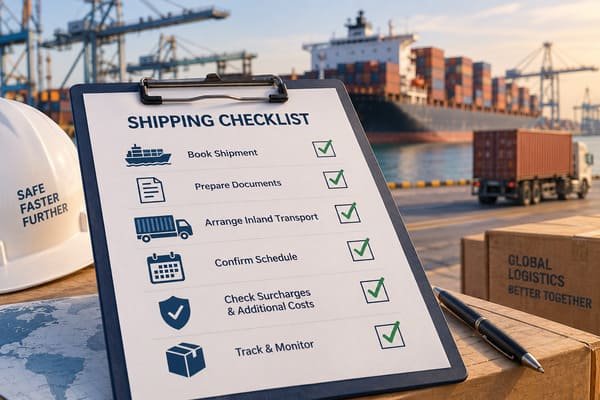
A well-planned shipment is your best defense against peak season chaos. I always walk my clients through a checklist to make sure nothing falls through the cracks. It’s not just about booking a ship; it’s about managing the entire door-to-door process. Here is a simple but effective checklist you can follow for your 2026 shipments.
Pre-Booking Phase (10-12 weeks out)
- [ ] Confirm final production-ready date with your supplier.
- [ ] Define your absolute latest delivery date at your US warehouse.
- [ ] Request all-in quotes from freight forwarders that itemize all potential surcharges.
Booking & Departure Phase (6-8 weeks out)
- [ ] Book your container and confirm the sailing schedule and transit time.
- [ ] Double-check vessel cut-off dates for cargo delivery to the port.
- [ ] Prepare and submit all shipping instructions (SI) and commercial documents accurately.
In-Transit & Arrival Phase
- [ ] Submit ISF (10+2) filing at least 24 hours before vessel departure from China.
- [ ] Arrange for customs clearance while the vessel is still at sea (pre-clearance).
- [ ] Book your trucker for port pickup to avoid demurrage.
FAQ
How early should I book a container from China during the 2026 US peak season?
There is no single booking window that works for every shipment. During peak periods, shippers should start planning before the cargo is fully ready and confirm space based on the origin port, destination, carrier, sailing schedule and cargo-ready date. Extra time should also be allowed for trucking delays, missed cut-offs or schedule changes.
What peak season surcharges can affect China–US shipping costs?
Depending on the carrier and service, shippers may encounter Peak Season Surcharges (PSS), rate adjustments, equipment-related charges and other temporary fees. After the cargo arrives in the US, seasonal demand surcharges from parcel carriers such as FedEx or UPS may also increase final delivery costs. Always compare the all-in logistics cost rather than ocean freight alone.
How can shippers reduce demurrage and detention risks during peak season?
Confirm container free time, customs documentation, port pickup arrangements and warehouse receiving capacity before the vessel arrives. During busy periods, port or warehouse congestion can make timely container pickup and return more difficult, so importers should leave additional operational buffer and coordinate closely with their freight forwarder, customs broker and warehouse.
Conclusion
In summary, winning the 2026 peak season is about proactive planning, not just chasing low rates. Early booking and clear communication ensure your cargo arrives on time and within budget.
"2025 Peak Season Shipping Came (and Left) Early: What SMB ...", https://www.freightos.com/freight-resources/2025-peak-season-smb-importers/. A neutral logistics or trade source documents that U.S. import shipping demand commonly rises in late summer and early autumn as retailers prepare for year-end sales, supporting August–October as a conventional peak-season window. Evidence role: general_support; source type: institution. Supports: The U.S. ocean import peak season from China typically falls around August through October.. Scope note: The source is likely to describe recurring seasonal patterns rather than prove the exact timing for 2026 specifically. ↩
"Monthly Retail Trade - Sales Report", https://www.census.gov/retail/sales.html. Retail and trade data show that U.S. retailers build inventory ahead of major late-year shopping events, providing contextual support for increased shipping demand before Black Friday, Cyber Monday, and Christmas. Evidence role: mechanism; source type: institution. Supports: Shipping demand rises because businesses import inventory ahead of Black Friday, Cyber Monday, and Christmas.. Scope note: Such sources support the demand driver but may not isolate China-to-U.S. container volumes specifically. ↩
"Drewry - Service Expertise - World Container Index - 10 Sep", https://www.drewry.co.uk/supply-chain-advisors/supply-chain-expertise/world-container-index-assessed-by-drewry. Industry and maritime-market analyses report that supply-chain disruptions, capacity constraints, or demand shifts can pull peak-season shipping activity forward, offering contextual support for an earlier start under volatile market conditions. Evidence role: general_support; source type: research. Supports: Market volatility can cause the peak shipping season to begin earlier than the traditional August–October period, potentially as early as late June.. Scope note: This would support the possibility of an early peak season but would not verify that 2026 will begin in late June. ↩
"FMC Publishes Final Rule on Detention and Demurrage ...", https://www.fmc.gov/articles/fmc-publishes-final-rule-on-detention-and-demurrage-billing-practices/. The U.S. Federal Maritime Commission distinguishes detention from demurrage by associating detention with the use of carrier equipment outside the terminal beyond free time, supporting the article’s definition. Evidence role: definition; source type: government. Supports: Detention fees are charged when carrier equipment is kept outside the terminal beyond the allowed free time.. ↩