
New EU battery rules are complex. Worried your battery shipments will be seized? Understanding compliance is your key to avoiding costly delays and securing your market access.
To export batteries to the EU, you must comply with Regulation (EU) 2023/1542. This involves creating a digital battery passport, declaring carbon footprints, and meeting recycled content targets1. Early preparation of these compliance documents is essential for smooth customs clearance and to avoid market bans.
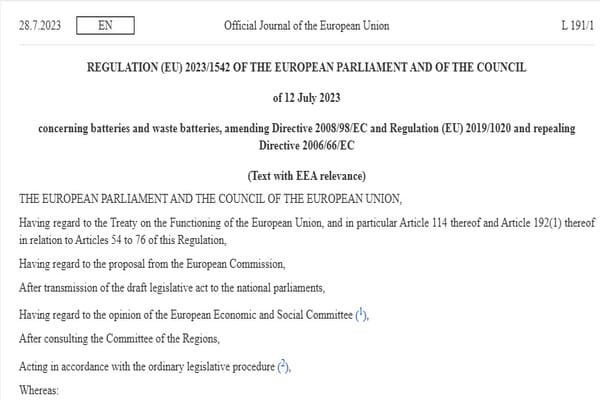
The European Union is tightening its grip on the battery market.2 This isn't just another small update; it's a complete overhaul called the EU Battery Regulation (EU) 2023/1542.3 I've been in logistics for over 10 years, and I've seen how new regulations can catch even the most experienced exporters off guard. A few years ago, a client almost lost a major contract due to a simple documentation error. These new battery rules are far more complex. They will change how you manufacture, document, and ship your products. We need to break down what this means for your business, step by step, so you can stay ahead of the curve and keep your supply chain moving.
How will the 2027-2031 rules for traceability and recycled materials affect your battery exports?
You're trying to plan your future production and sourcing. But the upcoming EU rules on recycled content seem confusing. Ignoring them could make your products unsellable in a few years.
Starting from 2027, you must provide a "digital battery passport"4 proving traceability. By 2031, your batteries must meet minimum recycled content targets5 for key materials like cobalt, lead, lithium, and nickel. This requires a transparent and verifiable supply chain from the very beginning.

These upcoming rules are not just suggestions; they are mandatory requirements for market access. The EU wants to create a circular economy for batteries, and that starts with knowing what's inside them and where it came from.6 For us in the logistics world, this means our job is shifting from just moving boxes to moving data-rich products.
Let's dive deeper into these requirements.
Traceability and Due Diligence
By August 2027, every industrial and EV battery over 2 kWh7 must have a Digital Battery Passport (DBP). This is a digital record linked to the battery via a QR code. It must contain information about the battery's origin, composition, and performance. This means you need to have a system in place to track raw materials from the mine to the factory. You'll need to prove you've followed due diligence policies to avoid sourcing materials linked to social or environmental risks.8
Recycled Content Mandates
The targets for recycled materials are aggressive and will be phased in. You need to plan for this now. Here's a simple breakdown of the minimum recycled content required by 2031:
| Material | Minimum Recycled Content (by 2031) |
|---|---|
| Cobalt | 16% |
| Lead | 85% |
| Lithium | 6% |
| Nickel | 6% |
Meeting these targets means redesigning your supply chain to include certified recycled materials. We are already helping clients connect with verified suppliers and set up documentation processes to prove compliance long before these deadlines hit.
What are the carbon footprint and traceability requirements for EU certification?
Your batteries are ready to ship. But you hear whispers about carbon footprint labels and QR codes. Not having them could mean your entire shipment gets rejected at the EU border.
For EU certification, you must declare the carbon footprint for each battery model. This data, along with extensive traceability information, must be accessible through a QR code linked to a Digital Battery Passport (DBP). This is mandatory for market access.

The idea of a "passport" for a battery might sound strange, but it's the new reality. Think of it as a visa for your product. Without this digital document, your batteries simply won't be allowed into the European market. It’s a huge shift, and we’re working closely with our clients to ensure they are prepared. The key is to see this not as a barrier, but as a new standard of quality and transparency.
Let's break down what this means in practice.
Carbon Footprint Declaration
Starting from February 2025 for EV batteries, and expanding to other types later, you must provide a detailed carbon footprint declaration.9 This isn't just a single number. It must cover the entire lifecycle of the battery, from mining raw materials to production, and even anticipate its recycling. The EU will eventually introduce performance classes10 (like an energy label on an appliance) based on this carbon footprint. Batteries with a high carbon footprint could face market restrictions. Your declaration will include:
- Administrative information about the manufacturer.
- Information about the battery model.
- Details about the geographic location of the manufacturing plant.
- The total carbon footprint of the battery.
- The carbon footprint broken down by life cycle stage.
The Digital Battery Passport (DBP) and QR Code
The QR code is your gateway to the DBP. It must be clearly visible and permanently marked on the battery. When scanned, it must provide instant access to public information, while granting secured access to more sensitive data for regulators and recyclers. This passport will contain everything from general information like manufacturer details and battery type, to performance and durability data, and eventually, real-time battery health information. We help our clients structure this data correctly, ensuring that when customs officials scan that QR code, everything is in perfect order.
How can you avoid cargo seizure by understanding penalties and using compliance logistics?
You've invested heavily in your battery products. The thought of an entire shipment being seized and banned from the EU market due to a documentation error is a nightmare.
Non-compliance with the EU Battery Regulation can lead to cargo seizure, heavy fines, and a complete ban from the market. Using a compliance-focused logistics partner who checks documents and manages the Digital Passport data before shipping is your best defense.
The penalties for getting this wrong are severe. Each EU member state will enforce the rules, and they won't be lenient. I've seen it happen with other regulations; a simple mistake can lead to months of delays and thousands in storage fees and fines. The risk is just too high to manage on your own. This is where a logistics partner becomes more than just a transporter; we become part of your compliance team. Our job is to make sure your batteries never face that risk.
Let's look at how we can protect your business.
Understanding the Penalties
The regulation is clear: non-compliant batteries will be barred from the market. This isn't a future problem; the framework is being built now. National authorities will have the power to conduct checks at any point in the supply chain. If they find a battery without a valid QR code, an incomplete Digital Battery Passport, or a false carbon footprint declaration, they can order an immediate sales stop and recall of all similar products. The financial and reputational damage could be immense.
The Power of Compliance Logistics
This is where we step in. We don't just pick up your cargo. We help you prepare it for its destination. Our process for battery shippers is built around proactive compliance.
| Your Task | How Deeplinker Helps |
|---|---|
| Gathering Raw Material Data | We provide checklists based on the regulations to ensure you collect the right information from your suppliers. |
| Creating the Digital Battery Passport | Our team helps sort and verify your data, ensuring it's structured correctly for the DBP system before shipment. |
| Document Verification | We perform a pre-shipment audit of all your compliance documents, catching errors before they become customs problems. |
| Customs Clearance | Our experienced brokers are experts in the new battery rules, ensuring a smooth process with EU authorities. |
We handle all types of batteries, from industrial and traction batteries to the lead-acid batteries that power many systems.11 By partnering with us, you are not just outsourcing your shipping; you are securing your access to the entire EU market.
Conclusion
Navigating the new EU battery rules is complex, but essential. Proactive compliance and expert logistics support are your best tools for uninterrupted market access and business growth.
EU Battery Passport Regulation Requirements — detailed breakdown of digital battery passport, carbon footprint, and recycled content rules — *Circularise*: https://www.circularise.com/blogs/eu-battery-passport-regulation-requirements/ ↩
European Union — the political and economic union of 27 member states that sets the battery regulation — *Wikipedia*: https://en.wikipedia.org/wiki/European_Union ↩
Regulation (EU) 2023/1542 concerning batteries and waste batteries — the full official legal text — *EUR-Lex, Official Journal of the European Union*: https://eur-lex.europa.eu/eli/reg/2023/1542/oj ↩
EU New Battery Regulation (EU) 2023/1542 — overview of the digital battery passport and traceability timeline — *TÜV Rheinland*: https://www.tuv.com/landingpage/en/eu-new-battery-regulation-eu-2023-1542/ ↩
EU Batteries Regulation 2023 — market intelligence on recycled content targets and compliance deadlines — *International Trade Administration (ITA), U.S. Department of Commerce*: https://www.trade.gov/market-intelligence/eu-batteries-regulation-2023 ↩
Circular economy — an economic model aimed at eliminating waste through continual reuse and recycling of resources — *Wikipedia*: https://en.wikipedia.org/wiki/Circular_economy ↩
EU New Battery Regulation — scope covering industrial and EV batteries above 2 kWh — *TÜV Rheinland*: https://www.tuv.com/landingpage/en/eu-new-battery-regulation-eu-2023-1542/ ↩
Due diligence — the investigation and risk-assessment process required to verify responsible sourcing of materials — *Wikipedia*: https://en.wikipedia.org/wiki/Due_diligence ↩
Carbon footprint — the total greenhouse gas emissions associated with a product across its life cycle — *Wikipedia*: https://en.wikipedia.org/wiki/Carbon_footprint ↩
EU New Battery Regulation — carbon footprint performance classes and labelling requirements — *TÜV Rheinland*: https://www.tuv.com/landingpage/en/eu-new-battery-regulation-eu-2023-1542/ ↩
Lead–acid battery — a rechargeable battery type widely used in vehicles and backup power systems — *Wikipedia*: https://en.wikipedia.org/wiki/Lead%E2%80%93acid_battery ↩