
Are your shipping invoices suddenly higher? A new charge, the EU ETS, is likely the cause, making your logistics budget feel unpredictable. Understanding it is key to managing costs.
The EU Emissions Trading System (ETS) is a carbon tax for shipping.1 For FCL, it's a clearer per-container fee; for LCL, costs can be more complex and sometimes higher.
I've been in logistics for over a decade, and I've seen many regulations come and go. But the EU ETS is a big one. It's changing the cost structure of shipping to Europe, and many of my clients are asking the same questions you are. They see this new fee and worry about their bottom line. It's not just another line item; it's a fundamental shift in how we account for the environmental impact of logistics. My goal here is to demystify this for you, just like I do for my clients every day. I want to give you the clarity you need to navigate this change confidently and keep your supply chain running smoothly and cost-effectively.
What Is EU ETS in Shipping? Key Facts for Importers?
You've heard about the EU ETS, but the details seem complicated. This confusion can lead to surprise charges and budget overruns, making you feel unprepared for shipping to Europe.
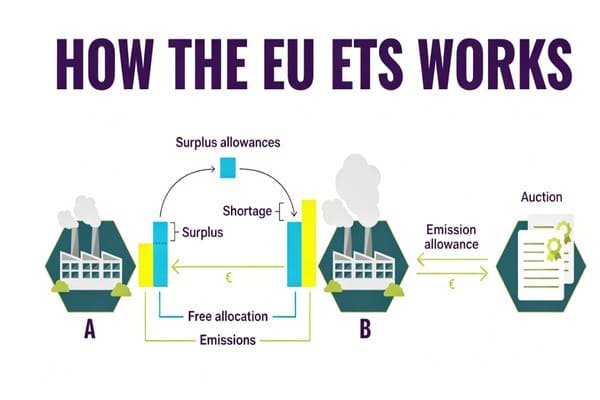
The EU ETS is a "cap and trade" system.2 It sets a limit on total greenhouse gas emissions. Shipping companies must buy "allowances" (EUAs) for every ton of CO2 they emit on voyages to, from, and within the EU.3 This cost is then passed on as a surcharge.4

Think of it like a carbon budget for the shipping industry. The EU has set a "cap," or a limit, on the total amount of carbon that can be emitted. To emit CO2, shipping lines must hold a matching number of permits, called EU Allowances (EUAs). They have to buy these EUAs from a central market, and the price fluctuates based on supply and demand.
The implementation is happening in phases, which is important to know for your budget planning:
- 2024: Carriers must pay for 40% of their reported emissions.
- 2025: This increases to 70% of their emissions.
- 2026: They will be responsible for 100% of their emissions.
The routes covered are also specific:
- 100% of emissions for voyages between two EU ports.
- 50% of emissions for voyages that start or end in the EU (e.g., from China to Germany).
This phased approach means the cost you see today will increase over the next two years. Understanding this timeline is the first step to accurately forecasting your future logistics expenses.
Why Your Shipping Costs Increased: How EU ETS Charges Are Applied?
You just received a freight invoice and saw a new, confusing ETS surcharge. You're not sure how it was calculated, leaving you to wonder if the charge is fair or inflated.
Carriers calculate the total emissions for a voyage, purchase the required number of EU Allowances (EUAs) to cover those emissions, and then divide this total cost among all the containers on the ship. This cost is passed directly to you as an ETS surcharge on your invoice.
The way this charge appears on your bill can be confusing because there isn't one single, industry-standard method5. Each shipping line has developed its own formula for passing this cost on. The core calculation starts with the ship's fuel consumption on a specific route, which is used to determine its total CO2 emissions. The carrier then buys EUAs on the open market to cover these emissions. The price of an EUA can change daily, just like a stock6, which adds a layer of volatility to the final cost.
Once the carrier has the total ETS cost for the voyage, they need to allocate it. Here's where it gets tricky:
- Per-TEU Surcharge: Many carriers apply a flat fee per Twenty-foot Equivalent Unit (TEU). A 40-foot container (2 TEU) would be charged double the TEU rate. This is the most common and transparent method.
- Percentage of Freight: Some might calculate the ETS fee as a percentage of the base ocean freight rate.
- Lumpsum Fee: Others might use a more complex algorithm based on vessel type, distance, and container type.
This variation is why you might get different ETS quotes from different carriers for the same route.
FCL vs LCL: Which Shipping Method Has Higher ETS Costs?
You have a shipment for Europe and need to choose between FCL and LCL. With the new ETS fee, you're worried that making the wrong choice could significantly inflate your shipping costs.
Generally, FCL (Full Container Load) offers a more straightforward and predictable ETS cost, calculated per container. LCL (Less than Container Load) costs can be more complex and sometimes proportionally higher, as the total container fee is split among multiple shippers based on cargo volume or weight.
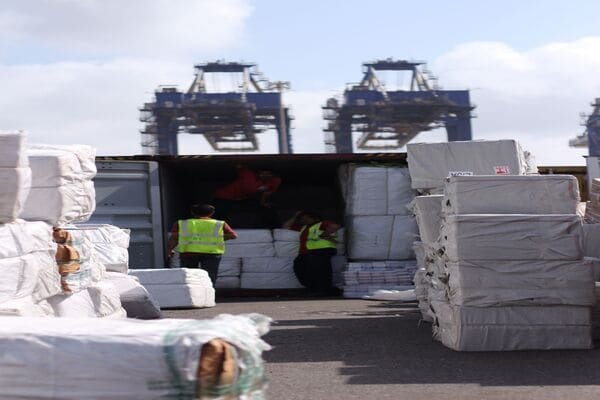
When you ship FCL, the ETS cost calculation is relatively simple. The carrier determines the ETS surcharge for your container (e.g., a flat rate per TEU), and that's the fee you pay. It's clean and predictable. If the ETS rate is €50 per TEU, your 20-foot container costs €50, and your 40-foot container costs €100. This transparency makes budgeting for FCL shipments easier.
LCL, however, is a different story. In an LCL shipment, your goods share container space with cargo from other shippers. The freight forwarder or consolidator pays the full ETS surcharge for the entire container to the shipping line. They then have to divide this total cost among all the individual shipments inside. This allocation is usually done based on the volume (per cubic meter, CBM) or weight of your cargo. The issue is that this allocation method can sometimes result in a higher cost per CBM than if you had shipped FCL. Consolidators may also add an administrative margin.
| Feature | FCL (Full Container Load) | LCL (Less than Container Load) |
|---|---|---|
| ETS Calculation | Flat fee per container (TEU). | Based on shipment volume (CBM) or weight. |
| Transparency | High. One clear charge. | Lower. Allocation method can vary. |
| Cost Predictability | High. Easy to budget. | Medium. Depends on consolidator's formula. |
| Potential Cost | More cost-effective for larger volumes. | Can be proportionally higher per unit. |
I recently worked with a client, who imports outdoor equipment. He was sending several smaller LCL shipments per month. When we analyzed his costs after ETS was introduced, we found that by consolidating his orders and shipping one 40-foot FCL every two months, he not only simplified his logistics but also significantly reduced his total ETS fees.
How to Reduce EU ETS Shipping Costs?
You want to lower your logistics expenses, but these new ETS fees feel like an unavoidable tax on your business, squeezing your profit margins on every shipment to Europe.
To reduce EU ETS costs, you can optimize cargo loads to favor FCL, choose carriers with modern and fuel-efficient fleets, plan shipments well in advance, and partner with a transparent freight forwarder who provides clear cost breakdowns and strategic advice.
While you can't avoid the ETS regulation, you can absolutely take steps to minimize its impact on your budget. It requires a more strategic approach to your shipping. As a logistics partner, this is where we provide the most value—by helping you navigate these options.
Here are the most effective strategies we use with our clients:
-
Consolidate and Optimize for FCL: As we saw with LCL, the per-unit ETS cost can be higher. If your shipment volumes are approaching the capacity of a full container, it's often cheaper to move to FCL. Plan your production and purchase order schedules to group shipments together. This is the single biggest lever you can pull to control ETS costs.
-
Carrier and Service Selection: Not all ships are created equal. Newer, more technologically advanced vessels are more fuel-efficient, which means they produce fewer emissions.7 Lower emissions translate directly to lower ETS charges. A knowledgeable forwarder has access to carrier data and can help you select services that use these "greener" ships.
-
Advance Planning: The logistics market always rewards planning. Booking your shipments well in advance gives you more options for carriers and routes. It helps you avoid peak season rushes when vessel space is tight and carriers can charge a premium, which would also apply to the ETS portion of the cost.
-
Work with a Transparent Partner: This is crucial. You need a freight forwarder who will give you a complete and honest breakdown of all charges, including the ETS fee. At Deeplinker, we show you exactly how the ETS cost is calculated so you can be confident you're not overpaying. We see our role as more than just moving boxes; we're here to provide the insights you need to make the smartest financial decisions for your supply chain.
Conclusion
The EU ETS is a permanent change in shipping. Understanding how it affects FCL and LCL costs and planning strategically with a transparent partner are essential for keeping your budget in check.
"European Union Emissions Trading System", https://en.wikipedia.org/wiki/European_Union_Emissions_Trading_System. The European Commission describes the EU ETS as a cap-and-trade system that now includes maritime transport emissions, requiring covered operators to surrender allowances for reported emissions; this supports the cost-imposition context but the instrument is legally an emissions trading scheme rather than a conventional tax. Evidence role: definition; source type: government. Supports: The EU ETS creates a carbon-cost obligation for shipping.. Scope note: Contextual support only: official EU sources generally do not define the ETS as a carbon tax. ↩
"Carbon emission trading - Wikipedia", https://en.wikipedia.org/wiki/Carbon_emission_trading. Official EU materials characterize the EU ETS as a cap-and-trade system in which a declining cap limits total emissions and allowances are traded among covered entities. Evidence role: definition; source type: government. Supports: The EU ETS operates as a cap-and-trade system.. ↩
"Reducing emissions from the shipping sector - EU Climate Action", https://climate.ec.europa.eu/areas-action/transport-decarbonisation/reducing-emissions-shipping-sector_en. EU maritime ETS guidance states that shipping companies must monitor emissions and surrender EU allowances for covered CO2 emissions from voyages within the EU and for a specified share of voyages entering or leaving the EU. Evidence role: mechanism; source type: government. Supports: Shipping companies must surrender EU allowances for covered maritime emissions on EU-related voyages.. Scope note: The source should be checked for current phase-in percentages and any covered greenhouse gases beyond CO2 in the relevant compliance year. ↩
"EU ETS in 2026: Why Shippers and Forwarders Can't Afford to Ignore ...", https://searoutes.com/en/blog/eu-ets-shipping-surcharges-impact. Analyses of maritime ETS implementation note that carriers commonly recover allowance costs through customer-facing ETS or emissions surcharges, supporting the commercial pass-through mechanism rather than proving the amount charged on any individual invoice. Evidence role: general_support; source type: institution. Supports: Allowance costs are commonly passed to shippers as ETS-related surcharges.. Scope note: Pass-through practices vary by carrier, contract, trade lane, and market conditions. ↩
"A competitive analysis for shipping companies - ADS", https://ui.adsabs.harvard.edu/abs/2025TRPE..20204338W/abstract. Maritime decarbonization and freight-market analyses report that shipping lines use differing ETS surcharge formulas and recovery mechanisms, supporting the absence of a single industry-wide surcharge methodology. Evidence role: general_support; source type: institution. Supports: Carriers do not all use one standardized method for calculating customer-facing ETS surcharges.. Scope note: Evidence is likely based on observed carrier practices and may change as contracts and regulatory compliance mature. ↩
"European Union Emissions Trading System - Wikipedia", https://en.wikipedia.org/wiki/European_Union_Emissions_Trading_System. Market data from official auction platforms or financial-market references show that EU allowance prices are traded and vary over time, supporting the statement that EUA costs are market-based and volatile. Evidence role: mechanism; source type: institution. Supports: EUA prices fluctuate in a traded market, contributing to variable ETS costs.. Scope note: A market-data source supports price variability but does not by itself explain how any carrier sets a surcharge. ↩
"[PDF] ENERGY EFFICIENCY DESIGN INDEX (EEDI) MARPOL ANNEX VI", https://upcommons.upc.edu/bitstreams/c5c528fe-54ad-4a6d-866b-98c217975827/download. IMO and academic literature on ship energy-efficiency measures explains that improved hull design, engines, operational efficiency, and energy-efficiency standards can reduce fuel consumption and associated CO2 emissions per transport work. Evidence role: mechanism; source type: institution. Supports: More fuel-efficient vessels generally emit less CO2 for comparable transport work.. Scope note: Efficiency gains depend on vessel type, speed, load factor, fuel, and operating conditions; a newer vessel is not automatically lower-emitting in every voyage context. ↩