

1. Introduction: The New Normal of Middle East Shipping Disruption
The Middle East has long served as a critical global shipping crossroads, connecting Asia, Europe, Africa, and the Gulf Cooperation Council (GCC) regional markets. Its maritime logistics system has historically relied on stable access to two vital waterways: the Strait of Hormuz and the Red Sea–Bab-el-Mandeb corridor. Geopolitical tensions have disrupted shipping and prompted changes to Middle East cargo transshipment in 2026, as documented in Maersk’s Strait of Hormuz operational updates.
Traditional logistics models, which feature large container vessels sailing directly into Persian Gulf inner ports for unloading and distribution, have become increasingly risky and unreliable. Carrier route adjustments, surging war risk insurance premiums, and intermittent channel blockages have forced shippers, forwarders, and logistics enterprises to adopt widespread cargo rerouting, port switching, and sea-to-land-bridge transportation transitions.
Cargo rerouting is no longer a temporary emergency measure but a long-term operational strategy for Middle East logistics. This article systematically analyzes current shipping patterns, differentiates core transshipment models, and summarizes essential pre-operation checks for port replacement and land-bridge conversion, helping logistics practitioners balance safety, cost, and timeliness amid persistent market volatility.
2. Core Shipping Landscape: Ports Inside vs Outside the Strait of Hormuz
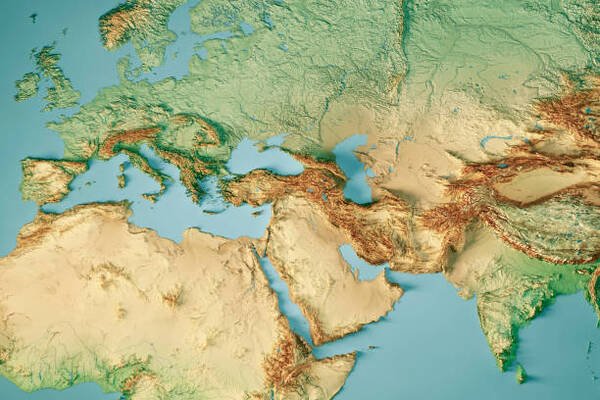
To understand modern Middle East cargo rerouting, it is useful to distinguish between ports inside the Persian Gulf and ports outside the Strait of Hormuz. These are practical route-planning categories rather than official port classifications. The core difference is whether the sea leg must pass through the strait, which affects route exposure, insurance arrangements, and schedule planning.
Persian Gulf inner ports refer to terminals located inside the Persian Gulf, including Jebel Ali and Khalifa Port in the UAE, Dammam Port in Saudi Arabia, Hamad Port in Qatar, and Umm Qasr Port in Iraq. These ports offer established terminal facilities, warehousing, and distribution connections to GCC markets, with Jebel Ali serving as a major regional hub. Vessels arriving from outside the Gulf must traverse the Strait of Hormuz to reach these ports, exposing shipments to disruptions affecting that passage.
Ports outside the Strait of Hormuz include Fujairah and Khorfakkan Container Terminal on the UAE’s Gulf of Oman coast, as well as the Port of Salalah on Oman’s Arabian Sea coast. Ocean vessels can reach these ports without entering the Persian Gulf. They offer alternative gateways, but berth capabilities, liner coverage, inland connections, and current operating conditions differ by terminal. Avoiding the strait does not eliminate wider regional security risks.
This distinction gives logistics planners a practical framework for diversifying gateways and comparing direct Gulf services with alternative maritime and inland connections.
3. Why Traditional Gulf Shipping Transshipment Models Face Pressure in 2026
For decades, a common Middle East logistics model combined long-haul ocean shipping, direct berthing at Gulf hubs, and regional feeder distribution. Large container vessels called at Persian Gulf ports to unload and redistribute cargo. This model can deliver low unit costs and efficient connections under stable conditions, but disruptions in 2026 have highlighted the need for alternatives.
First, Strait of Hormuz traffic remains subject to changing security conditions. Carrier suspensions, booking restrictions, and service resumptions must be checked by route and date. Shippers should confirm their carrier’s latest advisory rather than assume that all liner companies follow the same access rules or operating policy.
Second, insurance restrictions and risk-related costs can change quickly. For example, TT Club’s August 2026 war risk exclusions circular amended excluded areas for specified equipment covers. Hull, liability, cargo, and equipment policies have different terms, so shippers must confirm the relevant exclusions, endorsements, and premiums for their shipment.
Third, schedule reliability can deteriorate during disruptions. Carrier port omissions, temporary route changes, and interrupted strait access can affect cargo arrival dates, container availability, and supply chain planning for GCC importers and exporters.
These pressures make contingency gateways and land-bridge options increasingly valuable alongside traditional Gulf services.
4. Overview of Current Mainstream Rerouting Solutions
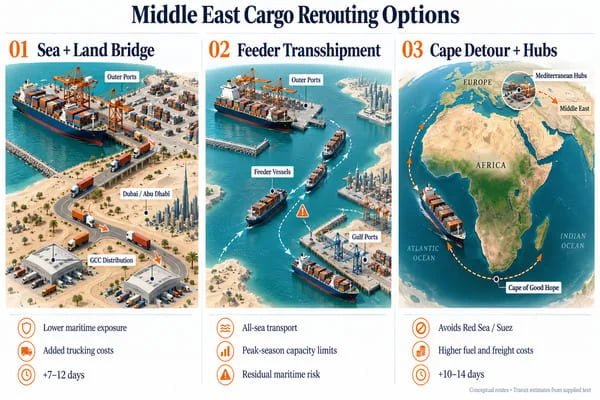
Faced with disruptions affecting the Strait of Hormuz and Red Sea, logistics planners can evaluate three broad rerouting approaches. Their availability, cost, and transit time depend on the origin, destination, carrier, and operating date.
The first solution is outer-port maritime shipping + bonded land-bridge transshipment. Cargo is discharged at an available gateway outside the Strait of Hormuz and moved inland through approved transit arrangements. DP World’s GCC overland network update describes bonded corridors linking UAE east coast gateways and Sohar to Jebel Ali. Onward distribution may use domestic or cross-border trucking, depending on the destination. This approach can avoid the strait on the ocean leg, but adds handling and inland transport costs; delivery time must be estimated for the specific corridor.
The second solution is maritime feeder transshipment via outer ports, where an operating service is available. After ocean vessels unload cargo at an alternative hub, feeder ships undertake secondary distribution. This can reduce land transportation requirements. However, a feeder sailing from outside the Gulf to an inner Gulf port must still pass through the Strait of Hormuz. Smaller vessel size does not remove that exposure, and space, insurance, and service availability require confirmation.
The third solution is Cape of Good Hope rerouting for affected long-haul services. Vessels on suitable trade lanes can bypass the Red Sea and Suez Canal by sailing around southern Africa. UNCTAD’s analysis of the Red Sea crisis explains how this diversion lengthens voyages and affects port operations. Mediterranean transshipment may form part of some carrier networks, but is not a universal step for Middle East cargo. Cape routing also does not by itself solve access to ports inside the Strait of Hormuz. Additional sailing time and fuel costs depend on the complete itinerary.
5. Essential Checks Before Switching Middle East Transshipment Ports
Port switching is the core step of Middle East cargo rerouting, and blind port replacement may lead to hidden risks such as cargo delays, cost overruns, and terminal congestion. Before adjusting transshipment ports, logistics practitioners must verify the following key indicators.
First, confirm carrier call frequency and space stability. Not all alternative ports have the same long-haul liner coverage. Verify the current service rotation, next available sailing, booking acceptance, and onward connection before changing the discharge port. A port’s physical capability does not guarantee space on the required route.
Second, evaluate terminal operation efficiency and congestion risks. Diverted cargo can increase pressure on yards, truck gates, and container handling. Request current vessel waiting times, cargo availability estimates, and gate appointment information from the terminal or carrier, and allow for potential dwell time.
Third, verify regional supporting transshipment capacity. Port switching is not isolated; it must match subsequent land-bridge trucking or sub-feeder maritime capacity. When choosing outer ports, confirm whether local bonded transit systems are complete and whether cross-border trucking resources can support continuous cargo delivery to GCC inland markets.
Fourth, distinguish risk levels and insurance coverage. Different ports and transport legs can fall under different policy conditions. Do not assume that a port outside the strait automatically offers lower premiums or broader coverage. Confirm the full itinerary, including storage and trucking, with the insurer before booking.
6. Critical Factors When Switching from Sea Freight to Land-Bridge Trucking
The shift from pure sea freight to sea-land combined transportation is an important operational consideration in Middle East cargo transshipment. Unlike a fully maritime routing, a land bridge involves additional handovers, road transportation, and, for some corridors, cross-border customs transit. These steps require careful pre-operation checks.
First, confirm bonded transit compliance rules. Bonded transit does not mean the shipment is exempt from customs procedures. Dubai Customs’ published transit policy describes declarations, guarantees, and customs controls for goods in transit. Confirm the current corridor-specific requirements with the relevant customs authority or broker. Where applicable, the TIR customs transit system can facilitate cross-border movements under a guarantee framework, but eligibility must be checked for the route and operator.
Second, control comprehensive cost premiums. Land-bridge transshipment can incur trucking fees, border charges, additional handling, storage, and container repositioning costs. Obtain a written, itemized quotation for the specified 40HQ movement, including free time and empty-return terms. A single region-wide surcharge range is not a reliable basis for budgeting.
Third, assess road transportation capacity and delivery time. Cross-border trucking may face capacity shortages, inspections, and border delays. Compare complete door-to-door schedules for the available sea and land-bridge options, allowing for terminal dwell time and customs processing. Land-bridge transit is not uniformly slower: the result depends on the ports, destinations, and alternatives being compared.
Fourth, clarify special restrictions for dangerous goods. Dangerous goods, chemicals, and energy storage equipment may require additional approvals and specialized trucking. Booking acceptance can differ by cargo type, port, and final destination, as illustrated by Maersk’s Middle East Operational Update 44, dated 31 August 2026. Obtain current written acceptance for every transport leg before moving the cargo.
7. Cost, Insurance and Risk Trade-Offs of Rerouting Strategies
Each Middle East cargo rerouting solution has obvious trade-offs in cost, insurance, and risk, and there is no one-size-fits-all optimal strategy. Logistics practitioners need to make comprehensive decisions based on cargo attributes, delivery deadlines, and budget limits.
In terms of safety and risk, Cape routing can avoid the Red Sea, while an outer-port land bridge can avoid a maritime transit of Hormuz. Neither is risk-free. Assess the full itinerary, including port security, road conditions, cargo handling, and any remaining maritime chokepoints.
In terms of insurance costs, premiums and coverage depend on the cargo, vessel, geographical limits, inland legs, and policy wording. Compare actual quotations and endorsements rather than assigning a fixed insurance ranking to each route type.
In terms of timeliness efficiency, direct Gulf shipping may offer efficient delivery when services operate normally. A land bridge can improve or worsen delivery time depending on sailing frequency and inland conditions. Cape rerouting generally extends affected voyages, but the end-to-end comparison must use confirmed carrier schedules.
In terms of comprehensive economy, compare the total delivered cost, including freight, insurance, handling, trucking, storage, and the business cost of delay. The best balance will differ by shipment; an outer-port land bridge is a valuable option rather than a universal default.
8. Practical Guidelines for Stable Cargo Transportation Arrangement
Based on the current Middle East shipping pattern and rerouting characteristics, the following practical operation guidelines can help shippers and forwarders achieve stable and controllable cargo transportation arrangements.
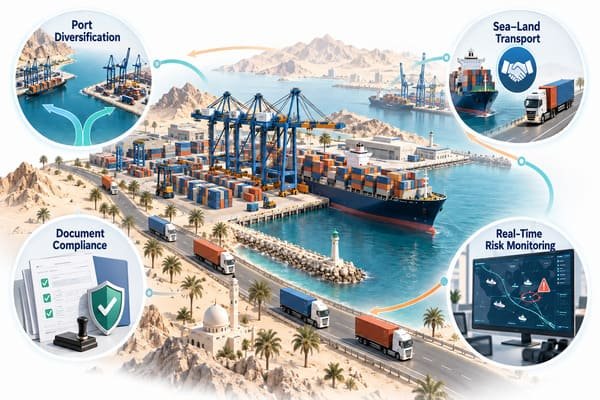
First, adopt a diversified port layout strategy. Avoid relying solely on traditional inner ports or a single outer port. Match mainstream outer ports such as Fujairah and Salalah as alternative transshipment hubs to respond flexibly to sudden route adjustments and port congestion.
Second, lock in long-term multi-modal transportation resources. For enterprises with stable Middle East shipping demands, sign long-term cooperation agreements with land-bridge trucking companies and feeder carriers to avoid space and capacity shortages in peak seasons.
Third, optimize document and compliance management. Sort out standardized document templates for outer-port unloading and bonded land-bridge transit in advance to improve customs and transit efficiency and reduce cargo detention risks caused by document errors.
Fourth, establish a real-time risk monitoring mechanism. Monitor UKMTO maritime security warnings and advisories, carrier notices, and terminal operating updates. Security alerts provide situational information; confirm the practical effect on bookings, port calls, and inland delivery with the service provider before changing the routing.
9. Conclusion: Build a Diversified and Resilient Middle East Supply Chain
Disruption in the Middle East has highlighted the vulnerability of relying on a single channel or transshipment hub. Direct Gulf shipping remains an important part of regional logistics, while alternative gateways and bonded land-bridge transportation provide additional options when established routes are constrained.
Middle East cargo rerouting is both a response to current disruption and a component of longer-term contingency planning. Logistics practitioners should balance safety, compliance, cost, and timeliness instead of relying on a single measure such as the lowest freight rate.
By rationally selecting transshipment ports, flexibly switching sea-land combined transportation modes, and establishing a diversified risk response mechanism, enterprises can effectively build resilient Middle East supply chains and maintain stable cargo circulation amid persistent geopolitical uncertainties.
10. FAQ: Common Questions About Middle East Cargo Rerouting
Q1: What is the main advantage of outer-port land-bridge transshipment compared with traditional inner-port shipping?
The core advantage is avoiding the high geopolitical risk of the Strait of Hormuz. Outer ports do not require vessels to enter the Persian Gulf, effectively reducing war risk premiums and navigation uncertainties, with far higher overall transportation stability than traditional inner-port routes.
Q2: How much extra cost and time will land-bridge trucking bring?
On average, each 40HQ container increases by $300–$500 in comprehensive costs, and the overall transit time increases by 7–12 days. The specific increment fluctuates with peak trucking capacity and terminal operation efficiency.
Q3: Are there any restrictions on cargo types for land-bridge transshipment?
Yes. High-risk dangerous goods, special chemical products, and oversized cargoes are subject to strict road transportation supervision and partial access restrictions. It is necessary to confirm local transportation rules in advance before arranging shipments.
Q4: Which rerouting scheme is most suitable for high-value and time-sensitive cargo?
The outer-port + land-bridge solution is the best choice. It balances safety and timeliness, avoiding extreme risks of inner-port routes and excessive time loss of Cape rerouting, ensuring stable and efficient delivery of high-value cargo.
Q5: Will the traditional inner-port direct shipping model recover in the future?
It is difficult to fully return to the pre-disruption pattern. Even if regional geopolitics ease, the industry will retain a diversified transshipment system dominated by outer ports and land bridges to avoid supply chain risks caused by over-reliance on single waterways and hubs.