
Your shipments to the Gulf are stuck in a high-risk zone. Unpredictable delays and soaring costs are hurting your business. MSC's new route offers a safer, more stable alternative.
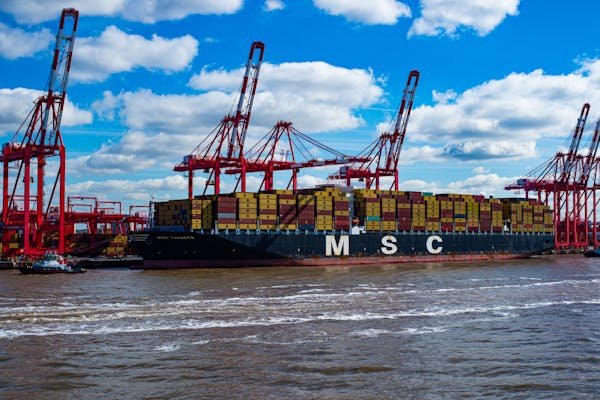
This new service, which launched May 10, uses a sea-land-sea model. Cargo travels by sea to Saudi Arabia's King Abdullah Port, crosses the country by land, and then continues from Dammam Port. It completely bypasses the risky Strait of Hormuz, offering a reliable new corridor.
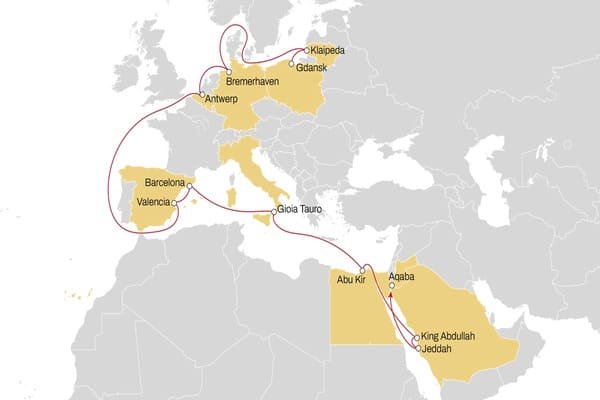
This isn't just a minor update from a shipping line. I see it as a fundamental shift in how we approach Middle East logistics. For years, we've all been too reliant on the Strait of Hormuz, and recent events have shown us just how fragile that reliance is. This new route is more than a backup plan; it's a strategic move that offers stability in a volatile world. For anyone shipping to the Gulf, understanding the details of this change is no longer optional—it's essential for survival and growth.
Why Has Bypassing the Strait of Hormuz Become a Must?
Shipping through the Strait of Hormuz feels like a gamble right now. Your cargo could be seized or delayed, costing you money and damaging your reputation with customers.
The Strait of Hormuz has become a high-risk zone due to severe geopolitical tensions.1 This leads to vessel seizures, sudden attacks, and skyrocketing war risk insurance premiums2. Bypassing it is now essential for maintaining a predictable, secure, and cost-effective supply chain to the Gulf.
I've been in this business for over 20 years, and I've seen chokepoints become problematic before, but the situation in Hormuz is on another level. It's not just about potential delays anymore; it's about fundamental safety and financial viability. For our clients, like brand owners in Germany or e-commerce sellers in the US, predictability is everything. This is why a change is not just needed, it's overdue.
The Geopolitical Powder Keg
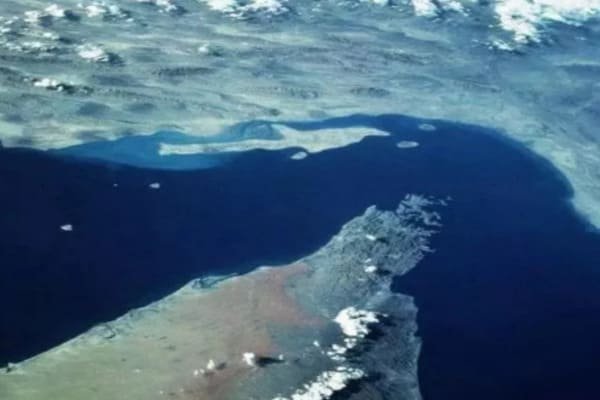
The Strait of Hormuz is a narrow waterway3, and any instability in the region directly impacts the ships passing through it. We've seen an increase in incidents where commercial vessels are detained or attacked. This isn't a theoretical risk. It's happening now, and it creates a level of uncertainty that supply chains simply cannot handle. A shipment delayed by a week can mean a missed retail deadline, but a shipment seized indefinitely can cripple a small business. The political situation is complex, but the business impact is simple: it's too risky.
The Soaring Costs of Risk
When risk goes up, so do costs. The most direct impact has been on insurance. War risk premiums for passing through Hormuz have gone through the roof. This isn't a small surcharge; it's a significant cost that gets passed down the line, ultimately making products more expensive for the end consumer. But the costs don't stop there. Here's a simple breakdown:
| Cost Factor | Traditional Hormuz Route | Impact of Instability |
|---|---|---|
| Insurance Premium | Standard | War Risk Surcharge (Soaring) |
| Transit Time | Predictable (Historically) | Highly Unpredictable (Delays) |
| Operational Security | Low | High (Risk of Seizure/Attack) |
| Crew Safety | High | Low |
The Ripple Effect on Supply Chains
These risks and costs create a massive ripple effect. I remember a client, a procurement manager for a large retail chain, who had a container full of seasonal goods stuck due to tensions in the strait. The delay meant they missed the peak selling season, and the goods had to be sold at a deep discount. It was a huge financial loss and a blow to their customer relationships. This is the reality businesses face. An unreliable shipping lane means unreliable inventory, which leads to lost sales and broken trust. That’s why bypassing Hormuz is now a business necessity.
What is MSC's New Route Layout with the Red Sea + Saudi Land Bridge?
You know you need an alternative to Hormuz, but what exactly is it? A new, untested route could bring its own set of problems. MSC's new layout offers a clear, structured solution.
This innovative route uses a multi-modal system. Ships from Europe and Asia dock at King Abdullah Port on the Red Sea. Containers are then trucked across Saudi Arabia to Dammam Port on the Gulf coast, completely avoiding the Strait of Hormuz for the main leg of the journey.
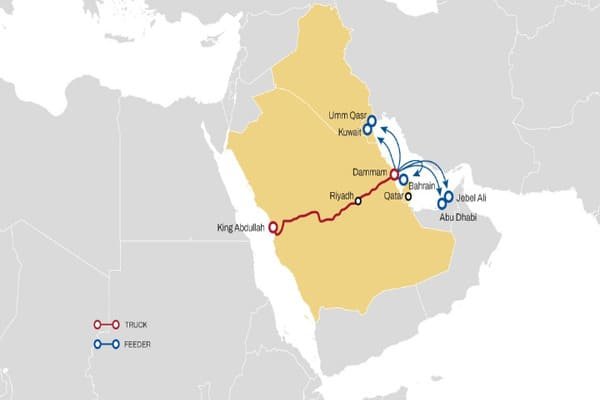
At Deeplinker, we specialize in complex logistics, so this kind of multi-modal solution is right up our alley. Combining sea and land transport isn't new, but applying it on this scale to bypass a major global chokepoint is a game-changer. It requires precise coordination, robust infrastructure, and deep local knowledge—all things we've built our reputation on. This route isn't just a line on a map; it's a carefully engineered solution to a critical problem.
Step 1: Sea Leg to the Red Sea
The journey begins with a standard ocean voyage from major ports in Europe, the Americas, or Asia. However, instead of heading towards the Strait of Hormuz, the vessel docks at King Abdullah Port (KAP) in Saudi Arabia. KAP is a modern, efficient port strategically located on the Red Sea coast.4 Its world-class infrastructure is designed to handle massive volumes of cargo quickly, which is critical for making the first step of this multi-modal journey seamless and avoiding bottlenecks at the port.
Step 2: The Saudi Land Bridge
This is the core of the new solution. Once unloaded at KAP, containers are loaded onto trucks for a journey of approximately 1,300 kilometers across Saudi Arabia to Dammam Port5. The Kingdom has invested heavily in its road and rail infrastructure as part of its Vision 2030 plan6. This means the cargo travels on modern, well-maintained highways, ensuring a smooth and relatively fast transit. This land bridge provides a secure, controlled corridor that is completely insulated from the maritime risks present in the Strait of Hormuz.
Step 3: Final Sea Leg from Dammam
After arriving at Dammam Port, another major hub on the Persian Gulf, the containers are loaded onto smaller feeder vessels for the final, short sea leg to their ultimate destinations, such as Jebel Ali (UAE), Hamad Port (Qatar), or other ports in the region. Because this final leg is within the relative safety of the inner Gulf, the exposure to the risks associated with the Strait of Hormuz is eliminated. This three-step process creates a robust and resilient alternative.
How Does MSC's New Route Compare to Traditional Shipping in Time & Cost?
A new route sounds good, but is it affordable and fast? High costs or long delays could make it just as bad as the old route. Let's break down the real-world comparison.
The new route offers a balanced solution. It is significantly faster than detouring around the Cape of Good Hope and infinitely safer than passing through Hormuz. While land transit has its own cost, it avoids the massive war risk insurance premiums, making the total cost highly competitive.

When I talk to clients, the conversation always comes down to two things: time and money. They need to know the total landed cost and the estimated time of arrival. For years, the Hormuz route was the clear winner on both fronts. But the game has changed. Now, the "cheapest" or "fastest" route on paper is often the most expensive or slowest in reality due to unforeseen events. This new land bridge route redefines value by prioritizing predictability.
Head-to-Head Comparison: Three Key Routes
To make an informed decision, you have to look at all the options. Right now, a shipper has three main choices for getting goods from Europe to a port like Jebel Ali. Each has its own profile of risk, time, and cost.
| Feature | Hormuz Strait Route | Cape of Good Hope Detour | MSC's New Land Bridge Route |
|---|---|---|---|
| Safety Risk | Extremely High (Current) | Very Low | Very Low |
| Transit Time | Fastest (Theoretically) | Slowest (+15-20 days) | Moderate (Faster than C.G.H) |
| Insurance Cost | Very High (War Risk Premium) | Standard | Standard (No War Risk) |
| Operational Cost | Sea Freight + Surcharges | High Fuel & Charter Costs | Sea Freight + Land Transit |
| Predictability | Extremely Low | High | Very High |
Analyzing the Trade-offs
Looking at this table, the choice becomes clearer. The Hormuz route is a high-risk gamble. The Cape of Good Hope detour is safe but adds weeks to the transit time7, which is unacceptable for most modern supply chains. The MSC Land Bridge route sits in the sweet spot. Yes, there is an added cost for the trucking leg, but you save a fortune on war risk insurance. More importantly, you gain predictability. You can give your customers a reliable delivery date. For a business owner like David in Germany, knowing his products will arrive on time is often more valuable than saving a few hundred dollars on a container. This route transforms the shipping calculation from a cost-only decision to a value and risk management decision.
Why Should We Embrace This New Gulf Logistics Layout Beyond Just Avoiding Risk?
You might see this new route as just a temporary fix for the Hormuz problem. But thinking that way means you could miss the long-term strategic advantage this shift offers your business.
This is not just a backup plan; it's the beginning of a strategic evolution in logistics. It creates a more resilient, multi-faceted supply chain for the Middle East, reducing our collective dependence on a single, vulnerable chokepoint and opening up new opportunities.
I've learned that in logistics, the biggest risks often come from a lack of imagination and an unwillingness to adapt. We get comfortable with established routes and processes. But major disruptions, like the one we're seeing in Hormuz, force us to innovate. Those who see this as a temporary problem to be waited out will be left behind. Those who see it as an opportunity to build a better, stronger supply chain will be the winners in the long run.
Building Supply Chain Resilience
The last few years have taught us a hard lesson about the importance of resilience. A supply chain with a single point of failure is a fragile one. The Strait of Hormuz has long been that single point of failure for the Gulf.8 This new land bridge creates a vital second artery. It diversifies risk and ensures that if one route is compromised, goods can still flow. For businesses, this means greater stability and the ability to continue operations even when geopolitical events disrupt traditional sea lanes. It's about moving from a reactive to a proactive supply chain strategy.
The Rise of New Logistics Hubs
This route does more than just move containers; it re-draws the logistics map of the Middle East. It elevates the status of King Abdullah Port and Dammam Port, turning them into critical gateways. More importantly, it establishes Saudi Arabia as a key land-based transit hub, connecting the Red Sea with the Gulf. This will spur further investment in warehousing, distribution centers, and logistics infrastructure within the Kingdom. For our clients, this could open up new, more efficient ways to distribute products throughout the entire Gulf region, not just a single port.
A Competitive Advantage for Early Adopters
In any major market shift, there are those who lead and those who follow. From my experience at Deeplinker, the clients who embrace these changes early are the ones who gain a significant competitive edge. While your competitors are still grappling with the delays, high insurance costs, and uncertainty of the Hormuz route, you can offer your customers something they desperately need: reliability. By adopting this new route now, you can secure capacity, stabilize your costs, and build a reputation as a dependable supplier in the Middle East market.
Conclusion
The Strait of Hormuz is no longer a reliable route. MSC's sea-land bridge is a smart, stable, and competitive alternative that redefines Gulf logistics. Embracing this change is essential for success.
"2026-001A-Strait of Hormuz, Persian Gulf, Gulf of Oman, and ...", https://www.maritime.dot.gov/msci/2026-001a-strait-hormuz-persian-gulf-gulf-oman-and-arabian-sea-military-operations-and. The source summarizes recent security and geopolitical risks affecting maritime traffic around the Strait of Hormuz, including tensions involving Gulf states and Iran. Evidence role: expert_consensus; source type: institution. Supports: The Strait of Hormuz is currently considered a high-risk maritime area because of geopolitical tensions.. Scope note: Risk levels fluctuate over time, so the source should be recent and should not be treated as a permanent assessment. ↩
"Strait of Hormuz reopening won't mean cheaper shipping as ...", https://www.khaleejtimes.com/world/strait-hormuz-reopening-shipping-costs-insurance-premiums. The source reports that war-risk insurance costs for vessels transiting the Gulf or Strait of Hormuz have risen during periods of heightened regional tension. Evidence role: statistic; source type: other. Supports: War-risk insurance premiums for Hormuz-related shipping have increased sharply during heightened tensions.. Scope note: Insurance rates vary by vessel, voyage, underwriter, and date, so the source may support a trend rather than a universal premium level. ↩
"Strait of Hormuz - Wikipedia", https://en.wikipedia.org/wiki/Strait_of_Hormuz. The source identifies the Strait of Hormuz as a narrow passage between the Persian Gulf and the Gulf of Oman and gives its approximate width or navigational constraints. Evidence role: definition; source type: encyclopedia. Supports: The Strait of Hormuz is a narrow maritime waterway.. Scope note: Geographic facts explain the chokepoint character but do not independently establish current security risk. ↩
"Logistics performance index: Overall (1=low to 5=high) - Saudi Arabia", https://data.worldbank.org/indicator/LP.LPI.OVRL.XQ?locations=SA. The source describes King Abdullah Port’s location on Saudi Arabia’s Red Sea coast and provides contextual information about its container-handling infrastructure. Evidence role: general_support; source type: institution. Supports: King Abdullah Port is a major Red Sea port with substantial container-handling infrastructure.. Scope note: Statements such as “modern” and “efficient” are partly evaluative; neutral sources can support infrastructure scale and location more directly than performance quality. ↩
"King Abdullah Economic City - Wikipedia", https://en.wikipedia.org/wiki/King_Abdullah_Economic_City. The source provides the approximate road distance between King Abdullah Port or King Abdullah Economic City and Dammam, supporting the stated scale of the overland leg. Evidence role: statistic; source type: other. Supports: The overland leg from King Abdullah Port to Dammam Port is about 1,300 kilometers.. Scope note: The exact distance may vary by route, road restrictions, and whether the measurement is from port gate to port gate or city center to city center. ↩
"Transportation and Logistics Trade Mission to Saudi Arabia", https://www.trade.gov/transportation-and-logistics-trade-mission-saudi-arabia. The source explains that Saudi Vision 2030 includes substantial transport and logistics infrastructure development, including road, rail, and logistics-network investment. Evidence role: historical_context; source type: government. Supports: Saudi Arabia has made major transport infrastructure investment part of its Vision 2030 logistics strategy.. Scope note: This supports the national policy context and investment direction, not the condition of every road segment used by the route. ↩
"Cape of Good Hope Rerouting: What It Means for Your Transit Times ...", https://air7seas.com/blog/cape-of-good-hope-rerouting-what-it-means-for-your-transit-times-and-costs. The source estimates that rerouting Asia-Europe or Gulf-related shipping around the Cape of Good Hope adds significant voyage time compared with Red Sea or Suez-area routes. Evidence role: statistic; source type: institution. Supports: Cape of Good Hope rerouting can add weeks to shipping transit times.. Scope note: Added transit time depends on origin, destination, vessel speed, port rotation, and congestion, so evidence may support an approximate range rather than one fixed duration. ↩
"The Strait of Hormuz is the world's most important oil transit chokepoint", https://www.eia.gov/todayinenergy/detail.php?id=61002. The source explains the Strait of Hormuz’s role as a strategic maritime chokepoint for Gulf trade and energy flows, supporting its characterization as a critical dependency. Evidence role: expert_consensus; source type: government. Supports: The Strait of Hormuz is a critical chokepoint for Gulf maritime flows and a major dependency for regional logistics.. Scope note: The phrase “single point of failure” is an analytical framing; sources can substantiate the chokepoint’s strategic importance rather than prove the business metaphor directly. ↩