
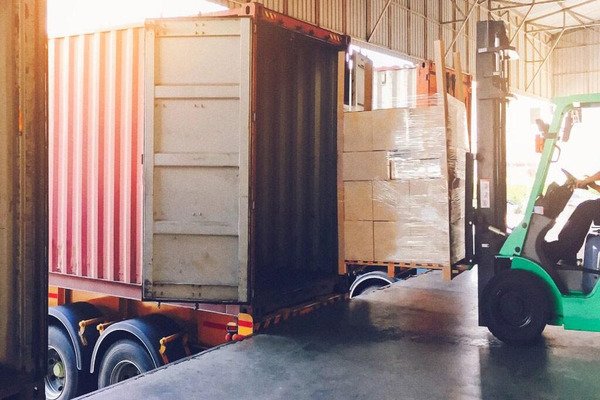
Loading a shipping container is not simply about fitting as much cargo as possible into the available space. The way goods are arranged, distributed, and secured can directly affect cargo safety throughout the transportation process.
A container may remain within its maximum payload limit and still have an unsafe loading arrangement. Heavy cargo concentrated in one area, an uneven center of gravity, or insufficient securing can create problems during lifting, road transportation, sea passage, and unloading.
For exporters shipping machinery, industrial equipment, palletized goods, or mixed cargo, proper container loading should be planned before the cargo reaches the warehouse.
This guide explains how to plan a shipping container loading arrangement, distribute cargo weight, select suitable securing methods, and avoid common loading mistakes.
1. What Is Container Loading and Why Does It Matter?
Container loading refers to the process of arranging, positioning, and securing cargo inside a shipping container before transportation.
A proper loading operation considers more than the number of packages or the available container space. It must also account for cargo dimensions, weight, packaging strength, handling requirements, and transportation conditions.
1.1 Understanding the Container Loading Process
A typical container loading operation involves several stages:
- Cargo inspection: Check package condition, dimensions, weight, and handling marks.
- Loading plan preparation: Determine the most suitable cargo arrangement.
- Container inspection: Check whether the container is suitable for the intended cargo.
- Cargo positioning: Arrange packages according to weight, size, and stacking requirements.
- Cargo securing: Use appropriate blocking, bracing, lashing, or other securing methods.
- Final inspection: Check the cargo arrangement, securing materials, and container condition before closing the doors.
A well-prepared container loading plan helps reduce unnecessary handling, improve space utilization, and prevent avoidable cargo damage.
1.2 What Can Go Wrong with Poor Container Loading?
Incorrect loading arrangements can create several transportation risks.
| Loading problem | Potential consequence |
|---|---|
| Uneven weight distribution | Unbalanced loading and handling difficulties |
| Concentrated floor loads | Localized damage to the container floor |
| Poor cargo securing | Cargo movement during transportation |
| Unstable stacking | Packages may collapse or become damaged |
| Unfilled spaces | Cargo may shift or collide |
| Incorrect loading sequence | Difficult or unsafe unloading |
These problems do not only affect the cargo owner. They can also create risks for warehouse workers, truck drivers, terminal personnel, and vessel operations.
The IMO/ILO/UNECE Code of Practice for Packing of Cargo Transport Units (CTU Code) provides guidance on safe cargo packing and securing throughout the intermodal transportation chain.1
2. How to Plan a Container Loading Layout
A good container loading plan starts before the cargo is delivered to the loading warehouse.
The objective is to make the best use of the available space while maintaining safe weight distribution, cargo stability, and efficient loading and unloading.
2.1 Choose the Right Container Type
The first step is selecting a container that can accommodate the cargo.
Common dry container options include:
| Container Type | Typical Application |
|---|---|
| 20GP | General cargo, dense goods, and heavier individual packages |
| 40GP | Larger-volume general cargo and palletized shipments |
| 40HQ | High-volume cargo requiring additional internal height |
The actual internal dimensions and maximum payload vary by container manufacturer and equipment specification.
Before booking, exporters should check:
- Internal length, width, and height.
- Door opening dimensions.
- Maximum gross mass.
- Maximum payload.
- Floor loading limitations.
- Availability of suitable lashing points.
- Special handling requirements.
For oversized machinery or unusually heavy cargo, a standard dry container may not be suitable. Open-top containers, flat racks, or other specialized equipment may need to be considered.
Do not select a container based only on its cubic capacity. The cargo must also fit through the door and be safely loaded, secured, and unloaded.
2.2 Measure Cargo Before Loading
Accurate cargo information is essential for preparing a reliable loading plan.
Before arranging container loading, collect the following information:
| Cargo Information | Why It Matters |
|---|---|
| Length, width, and height | Determines whether cargo can fit inside the container |
| Gross weight | Helps calculate the total loaded weight |
| Number of packages | Determines the loading arrangement |
| Packaging type | Helps assess stacking and handling strength |
| Center of gravity | Important for heavy or irregularly shaped cargo |
| Stackability | Determines whether packages can be placed on top of each other |
| Lifting points | Helps plan safe loading and unloading |
| Handling instructions | Identifies special positioning or handling requirements |
For heavy machinery, the weight of each individual item is particularly important.
A shipment containing ten machines weighing 2,000 kg each presents a different loading challenge from ten pallets weighing 2,000 kg in total.
The loading plan should be based on actual package-level information rather than only the total shipment weight.
2.3 Prepare a Practical Container Loading Plan
A container loading plan should identify where each package will be placed and how it will be secured.
For general cargo, the arrangement may prioritize:
- Package dimensions and shape.
- Weight distribution across the floor.
- Stacking strength.
- Compatibility between different cargo items.
- Loading and unloading sequence.
- Available securing points.
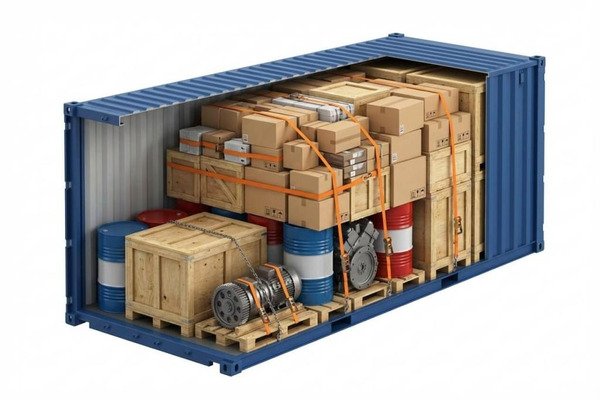
For mixed cargo, heavier and stronger packages are generally positioned lower, while lighter packages may be placed above them when their packaging and stacking strength allow it.
However, this is not a universal rule. Cargo marked with specific handling instructions, fragile packages, liquids, and irregularly shaped goods may require different arrangements.
The CTU Code recommends planning the packing operation in advance and considering whether the cargo can form a tight stow or requires additional blocking and lashing.2
A good loading plan should answer three questions:
- Where should each package be positioned?
- How will the cargo remain stable during transportation?
- How will the cargo be safely unloaded at the destination?
3. Container Weight Distribution: How to Load Cargo Safely
One of the most important parts of container loading is distributing cargo weight correctly.
The total cargo weight is only one part of the calculation. Its position, contact area with the container floor, and center of gravity also matter.
A container can be within its maximum payload limit but still have an unsafe loading arrangement if too much weight is concentrated in a small area.
3.1 Distribute Cargo Weight Along the Container Floor
Heavy cargo should not be concentrated at one end of the container without considering the container's structural loading limits.
A loading plan should distribute the cargo appropriately along the container floor.
For example, placing a heavy industrial machine directly against the front wall while leaving most of the remaining floor empty may create an unsuitable loading arrangement.
The actual weight distribution must be assessed according to:
- Cargo weight and dimensions.
- Length of the cargo footprint.
- Container floor specifications.
- Maximum permitted spread load.
- Applicable concentrated-load limitations.
- Support and load-transfer arrangements.
For certain heavy packages, suitable wooden or steel beams may be required to spread the load over a larger area and transfer it to the container's structural members.
Hapag-Lloyd's weight distribution guidance explains that container floor limits can depend on the length over which cargo rests on the floor, not simply the total weight of the cargo.3
Important: Weight distribution limits differ between container designs. Always check the actual container manufacturer's specifications and the carrier's applicable loading guidance.
3.2 Maintain Balanced Left-to-Right Weight Distribution
Cargo should also be distributed appropriately across the width of the container.
If most of the cargo weight is concentrated on one side, the container may become laterally unbalanced.
This can create difficulties during lifting, handling, and transportation.
For example, consider a container carrying two heavy industrial machines:
- Machine A: 8,000 kg.
- Machine B: 2,000 kg.
Placing both machines on the same side without considering the overall load arrangement may create unnecessary imbalance.
A better loading plan should consider the position of both machines, their footprints, and the available supporting structure.
However, an exact 50/50 split is not a universal requirement. The appropriate arrangement depends on the cargo configuration, container specifications, and permitted center-of-gravity limits.
3.3 Consider the Center of Gravity
The center of gravity (CoG) is the point at which the combined weight of the cargo can be considered to act.
Its position is important because it affects how the loaded container behaves during lifting, handling, and transportation.
For a safe loading arrangement, the center of gravity should be considered in three directions:
- Longitudinal: Along the length of the container.
- Transverse: Across the width of the container.
- Vertical: At the height of the loaded cargo.
A high or significantly off-center center of gravity can increase stability and handling risks.
For heavy machinery, the center of gravity may not be located at the geometric center of the machine.
This is particularly important for equipment with uneven weight distribution, such as machines with heavy motors, large tanks, or projecting components.
Exporters should obtain the manufacturer's center-of-gravity information where necessary and provide it to the loading team before the operation begins.
3.4 Avoid Concentrated Loads on Container Floors
Another common mistake is assuming that any cargo can be loaded as long as the total gross weight remains below the container's maximum payload.
This is not correct.
The weight of a package is transferred to the container floor through its contact points.
A heavy machine with a small base area can create much higher localized pressure than several pallets with the same total weight distributed over a larger area.
For example:
- A 5,000 kg machine supported by four small feet.
- Several 5,000 kg of palletized cargo spread across a much larger floor area.
Although both shipments have the same total weight, the loading requirements may be very different.
For heavy packages with a small footprint, the CTU Code recommends transferring concentrated loads to the structural transverse and longitudinal bottom girders using suitable supporting arrangements where necessary.4
Possible measures include:
- Properly designed timber supports.
- Steel support beams.
- Load-spreading structures.
- Suitable base frames.
The design and dimensions of these supports should be determined according to the actual cargo weight, contact area, container structure, and applicable loading limits.
3.5 Check Payload and Transport Weight Restrictions
Before finalizing the loading plan, check all relevant weight limitations.
These may include:
Maximum Gross Mass
The maximum permitted combined weight of the container, cargo, and other contents.
Maximum Payload
The maximum cargo weight permitted for the specific container.
Container Floor Loading Limits
Restrictions on how cargo weight can be distributed across the container floor.
Road and Rail Weight Restrictions
The maximum permitted weight of the loaded container and transport vehicle under the applicable inland transportation regulations.
A container that meets its payload limit may still exceed road axle limits or other transport restrictions.
Exporters should also confirm the Verified Gross Mass (VGM) requirements before loading the container onto the vessel.
The VGM includes the total mass of the packed container and must be provided according to the applicable SOLAS requirements.
4. How to Secure Cargo Inside a Shipping Container
Correct weight distribution helps create a stable loading arrangement, but it does not automatically prevent cargo movement.
During transportation, containers can experience longitudinal, transverse, and vertical accelerations.
Cargo that appears stable inside a stationary container may move when subjected to these forces.
This is why cargo securing is an essential part of container loading.

4.1 Blocking and Bracing
Blocking and bracing are used to prevent cargo from moving within the container.
Blocking involves placing suitable materials or structures against the cargo to restrict movement.
Bracing uses supporting structures to hold cargo in position.
Common materials include:
- Timber blocks.
- Wooden beams.
- Steel supports.
- Structural frames.
- Other suitable load-restraint materials.
For example, a heavy machine may require wooden blocking around its base to reduce the possibility of sliding.
The support structure must be strong enough to withstand the expected forces and must not damage the cargo or container.
4.2 Lashing and Strapping
Lashing is used to secure cargo by connecting it to suitable securing points.
Common equipment includes:
- Ratchet straps.
- Web lashings.
- Chains.
- Wire ropes.
- Suitable tensioning devices.
The choice depends on cargo weight, shape, available securing points, and the forces expected during transportation.
When selecting lashing equipment, consider:
- Lashing Capacity (LC).
- Material condition.
- Attachment points.
- Lashing angles.
- Required tension.
- Potential damage to cargo edges.
Do not assume that a strong-looking strap is automatically suitable for heavy cargo.
The lashing arrangement must be designed for the actual load and transportation conditions.
4.3 Dunnage and Void Filling
Dunnage and void-filling materials help prevent cargo from moving and reduce direct contact between packages.
Common materials include:
- Timber dunnage.
- Foam blocks.
- Corrugated materials.
- Air bags designed for cargo securing.
- Other suitable cushioning and filling materials.
For example, when loading pallets of different sizes, gaps may remain between the packages.
If these gaps are not properly addressed, cargo may move during transportation.
Dunnage can help stabilize the arrangement, but it must be selected according to the cargo weight and the forces it needs to resist.
4.4 Anti-Slip Materials
Anti-slip materials are used to increase friction between cargo and the supporting surface.
They can be particularly useful for palletized goods and certain heavy packages.
However, anti-slip mats should not be treated as a complete replacement for blocking, bracing, or lashing.
The securing arrangement must still be able to withstand the forces expected during transportation.
4.5 Match Securing Methods to Cargo Types
Different types of cargo require different securing arrangements.
| Cargo Type | Common Securing Considerations |
|---|---|
| Palletized cargo | Strapping, stretch wrapping, blocking, and void filling |
| Wooden crates | Suitable base support, blocking, and lashing |
| Heavy machinery | Load-spreading supports, blocking, and engineered lashing |
| Steel products | Suitable dunnage, chocks, and heavy-duty securing |
| Irregularly shaped cargo | Custom supports, bracing, and carefully planned lashing |
The important point is that cargo securing should be designed around the cargo itself rather than using the same method for every shipment.
5. Common Container Loading Mistakes and How to Avoid Them
Even experienced exporters can encounter loading problems when the arrangement is planned too late or cargo information is incomplete.
Here are six common mistakes worth checking before shipment.
5.1 Concentrating Heavy Cargo in One Area
Placing too much weight in one section can create excessive local floor loading.
How to avoid it: Review the cargo footprint and container floor limits before loading. Use suitable load-spreading arrangements where required.
5.2 Ignoring Left-to-Right Weight Distribution
An uneven arrangement can create handling and stability problems.
How to avoid it: Review the position and weight of each package when preparing the loading plan.
5.3 Stacking Heavy Goods Above Light Packages
Heavy packages placed above weaker packages may crush the goods underneath.
How to avoid it: Check the stacking strength of packaging and follow all applicable stacking and handling instructions.
5.4 Using Insufficient Cargo Securing
Cargo may shift even when the initial arrangement looks stable.
How to avoid it: Use suitable blocking, bracing, lashing, and void-filling materials based on the cargo and transportation conditions.
5.5 Leaving Unsecured Spaces Between Cargo
Large gaps can allow packages to move and collide.
How to avoid it: Plan the arrangement to create a tight stow where appropriate or use suitable securing methods to restrain remaining spaces.
5.6 Ignoring the Unloading Sequence
A loading plan that looks efficient at origin may create difficulties at the destination.
For example, cargo that must be delivered first may be positioned behind other packages.
How to avoid it: Confirm the delivery sequence and unloading requirements before finalizing the loading arrangement.
6. Container Loading Examples: Different Cargo, Different Plans
There is no single loading method suitable for every type of cargo.
The following examples illustrate how loading considerations change depending on the goods being transported.
6.1 Loading Palletized General Cargo
Palletized cargo is commonly used for consumer goods, industrial supplies, packaged materials, and other general cargo.
The loading arrangement should consider:
- Pallet dimensions and quantity.
- Total weight per pallet.
- Packaging strength.
- Stacking limitations.
- Weight distribution.
- Available space between pallets.
Pallets should be positioned to minimize unnecessary gaps while maintaining safe access and suitable securing arrangements.
Do not stack pallets beyond the packaging's permitted stacking height.
6.2 Loading Heavy Machinery
Heavy machinery requires more detailed loading preparation.
Before loading, confirm:
- Total machine weight.
- Dimensions and base footprint.
- Center of gravity.
- Lifting points.
- Required support structures.
- Available lashing points.
- Container suitability.
For machines with concentrated loads, suitable support beams or engineered base frames may be required to distribute the weight.
The machine must also be secured against sliding and tipping.
For exceptionally heavy or oversized machinery, a standard container may not be suitable. An open-top container, flat rack, or another specialized transport solution may be necessary.
6.3 Loading Mixed Cargo
Mixed cargo shipments may contain packages with different sizes, weights, shapes, and packaging strengths.
These shipments require particular attention because one package may affect the stability of another.
For example, a container may include:
- Wooden machinery crates.
- Palletized cartons.
- Steel components.
- Smaller packaged goods.
When arranging mixed cargo, consider:
- Package strength and stacking suitability.
- Heavy and light cargo positioning.
- Compatibility between different products.
- Weight distribution across the floor.
- Securing requirements for each cargo group.
- Unloading sequence at destination.
A loading plan should not prioritize maximum space utilization at the expense of cargo stability.
7. Final Container Loading Inspection Checklist
Before closing the container, the loading team should carry out a final inspection.
Use this checklist to review the main loading requirements.

Container Condition
Container floor, walls, and doors inspected. No visible holes, major deformation, or water ingress. Container is suitable for the intended cargo. Lashing points and structural components checked where required.
Cargo Information and Arrangement
Cargo dimensions and weights verified. Loading plan prepared. Maximum payload and applicable weight restrictions checked. Weight distributed appropriately. Heavy packages supported correctly. Stacking limitations observed. Cargo arrangement matches the intended unloading sequence.
Cargo Securing
Cargo secured against sliding and tipping. Blocking and bracing properly installed. Lashing equipment suitable for the intended load. Empty spaces filled where necessary. Packages protected against contact damage. Securing materials inspected before closing.
Final Records
Package count checked. Cargo marks and labels checked. Loading photographs taken. Container number recorded. Seal number recorded after sealing. VGM arranged according to applicable requirements.
Photographs are particularly useful when documenting the cargo arrangement, securing materials, and final container condition.
They can also provide supporting evidence if a cargo damage or loading dispute occurs later.
Conclusion: Safe Container Loading Starts Before Cargo Delivery
Safe container loading is a planning process, not simply a warehouse operation.
Before cargo reaches the loading facility, exporters should understand the dimensions, weight, packaging, and handling requirements of each item.
A suitable loading plan should then consider container capacity, weight distribution, center of gravity, local floor loading, and the appropriate cargo securing methods.
For businesses shipping machinery, industrial products, palletized goods, or mixed cargo, paying attention to these details can help reduce transportation risks and avoid unnecessary cargo damage.
Planning an export shipment from China?
Deeplinker helps businesses coordinate international freight arrangements, cargo handling requirements, and transportation solutions for general cargo and special shipments.
Whether you are shipping palletized goods, heavy machinery, or mixed cargo, contact our team to discuss your cargo dimensions, weight, loading requirements, and suitable transportation options.
Explore Deeplinker International Freight Services
Frequently Asked Questions
1. How should weight be distributed inside a shipping container?
Cargo weight should be distributed according to the container's floor loading limits, cargo footprint, center of gravity, and applicable transportation restrictions.
Heavy packages should not be concentrated in a small area without checking whether the container structure can safely support the load.
2. Can a shipping container be overloaded even if the cargo fits inside?
Yes. Cargo fitting inside the container does not mean the shipment is safe or compliant.
The total payload, maximum gross mass, floor loading limitations, and applicable road or rail weight restrictions must all be checked.
3. What is the best way to secure cargo inside a shipping container?
There is no single best method for every shipment.
Common methods include blocking, bracing, lashing, strapping, dunnage, and anti-slip materials. The correct arrangement depends on cargo weight, dimensions, packaging, securing points, and transportation conditions.
4. Why is center of gravity important in container loading?
The center of gravity affects the stability of the loaded container during lifting, handling, and transportation.
An excessively high or significantly off-center load may increase handling and transportation risks.
5. Can heavy machinery be shipped in a standard 40HQ container?
Some heavy machinery can be transported in a standard 40HQ container, provided its dimensions, weight, loading arrangement, floor loading, and securing requirements are suitable.
For oversized or unusually heavy equipment, open-top containers or flat racks may be more appropriate.
6. What is the CTU Code in container loading?
The CTU Code is the IMO/ILO/UNECE Code of Practice for Packing of Cargo Transport Units.
It provides guidance on safe cargo packing, weight distribution, securing, handling, and unpacking throughout the intermodal transportation chain.
It is a non-mandatory international code of practice unless its provisions are incorporated into applicable national regulations or contractual requirements.
References
Technical note: The CTU Code is a non-mandatory international code of practice. Its recommendations do not replace applicable national regulations, container manufacturer specifications, carrier instructions, or transport-specific requirements. Hapag-Lloyd's weight distribution guidance applies to its own container specifications and should not be treated as a universal limit for all containers.
[UNECE – IMO/ILO/UNECE Code of Practice for Packing of Cargo Transport Units (CTU Code)](https://unece.org/transport/intermodal-transport/imoilounece-code-practice-packing-cargo-transport-units-ctu-code). Official overview of safe container packing and securing guidance. ↩
[IMO – Cargo Securing and Packing](https://www.imo.org/en/ourwork/safety/pages/cargosecuring-default.aspx). Explains the importance of correct cargo stowage and securing for maritime safety. ↩
[Hapag-Lloyd – Weight Distribution in Containers for Safe Transport](https://www.hapag-lloyd.com/content/dam/website/downloads/pdf/Weight_distribution_guideline_03.pdf). Carrier guidance on container floor loading limits and cargo weight distribution. ↩
[IMO – CTU Code, Annex 7: Packing and Securing Cargo into CTUs](https://www.imorules.com/GUID-5EDD9F35-0C18-42FE-AF69-5E442824D99F.html). Technical guidance on loading plans, concentrated loads, center of gravity, and cargo securing. ↩