
A shipment has cleared customs in the Netherlands. The goods are in stock, and a customer in Britain places an order. Can the warehouse simply arrange a truck and treat the delivery like another European shipment?
Not quite. Goods released in the EU are not automatically cleared for Great Britain. Moving them across the UK–EU border generally creates another set of customs formalities, even when the onward journey is short.1
For importers, procurement teams and warehouse operators, understanding UK vs EU customs is therefore about more than preparing an invoice. It means identifying the correct importer, checking whether any tariff preference actually applies, and making sure customs, VAT and transport filings are coordinated before dispatch.
Scope: This guide covers general commercial shipments involving Great Britain and the EU. Northern Ireland has separate arrangements. Low-value e-commerce consignments and regulated goods may require additional procedures.
1. Similar Shipping Documents, Separate Customs Requirements
Brexit did not replace commercial invoices and packing lists with an entirely new set of documents. The important difference is that the supporting information now feeds separate customs and tax processes.
For ordinary commercial shipments between Great Britain and the EU, exporters and importers must arrange the applicable formalities on both sides. A completed export declaration does not replace the destination import declaration.1
| Area | Great Britain | European Union |
|---|---|---|
| Customs identification | A GB EORI is used for relevant GB customs activities. | An EU-valid EORI is needed for relevant EU customs activities; a GB EORI alone is not a substitute.2 |
| Import declarations | GB imports are declared through the UK Customs Declaration Service, subject to the applicable procedure. | EU import formalities must be completed separately under the applicable EU customs procedure.13 |
| Import VAT | UK VAT rules apply, including postponed VAT accounting where eligible. | EU VAT rules apply, with rates set by individual member states.45 |
| Entry safety and security | Relevant ENS filings use S&S GB. | EU entry safety and security requirements operate through ICS2, with certain combined transit-filing options.67 |
Check the Data, Not Just the Document Template
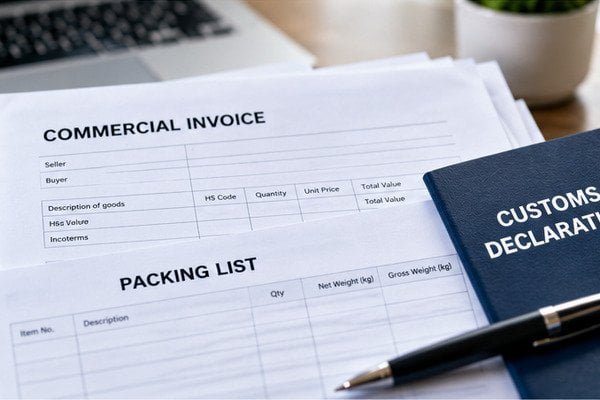
Before sharing a document pack with the broker, reconcile the commercial invoice, packing list and transport information. Check the product description, quantities, packaging, value, currency, freight charges and the identities of the parties involved.
HMRC’s import declaration guidance requires information covering the goods, consignor and consignee, transport costs, valuation, and any applicable certificates or licences.3
For example, “deliver to our Manchester warehouse” identifies a delivery location. Your booking instructions should also identify the business that will act as importer and the registration details the broker should use.
The same principle applies to EORI numbers. Do not ask only whether a customer “has an EORI.” Confirm which customs territory issued it and whether it belongs to the business involved in the declaration. Whether a company needs registrations in both markets depends on its role in each transaction.2
2. An EU Warehouse Does Not Create EU Origin
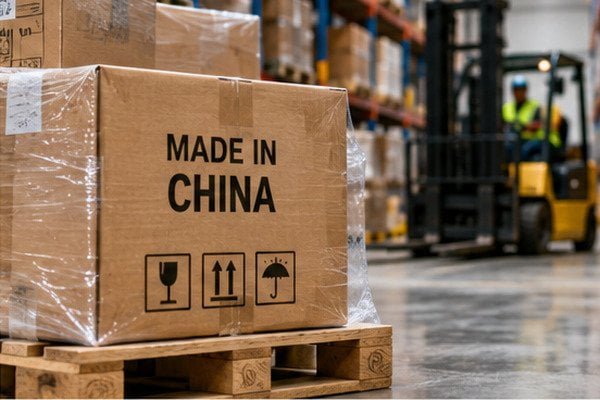
A particularly important pitfall arises when goods manufactured outside Europe are stored in an EU warehouse before being sold to British customers.
Consider this illustrative route:
China → import clearance in the Netherlands → ordinary warehouse storage → sale to a customer in Great Britain
If the goods are only stored and relabelled, those operations do not automatically make them EU-origin products. Customs clearance and preferential origin answer different questions: one concerns the customs procedure completed, while the other concerns whether the goods satisfy the production rules in a trade agreement.8
The UK–EU Trade and Cooperation Agreement provides tariff preferences for qualifying originating goods. It does not make every shipment dispatched from an EU address duty-free.1
This distinction matters when preparing an onward-delivery quotation. Do not assume zero UK duty simply because EU import charges have already been paid. Check the UK commodity classification, actual origin and any applicable relief before confirming the landed cost.9
What Proof Supports a Preference Claim?
Under the UK–EU agreement, a preference claim can normally be based on:
- A statement on origin: prescribed wording supplied by the exporter on an invoice or another document that identifies the goods.
- Importer’s knowledge: sufficient information held by the importer to demonstrate that the products meet the relevant origin rules.
A statement on origin is not simply a supplier’s address or an unsupported “Made in EU” note. The exporter must hold evidence supporting the originating status. Likewise, importer’s knowledge requires more than confidence in the supplier.10
For businesses serving both markets, the practical next step is to compare direct-to-GB supply with distribution through an EU warehouse. Include the onward customs work, applicable taxes, handling and delivery arrangements—not just the additional trucking charge.
3. Zero Customs Duty Does Not Mean Zero Import VAT
Even when goods qualify for preferential customs duty, import VAT must be considered separately. UK–EU trade no longer follows the same VAT procedures as an ordinary movement of goods within the EU.1
This creates two different questions for the buyer:
What tax is due, and how will it be accounted for?

Great Britain: Agree the VAT Method Before Declaration
Eligible UK VAT-registered businesses can use postponed VAT accounting (PVA) to account for import VAT on their VAT Return rather than necessarily paying it upfront at importation.
Eligibility includes requirements concerning business use, the right to dispose of the goods, and the VAT registration information on the declaration. PVA is an accounting mechanism, not a VAT exemption.4
The operational detail is important: when a broker or freight forwarder imports goods on your behalf, HMRC requires written instructions before they use PVA on the import declaration.
Do not assume that the broker will select it automatically. Agree the treatment in advance and reconcile the subsequent postponed import VAT statements—or the relevant C79 import VAT certificates where applicable—with your import records.4
The EU: Check the Member State, Not Just “Europe”
The EU has a common VAT framework, but individual member states set their VAT rates within that framework. There is no single rate that can be applied indiscriminately to every EU destination.5
For an EU import, confirm the applicable rate, registration requirements, payment arrangements and evidence needed for deduction with the relevant local adviser. Do not copy the UK PVA instructions into an EU booking.
For cost planning, it is also useful to distinguish a potentially recoverable VAT amount from a permanent landed-cost expense. Confirm recovery eligibility rather than assuming every importer can reclaim every amount charged.
4. Border Checks Involve More Than the Import Declaration
A shipment can have a customs declaration in place and still have outstanding transport or safety-and-security requirements. These processes should be coordinated, but their references are not interchangeable.
ENS: Advance Safety and Security Information
An Entry Summary Declaration (ENS) provides advance cargo information for safety and security risk assessment.
The temporary waiver for relevant EU-to-GB imports ended on January 31, 2025. GB entry declarations use S&S GB, and the carrier is responsible for ensuring submission, although an agreed third party can file on its behalf.6
For shippers, the useful questions are straightforward: who is filing, what information do they need, and what is the deadline for the chosen transport mode?
On the EU side, incoming cargo is subject to ICS2 safety and security requirements. Certain road and rail movements can use an authorised combined transit-and-ENS filing route. The European Commission warns that incomplete ENS data can lead to rejection, requests for additional information and delays.7
An import customs declaration should therefore never be treated as automatic confirmation that the ENS obligation has been fulfilled.
GMR: A Reference for the Vehicle Movement
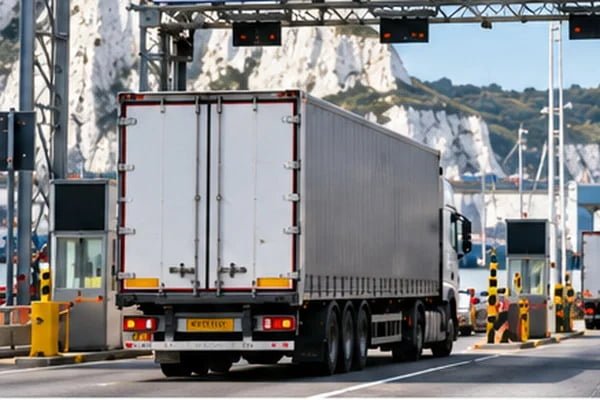
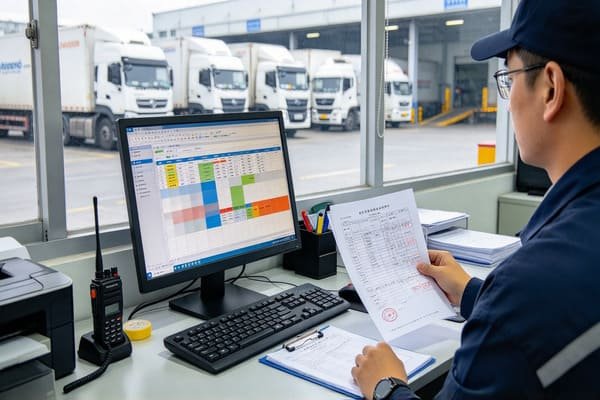
For movements requiring the UK Goods Vehicle Movement Service (GVMS), the haulier needs a valid Goods Movement Reference (GMR) containing the appropriate declaration references.
The GMR must be presented for the crossing, and the relevant references must cover the goods being carried. However, a valid GMR is not a guarantee that the shipment will avoid inspection or that all goods have been released.
HMRC requires operators to follow the instructions indicating whether they must report for checks or can continue their journey.11
Before collection, ask the forwarder to confirm the applicable declarations, the movement reference where required, and who will monitor any inspection instructions. This is more precise than asking only whether “customs is done.”
Product-Specific Requirements Still Matter
General customs documents are not the complete compliance file for every product. Animals, plants, certain foods, medicines, chemicals and other controlled goods may need additional licences or certificates.9
Check those requirements against the actual product and destination before choosing the route.
5. A Pre-Shipment Checklist for UK–EU Trade
Use the following as a booking-stage review rather than a last-minute check after the goods reach the port.
| Check | What to confirm |
|---|---|
| Destination and customs procedure | Is the shipment entering Great Britain, an EU member state or Northern Ireland? Where will import clearance take place? |
| Importer and registrations | Which business is the importer, which EORI applies, and what VAT details should the broker use? |
| Commercial information | Do the invoice, packing information and transport instructions consistently identify the goods, quantities, values and parties? |
| Origin and duty | Is any preferential claim supported by evidence, rather than the warehouse address or dispatch country? |
| VAT arrangements | How will import VAT be accounted for, and have the necessary written instructions been provided? |
| Border readiness | Who handles the ENS, any required GMR, product certificates, and inspection or release instructions? |
Keep the agreed instructions with the shipment records. They provide a useful reference when the supplier, warehouse, haulier and customs broker are working from different systems.
FAQ
Do goods qualify for zero duty simply because they are shipped from the EU to the UK?
No. Dispatch from the EU does not, by itself, establish preferential origin. The goods must meet the relevant agreement conditions. Storage or relabelling of non-originating goods does not automatically make them eligible.108
Does every UK–EU shipment need a separate certificate of origin?
Not necessarily. Under the UK–EU agreement, a preference claim can generally rely on a statement on origin or importer’s knowledge, subject to the applicable conditions and exceptions. A statement can appear on an invoice or another suitable document; a separate traditional certificate is not the default requirement.10
Can the same customs instructions be used for Great Britain and Northern Ireland?
Not without checking. Northern Ireland has special customs and goods-related VAT arrangements. This guide’s GB procedures should not be copied into a Northern Ireland shipment without a route-specific review.1
Conclusion
The practical lesson of UK vs EU customs is to plan each border crossing separately—not to redesign every shipping document.
Start with the importer and the customs procedure, then align the commercial information, origin evidence, VAT treatment and transport filings. For businesses using one warehouse to serve several markets, making those decisions before accepting an order or confirming a delivery date is more useful than treating customs as a final transport formality.
This article provides general information. Confirm shipment-specific customs and tax treatment with the relevant broker, customs authority or qualified tax adviser.
References
[European Commission / EU–UK: A New Relationship](https://taxation-customs.ec.europa.eu/customs/international-affairs/united-kingdom_en) ↩
[GOV.UK / Check Which EORI Number You Need](https://www.gov.uk/eori/Check-which-EORI-number-you-need) ↩
[HMRC / Making a Full Import Declaration](https://www.gov.uk/guidance/making-a-full-import-declaration) ↩
[HMRC / Check When You Can Account for Import VAT on Your VAT Return](https://www.gov.uk/guidance/check-when-you-can-account-for-import-vat-on-your-vat-return) ↩
[European Commission / VAT Rates](https://taxation-customs.ec.europa.eu/taxation/vat/vat-directive/vat-rates_en) ↩
[HMRC / Making an Entry Summary Declaration](https://www.gov.uk/guidance/making-an-entry-summary-declaration) ↩
[European Commission / Import Control System 2](https://taxation-customs.ec.europa.eu/customs/customs-security/import-control-system-2_en) ↩
[HMRC / Check Your Goods Meet the Rules of Origin](https://www.gov.uk/guidance/check-your-goods-meet-the-rules-of-origin) ↩
[GOV.UK / Import Goods into the UK: Step by Step](https://www.gov.uk/import-goods-into-uk) ↩
[HMRC / Proving Originating Status and Claiming a Reduced Rate of Customs Duty for Trade Between the UK and EU](https://www.gov.uk/guidance/proving-originating-status-and-claiming-a-reduced-rate-of-customs-duty-for-trade-between-the-uk-and-eu) ↩
[HMRC / Create a Goods Movement Reference](https://www.gov.uk/guidance/create-a-goods-movement-reference) ↩