
How AEO Certification Accelerates Customs Clearance for Consolidated Cargo Export from China
Most overseas importers source merchandise from dozens of Chinese suppliers and consolidate all goods into one container for export. While multi-supplier consolidation effectively cuts ocean freight costs, this shipping model brings persistent customs challenges. Inconsistent supplier documents, random customs inspections and unexpected container hold-ups often lead to missed vessel cutoffs, warehouse detention fees and costly delivery delays.
With the updated Measures for the Administration of the Credit Management of Enterprises Registered and Recorded with Customs fully implemented in 20261, China Customs has strengthened differentiated supervision for qualified enterprises. AEO Advanced Certified logistics operators now receive expanded clearance privileges, which deliver remarkable advantages for consolidated shipments.
This article explains how AEO certification optimises customs procedures for combined cargo from multiple factories, key policy updates in 2026, common misunderstandings, and why domestic consolidation with an AEO forwarder is more reliable than overseas third-country consolidation.
What Is China Customs AEO Advanced Certification (2026 Policy Update)
AEO stands for Authorized Economic Operator, a globally recognised compliance framework established by the World Customs Organization (WCO)2. Enterprises that pass strict audits on internal control, cargo security, document management and credit records obtain AEO certification.
There are two core grades in China's system: AEO General Certification and AEO Advanced Certification3. Advanced certified firms enjoy the maximum set of customs facilitation measures.
Key 2026 policy adjustments relevant to consolidation shipping:
- Greater priority for enterprises conducting batch delivery and centralised declaration4, the mainstream solution for multi-supplier consolidation;
- Tighter differentiated supervision: non-certified enterprises face higher inspection frequency, while qualified AEO operators maintain stable low inspection rates;
- Smoother coordination mechanisms for handling document discrepancies and customs enquiries.
A critical distinction many overseas buyers overlook: AEO certification of manufacturers is not equal to AEO certification of your freight forwarder. Even if all your suppliers hold AEO qualifications, you still benefit significantly from appointing an AEO forwarder responsible for warehouse consolidation and export declaration.
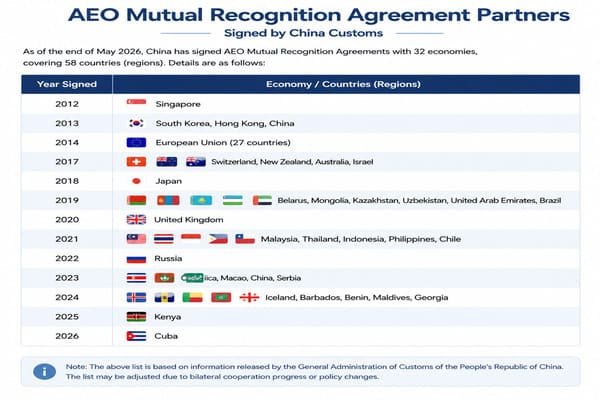
Furthermore, China maintains AEO mutual recognition agreements with more than 50 economies5, covering the EU, Russia, Egypt, Southeast Asia and other popular trade destinations. These mutual recognition arrangements extend clearance benefits to destination ports.
Why Consolidated Multi-supplier Cargo Carries Higher Customs Risks
When goods from 3, 5 or more independent manufacturers are packed into a single container, the risk profile rises sharply.
Different factories often submit inconsistent commodity descriptions, HS codes, gross weights, volumes and packing information. Minor data mismatches become a frequent trigger for customs scrutiny.
Worse still: if customs detects abnormalities in one supplier's cargo, the entire consolidated container may be held for inspection6.
Without an experienced AEO logistics partner:
- Random inspection probability increases;
- Inspection scheduling requires long waiting times during shipping peak seasons;
- Document disputes lack a dedicated communication channel with customs, prolonging clearance suspensions.
Read our detailed guide to eliminate these common cargo errors: How to Avoid Discrepancy When Consolidating Multiple Shipments
A small documentation deviation can result in container detention, missed sailing schedules and cascading delays for your whole supply chain.
Core Benefits: How AEO Speeds Up Clearance for Consolidated Cargo
1. Substantially Lower Inspection Rate
This is the most valuable advantage for consolidated shipments. AEO Advanced Certified operators maintain far lower inspection rates7 compared with ordinary logistics companies.
Lower inspection risk means you avoid the huge expense of unpacking consolidated containers for customs checks and minimise the chance of full-container delays caused by issues with a single supplier's goods.
2. Priority clearance and dedicated customs service
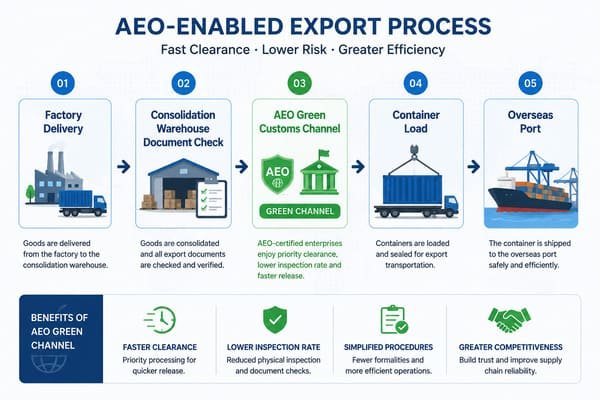
AEO enterprises enjoy priority declaration review and priority inspection arrangements8. During port congestion, holiday rush seasons or sudden customs policy tightening, this green channel creates vital time buffers for tight shipping schedules.
3. Optimised "Batch Delivery, Centralised Declaration" for Consolidation
Many overseas buyers arrange separate deliveries from various factories to a consolidation warehouse in China. The 2026 updated credit rules further support this operating model.
AEO forwarders can smoothly execute batch delivery and centralised declaration: suppliers deliver goods to the warehouse separately, and the logistics provider submits one unified export declaration after all cargo arrives. This reduces repeated declaration work and lowers the chance of declaration mistakes.
4. Faster resolution for customs enquiries and document discrepancies
Consolidated shipments frequently face customs questions about inconsistent supplier information. AEO certified firms have established communication channels with local customs9. Any data disputes or queries can be resolved more quickly, preventing prolonged cargo suspension.
5. Cross-border advantages via global AEO mutual recognition
When your goods arrive at ports in AEO mutual recognition regions, you can continue to benefit from simplified clearance procedures and reduced inspection frequency10.
These continuous compliance advantages are difficult to maintain if cargo undergoes transshipment and overseas consolidation in third countries.
6. Simplified customs guarantee requirements
Subject to relevant conditions, AEO operators can apply for exemptions or reductions on customs security deposits11, easing capital pressure for large-volume consolidated export projects.
Practical Buyer Checklist: Using AEO Services for Consolidated Shipments
Follow these rules to maximise AEO advantages when consolidating cargo from multiple Chinese suppliers:
- Confirm your logistics provider holds China domestic AEO Advanced Certification, not only overseas AEO qualifications.
- Request your AEO forwarder to distribute unified document templates to all suppliers in advance to standardise declaration data.
- Complete document pre-verification before cargo arrives at the consolidation warehouse to catch discrepancies early.
- Reserve reasonable lead time for container loading. While AEO reduces inspection risks, multi-supplier consolidation still requires contingency arrangements.
Common Misconceptions to Avoid
❌ Misunderstanding 1: If manufacturing factories have AEO certification, the consolidated shipment faces zero risks. Factory certification covers production links. Consolidation, warehousing and declaration operations rely on your freight forwarder's qualifications.
❌ Misunderstanding 2: AEO certification guarantees no customs inspection. AEO lowers inspection probability, but customs still conducts random inspections to enforce compliance. No logistics service can promise 100% inspection exemption.
❌ Misunderstanding 3: Overseas third-country consolidation can obtain identical AEO facilitation. Once cargo is split for head shipment and re-consolidated in a third nation, the continuous domestic AEO supervision chain breaks12. Multiple transshipment steps increase inspection and documentation risks, which also conflicts with standard Incoterms risk division rules.
AEO Forwarder VS Non-AEO Forwarder for Consolidated Shipments
| Comparison Item | AEO Certified Forwarder | Ordinary Non-AEO Forwarder |
|---|---|---|
| Customs Inspection Probability | Significantly lower | Industry average or higher |
| Declaration Processing | Priority review | Standard queuing |
| Handling Document Disputes | Dedicated customs communication channel | General consultation process, longer waiting time |
| Batch Delivery & Centralised Declaration | Smooth, full policy support | More restrictions and complicated approval |
| Cross-border Mutual Recognition Benefits | Available for eligible trade lanes | No additional facilitation |
| Risk of Full-container Delay | Reduced | Higher |
AEO Domestic Consolidation VS Overseas Third-country Consolidation
When planning your supply chain, it is essential to compare two consolidation models:
Consolidation inside China with an AEO warehouse All goods converge and are loaded into containers within China. The whole export procedure operates under one compliant logistics entity. AEO facilitation policies apply throughout domestic warehousing and customs declaration. Document control remains unified, avoiding information fragmentation.
Separated shipment and overseas consolidation in third countries Cargo leaves China in separate shipments and merges at an overseas transit hub. The continuous AEO compliance chain cannot be maintained. Every transshipment point introduces new customs risks, repeated handling costs and higher chances of document mismatch. Split shipments via third hubs commonly trigger stricter import verification for destination customs.
For most importers sourcing goods from China, completing consolidation within mainland China with an AEO-certified partner delivers better stability, fewer hidden risks and predictable transit schedules.
Conclusion
For importers purchasing goods from multiple Chinese vendors, consolidation remains a cost-effective shipping solution. Nevertheless, multi-supplier combined cargo naturally carries higher customs compliance risks.
Under the 2026 China Customs credit management framework, cooperating with an AEO Advanced Certified freight forwarder is one of the most practical ways to control clearance risks, avoid unexpected delays and stabilise your supply chain.
If you plan to consolidate cargo from different Chinese factories and arrange direct export from China, our team provides professional AEO consolidation services out of domestic warehouses.
Related Articles
FAQ
Q1: Does AEO certification eliminate customs inspection for consolidated cargo? AEO greatly reduces inspection frequency, but it cannot fully rule out random customs inspections required by regulation.
Q2: Can AEO forwarders manage both LCL and FCL multi-supplier consolidation? Yes. Qualified AEO logistics providers support less-than-container load and full-container load consolidation services for multiple suppliers.
Q3: Will AEO clearance benefits remain valid if goods transit via third countries? Generally no. Transshipment and overseas consolidation break the continuous AEO supervision chain, and facilitation measures cannot be inherited through multiple transit locations.
Q4: What is Batch Delivery and Centralised Declaration for consolidation cargo? It allows different suppliers to deliver goods to a shared consolidation warehouse separately. The logistics provider submits one unified customs declaration after all cargo arrives, simplifying multi-supplier export arrangements.
"China Customs Enterprise Credit Management Rules", https://www.china-briefing.com/news/china-customs-enterprise-credit-management-rules-2026/. Provides the official text or announcement of China's 'Measures for the Administration of Enterprise Credit Management,' outlining the different treatment for enterprises based on their credit rating, including AEO certified companies. The effective date for these measures can be confirmed through official decrees from the General Administration of Customs of China. Evidence role: general_support; source type: government. Supports: The claim that China Customs is implementing updated credit management measures that affect AEO enterprises.. Scope note: The source may be in Chinese and require translation. The article's interpretation of full implementation by 2026 may be based on transition periods mentioned in the policy. ↩
"Authorized economic operator", https://en.wikipedia.org/wiki/Authorized_economic_operator. The World Customs Organization (WCO) defines the Authorized Economic Operator (AEO) program as a core part of its SAFE Framework of Standards to Secure and Facilitate Global Trade, which was adopted in 2005. The program establishes a partnership between customs and businesses to enhance supply chain security. Evidence role: definition; source type: institution. Supports: The claim that the AEO program is a concept developed and standardized by the World Customs Organization.. ↩
"Customs AEO - Beijing - 北京市人民政府", https://english.beijing.gov.cn/investinginbeijing/Start_Your_Business/focus_guide/thematic_guide/CustomsAEO/index.html. Official publications from the General Administration of Customs of China confirm the existence of two tiers of AEO certification: General Certified Enterprise (一般认证企业) and Advanced Certified Enterprise (高级认证企业), with the latter receiving the most facilitation benefits. Evidence role: general_support; source type: government. Supports: The claim that China's AEO program is divided into General and Advanced certification levels.. ↩
"Report Name:GACC Announcement 277 - Regulation on ...", https://apps.fas.usda.gov/newgainapi/api/Report/DownloadReportByFileName?fileName=GACC%20Announcement%20277%20-%20Regulation%20on%20Declaration%20Management%20of%20Import%20and%20Export%20Goods_Beijing_China%20-%20People%27s%20Republic%20of_CH2025-0069. China Customs regulations allow for a 'centralized declaration' (集中申报) mode, where goods can be delivered to a customs-supervised warehouse in batches, followed by a single, consolidated declaration within a prescribed period. AEO status can facilitate the approval and smooth operation of this model. Evidence role: definition; source type: government. Supports: The claim that 'batch delivery, centralized declaration' is a formal customs procedure in China.. ↩
"Mutual recognition of AEOs - Taxation and Customs Union", https://taxation-customs.ec.europa.eu/customs/authorised-economic-operator/mutual-recognition_en. The General Administration of Customs of China (GACC) periodically publishes and updates the list of countries and regions with which it has signed AEO Mutual Recognition Arrangements. These official lists can be used to verify the total number of partner economies. Evidence role: statistic; source type: government. Supports: The claim that China has signed AEO MRAs with a large number of international partners.. Scope note: The exact number changes as new agreements are signed, so the source should be checked for its publication date. ↩
"Cargo Examination | U.S. Customs and Border Protection", https://www.cbp.gov/border-security/ports-entry/cargo-security/examination. Customs procedural guides explain that a consolidated container (LCL or FCL with multiple suppliers) is often treated as a single unit for risk assessment purposes. A discrepancy or issue related to one consignment can flag the entire container, potentially leading to a hold or full inspection of all contents. Evidence role: mechanism; source type: other. Supports: The claim that an issue with a single part of a consolidated shipment can lead to the detention of the entire container.. Scope note: The exact procedure can vary by port and country, but this is a widely recognized principle in freight forwarding. ↩
"The AEO Mutual Recognition Program Signed by ...", http://english.customs.gov.cn/statics/7b82cacd-1943-4cbe-bf97-11864ae92b07.html. According to regulations from China's General Administration of Customs, AEO Advanced Certified enterprises have an inspection rate that is significantly lower than the average for general enterprises. For example, past statements have indicated the rate can be less than 20% of the average inspection rate. Evidence role: statistic; source type: government. Supports: The claim that AEO status leads to a lower rate of customs inspections.. Scope note: Specific, up-to-the-minute percentages are rarely published and can fluctuate, but the principle of a substantially lower rate is an official tenet of the program. ↩
"Securing and Facilitating Trade in North America", https://www.cbp.gov/border-security/ports-entry/cargo-security/c-tpat-customs-trade-partnership-against-terrorism/mutual-recognition/aeo-programs. Official guidance on the AEO program from China's customs authority lists 'priority for inspection of goods' as a key benefit for certified enterprises. This means that if their cargo is selected for examination, it will be processed before non-AEO cargo. Evidence role: mechanism; source type: government. Supports: The claim that AEO status grants priority during the inspection process.. ↩
"Securing and Facilitating Trade in North America", https://www.cbp.gov/border-security/ports-entry/cargo-security/c-tpat-customs-trade-partnership-against-terrorism/mutual-recognition/aeo-programs. As part of the AEO program, China Customs implements a 'Customs Coordinator' system. AEO enterprises are assigned a specific coordinator who serves as a dedicated point of contact to help solve problems and facilitate communication between the company and customs. Evidence role: mechanism; source type: government. Supports: The claim that AEO companies have a dedicated point of contact at customs.. ↩
"CBP signs Mutual Recognition Arrangement with Brazil", https://www.cbp.gov/newsroom/national-media-release/cbp-signs-mutual-recognition-arrangement-brazil. The World Customs Organization explains that under a Mutual Recognition Arrangement (MRA), the customs administration of the importing country recognizes the AEO validation of the exporting country. This leads to tangible benefits such as a lower risk score, fewer inspections, and expedited processing for the AEO-certified exporter's shipments. Evidence role: mechanism; source type: institution. Supports: The claim that AEO status in one country can lead to customs benefits in a partner country.. ↩
"Securing and Facilitating Trade in North America", https://www.cbp.gov/border-security/ports-entry/cargo-security/c-tpat-customs-trade-partnership-against-terrorism/mutual-recognition/aeo-programs. Regulations from China's General Administration of Customs state that AEO Advanced Certified enterprises may, for certain customs procedures like processing trade, be exempted from providing financial guarantees or security deposits that are typically required of other companies. Evidence role: general_support; source type: government. Supports: The claim that AEO status can reduce the need for customs security deposits.. Scope note: This benefit is not automatic and applies only under specific conditions and for certain types of customs transactions. ↩
"Securing and Facilitating Trade in North America", https://www.cbp.gov/border-security/ports-entry/cargo-security/c-tpat-customs-trade-partnership-against-terrorism/mutual-recognition/aeo-programs. The WCO's AEO framework is built on the principle of securing the entire supply chain from the point of origin. AEO status is granted to operators who can demonstrate security throughout their processes. Introducing uncontrolled steps, such as re-consolidation by a non-certified entity in a third country, breaks this secure chain, and thus the AEO benefits are generally not transferable through such a process. Evidence role: mechanism; source type: institution. Supports: The claim that AEO benefits are tied to maintaining a secure, unbroken supply chain.. ↩