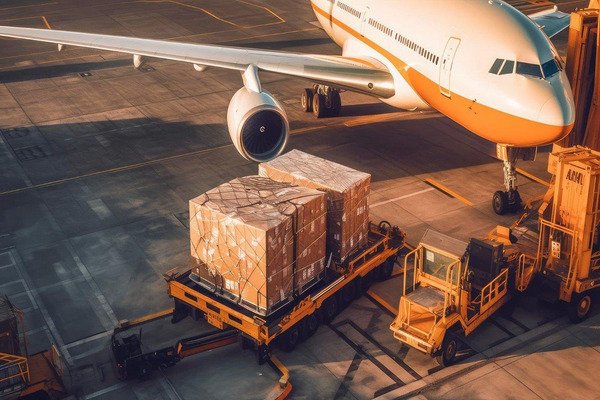

Your goods have completed their international journey. Customs clearance is progressing, and a truck is being arranged for the final delivery.
Then the warehouse asks a question nobody discussed: “Who is unloading the cargo?”
Door-to-door shipping from China can simplify transport coordination, but the phrase does not define every service at the destination. A delivery address alone does not tell the forwarder whether the warehouse needs an appointment, whether the truck can enter, or whether suitable unloading equipment is available.
Before booking, confirm the exact delivery point, the unloading arrangements and the receiving conditions. These details determine whether the goods can move smoothly from the vehicle into your warehouse.
1. Does door-to-door shipping include unloading?
Not automatically. Check both the sale contract and the logistics service quotation.
Under Incoterms® 2020, DAP and DDP generally provide for delivery at the named destination with the goods ready for unloading from the arriving vehicle. DPU includes unloading as part of the seller’s delivery obligation. ICC explains these distinctions in its guidance. ICC Academy: DAP and DDP and ICC Academy: C rules and D rules.
| Arrangement | Unloading point to clarify |
|---|---|
| Door-to-door logistics quotation | Read the stated service scope; the phrase alone does not define unloading |
| DAP sale | Goods are generally delivered ready for unloading; confirm how unloading will be arranged |
| DDP sale | Import formalities are part of the seller’s obligations, but unloading is not automatically included in its delivery obligation |
| DPU sale | Seller’s delivery obligation includes unloading at the agreed destination |
Unloading responsibility and unloading charges also need careful coordination. ICC notes that under DAP and DDP, unloading charges may already be for the seller’s account under its contract of carriage. Confirm what is included before adding a separate charge. ICC Academy: Unloading costs under the D rules.
A forwarder’s quotation should support the agreed delivery arrangement. It does not, by itself, rewrite the sales contract between buyer and seller.
For the wider quotation checklist, see our DDP shipping guide for overseas importers.
2. Define the delivery point more precisely than “our warehouse”
Give the logistics provider the full receiving address and identify the actual handover point.
For example:
- A specific loading dock.
- A designated receiving gate.
- A ground-level unloading area.
- A shared industrial building with vehicle restrictions.
- A site where a smaller vehicle must complete the final approach.
Also clarify whether the requested service ends after unloading beside the vehicle or includes movement into a building.
Inside delivery, unpacking, installation and removal of packaging should be described separately when needed. Do not leave these tasks hidden inside the phrase “delivery included.”
3. Arrange the warehouse appointment before dispatch
A warehouse’s opening hours and its available receiving appointments are not necessarily the same.
Ask the receiving team:
- Is an appointment required?
- Who must book it?
- Which purchase order or inbound reference is needed?
- How much notice is required?
- What are the permitted arrival times?
- What happens if the truck arrives early or late?
- Who can approve a revised slot?
DHL Freight’s European road-freight guidance, for example, describes delivery notification as an additional service that can support appointment arrangements. This is a service-specific example, so confirm the process used by your own destination carrier. DHL Freight: Road-freight FAQs.
Do not commit to an inflexible warehouse slot based only on the vessel’s estimated arrival. Coordinate the booking with cargo availability, release status and the planned inland movement.

4. Match the vehicle and unloading equipment to the cargo
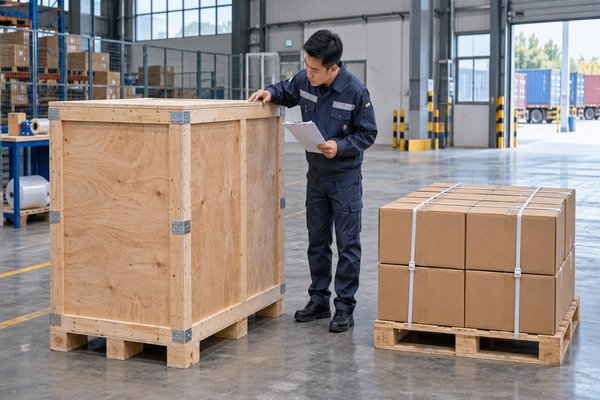
A warehouse may receive small parcel vans every day and still be unsuitable for a full container truck.
Provide the destination carrier with:
- Package or pallet count.
- Final packed dimensions.
- Gross weight of each handling unit.
- Whether cargo is palletized, crated or loose-loaded.
- Any restrictions on stacking or handling.
- The warehouse’s unloading equipment and access conditions.
Use that information to confirm the delivery setup:
| Receiving condition | Question to resolve before booking |
|---|---|
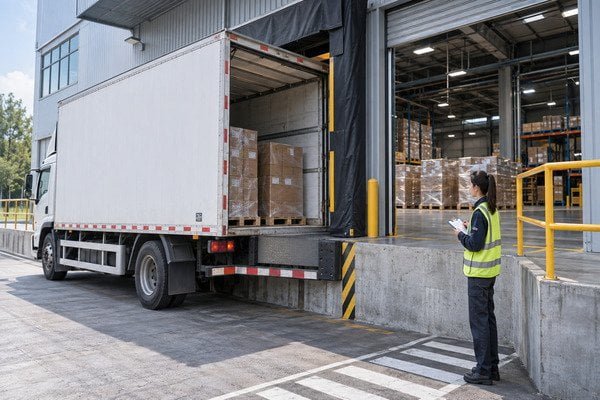
| Warehouse has a loading dock | Is the planned vehicle compatible with the dock and access route? |
| No dock, but a forklift is available | Can the equipment safely handle the actual packages and unloading position? |
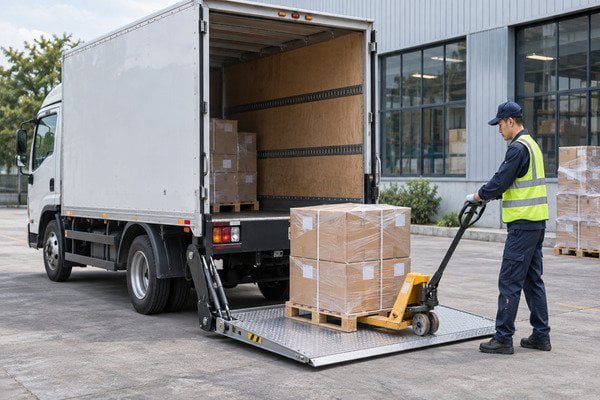
| No unloading equipment | Is a suitable tail-lift service available for the cargo? |
| Heavy or oversized equipment | Is a separately planned crane, rigging or specialist unloading operation required? |
| Narrow road or restricted entrance | Is a smaller final-delivery vehicle needed? |
| Loose cartons inside a container | Who provides the labor and time needed for unloading? |
A tail lift, also called a liftgate, is not suitable for every shipment. Confirm platform dimensions, load limits, package stability and the surface where the goods will be placed.
DHL Freight’s product manual identifies tail-lift unloading and delivery time-slot booking as distinct service selections. Availability depends on the product and route. DHL Freight: Product manual.
For industrial equipment, our machinery shipping guide covers additional loading and handling considerations.
5. Confirm how the goods will reach the warehouse
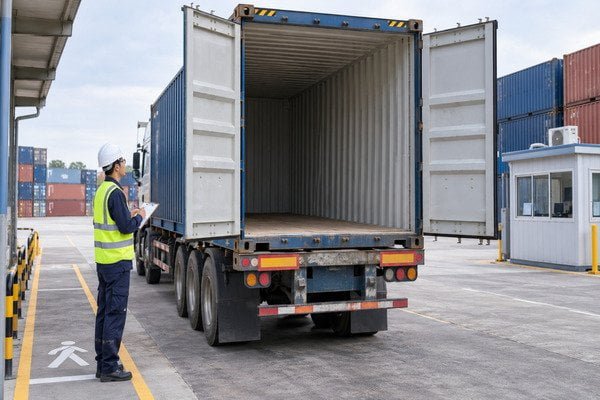
Ask whether the final delivery involves the ocean container itself or goods transferred into another vehicle.
Full-container delivery
For an FCL shipment, discuss whether the truck will wait while the container is unloaded or whether an approved arrangement allows equipment to remain on site for later collection.
Confirm:
- Whether the delivery method is available at the address.
- How much unloading or waiting time is included.
- Who supplies unloading labor and equipment.
- Whether the site can safely accommodate the planned operation.
- Who arranges collection and empty-container return.
Do not assume that a container can be left at the warehouse simply because there is space.
Delivery after unpacking or deconsolidation
An LCL shipment, or an FCL shipment arranged for transloading, may reach the warehouse on a different truck after unpacking at a destination facility.
Ask for the final package count, handling-unit dimensions and vehicle requirements. Confirm any agreed repalletizing or repacking before the delivery booking is made.
This step is especially useful when goods from several suppliers arrive with different packaging formats.
6. Check waiting, redelivery and storage charges in advance
Delivery problems can create costs even after the international transport is complete.
Request the applicable terms for:
| Potential charge | What to confirm |
|---|---|
| Vehicle waiting time | Included allowance, starting point and charging unit |
| Failed delivery or redelivery | Conditions that trigger a charge and how another attempt is booked |
| Temporary storage | Location, charging basis and any included period |
| Additional handling | Charges for approved repacking, sorting or palletizing |
| Special vehicle or unloading service | Availability, scope and confirmed price |
| Container or chassis use | Applicable free time, return obligations and charges where relevant |
These charges are not universal. Their applicability depends on the service agreement, location and events affecting the shipment.
If an extra charge is proposed, ask what triggered it, how it was calculated and whether it duplicates a service already included in the quotation.
7. Plan empty-container return before delivery day
Where your delivery involves a carrier-owned container, completing unloading is only part of the operational plan.
Confirm:
- The current authorized empty-return location.
- The applicable return deadline and free-time terms.
- Depot opening hours and appointment requirements.
- Who will arrange the return.
- What confirmation will show that the depot accepted the empty container.
Maersk provides shipment-specific empty-return information through its import demurrage and detention tools. This supports checking the actual instruction rather than assuming the nearest depot will accept the container. Maersk: Where do I return my empty container?.
Ask the carrier or destination agent for updated instructions if the assigned location cannot accept the return.
8. A practical example: the truck arrives, but the warehouse cannot unload
This is an illustrative scenario, not a Deeplinker customer case.
An importer orders six pallets of equipment from China and accepts a door-to-door quotation.
The buyer supplies the warehouse address but does not mention that the site has no loading dock or forklift. A truck arrives without an agreed unloading solution.
The delivery cannot proceed as planned. The parties must assess whether suitable equipment can be arranged, whether the vehicle can wait, or whether a new delivery attempt is needed.
A better preparation process would have been to:
- Confirm each pallet’s dimensions and weight.
- Send the warehouse’s access and unloading details before booking.
- Agree on a suitable vehicle and unloading method.
- Confirm the receiving appointment and on-site contact.
- Obtain a written quotation covering the required services.
The important information is the warehouse’s actual receiving capability—not simply its postal address.
9. A receiving checklist to send to your warehouse
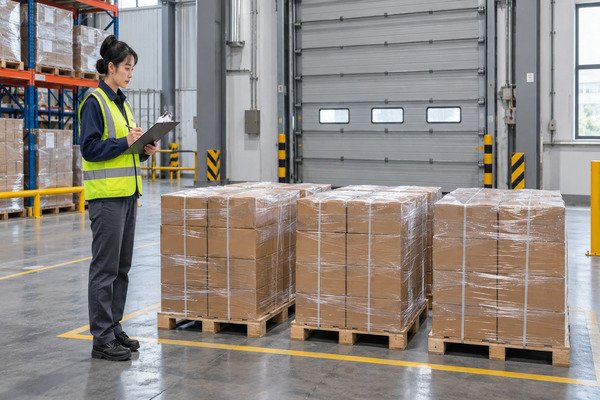
Ask the receiving team to complete the following information before final delivery is arranged:
| Required information | Warehouse response |
|---|---|
| Full address and receiving gate | Confirm location and entrance instructions |
| Contact person | Name, phone number and backup contact |
| Receiving hours | Include closure days and breaks |
| Appointment procedure | Booking contact, notice period and reference requirements |
| Vehicle restrictions | Size, height, access or parking limitations |
| Unloading equipment | Dock, forklift, tail lift or separately arranged equipment |
| Cargo handling | Pallet, crate or loose-carton requirements |
| Labor availability | Who will unload and how the work will be organized |
| Delivery paperwork | Required purchase-order, booking and receipt references |
| Delay contact | Person authorized to approve changes |
Keep the forwarder, destination carrier and warehouse working from the same confirmed information.
Frequently asked questions
Does DDP automatically include unloading?
No. Under Incoterms® 2020, DDP delivery is generally made with the goods ready for unloading. Check both the unloading arrangement and whether related charges are included in the transport contract.
Can I request a tail-lift truck after the goods arrive?
Ask the delivery provider, but do not rely on last-minute availability. The service must be suitable for the cargo’s weight, dimensions and delivery conditions.
Is the vessel’s arrival date the warehouse delivery date?
No. Cargo availability, release, inland transport and receiving arrangements must be coordinated before a warehouse delivery time can be confirmed.
Can the container stay at my warehouse overnight?
Only under an agreed and feasible arrangement. Confirm equipment availability, site suitability, collection timing and applicable charges before planning to retain it.
Conclusion
Door-to-door shipping from China works best when the receiving arrangements are planned as carefully as the international transport.
Confirm the exact delivery point, warehouse appointment, vehicle access and unloading method before dispatch. Make responsibility for labor, equipment, waiting time and container return clear in writing.
A complete delivery plan connects the freight quotation with what will actually happen at the warehouse. That helps reduce failed deliveries, avoidable handling and unexpected costs.
Plan your final delivery with Deeplinker
Share your destination address, receiving conditions, cargo dimensions and weights, and required delivery window with Deeplinker. Contact our team to discuss a transport plan that reflects how your warehouse can receive the goods.
References
-
ICC Academy — DAP & DDP Incoterms® 2020 explained: Key differences. Delivery and unloading responsibilities under DAP and DDP.
https://academy.iccwbo.org/incoterms/article/incoterms-2020-dap-or-ddp/ -
ICC Academy — Incoterms® 2020 C rules vs. D rules: Risk transfer explained. Delivery obligations and allocation of unloading costs under the D rules.
https://academy.iccwbo.org/incoterms/article/incoterms-2020-c-or-d-rules/ -
DHL Freight — FAQs for European Road Freight Shippers. Service-specific guidance on notification and delivery appointments.
https://www.dhl.com/dk-en/home/freight/help-center-for-european-road-and-rail/faqs-for-european-road-freight.html -
DHL Freight — APIs Product Manual, version 2026/R02. Examples of separately selected services, including tail-lift unloading and delivery time-slot booking.
https://developer.dhl.com/sites/default/files/2026-04/DHL%20API%20Developer%20Portal%20-%20DHL%20Freight%20APIs%20Product%20Manual%20-%202026%20R02_0.pdf -
Maersk — Where do I return my empty container? Guidance on locating shipment-specific empty-container return instructions.
https://www.maersk.com/support/faqs/2025/09/05/where-do-i-return-my-empty-container