

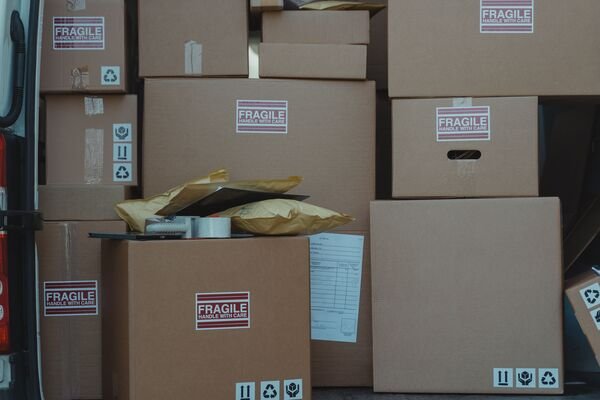
Your shipment arrives from China. Several cartons are wet, a pallet has collapsed, or a machine looks undamaged until your warehouse team opens the crate. Production is waiting, and the immediate question is straightforward: who pays?
Cargo damage does not automatically mean the carrier must reimburse the full invoice value. Responsibility depends on when and how the damage occurred, the contracts involved, the applicable law and the available evidence. Insurance adds a separate assessment: does the policy cover this particular loss?
For importers, wholesalers and manufacturers, the priority is to protect the goods, preserve claim rights and establish what happened. This guide explains how to approach those decisions without confusing commercial risk, carrier liability and cargo insurance.
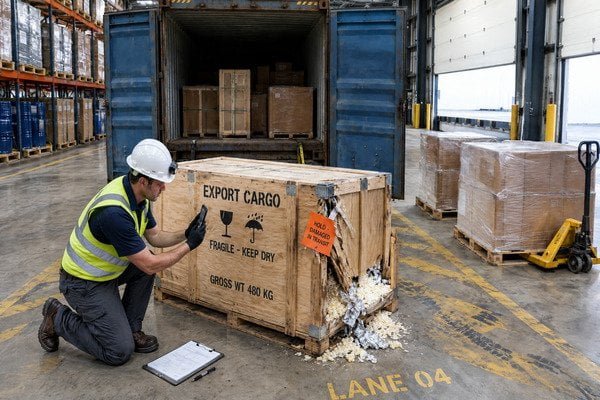
1. Why Cargo Gets Damaged During International Shipping
Damage can begin before the main international journey. A crate may be unsuitable for the machine inside it, a forklift may puncture a carton at a consolidation warehouse, or cargo may shift during final delivery.
Common patterns include:
- Impact and compression: crushed cartons, broken pallets, bent components or damage around lifting points.
- Movement and vibration: abrasion, loose fittings or internal damage where products can move inside their packaging.
- Moisture exposure: wet packaging, corrosion or mould requiring investigation of water ingress, condensation and conditions before loading.
- Handling or storage problems: inappropriate stacking, unsuitable equipment or exposure during transfers.
The visible symptom is only a starting point. A wet carton does not establish where water entered. An intact crate does not prove that its contents were protected throughout transit. Compare the condition before dispatch, at each handover and when the goods were unpacked.
2. Who Is Responsible for Cargo Damage?
Start with three separate questions: who bore the risk under the sale contract, who may be legally liable for the damage, and who has the right to bring the claim? These answers may involve different parties.
Identify each party’s role
Use the following as an investigation checklist, rather than a finding of liability:
| Party | Questions to investigate |
|---|---|
| Seller or packing contractor | Did the goods meet the agreed specification? Was the packaging suitable for the agreed journey? |
| Freight forwarder | Did it arrange transport as an agent, undertake carriage as a contracting carrier, or perform another service? What obligations did it accept? |
| Actual carrier | What condition was recorded when it received and delivered the cargo? What happened during its custody? |
| Warehouse or handling contractor | Was there a documented unloading, storage, lifting or transfer incident? |
| Buyer or consignee | Did damage arise during unloading or subsequent handling? Were agreed receiving procedures followed? |
Being the company that booked the shipment does not, by itself, settle responsibility. Equally, subcontracting the physical movement does not automatically remove a contracting carrier’s obligations. Examine the booking, transport documents and terms alongside the operational records.
Separate sales risk from transport liability
Incoterms® allocate responsibilities between seller and buyer; they do not replace the carrier’s liability regime. Paying freight to the destination does not necessarily mean the seller bears transit risk until arrival.
Insurance obligations also differ. Under Incoterms® 2020, CIF ordinarily requires Institute Cargo Clauses (C) cover or similar, while CIP requires the broader Clauses (A) cover or similar, subject to the parties’ permitted agreement. The ICC’s explanation of Incoterms® 2020 insurance requirements explains this distinction.
Record the agreed rule, named place or port, and edition in the sales contract. Then assess any supplier breach separately from a claim against the carrier.
Does a $20,000 shipment mean a $20,000 carrier payment?
No. Establishing liability and calculating compensation are separate tasks. Depending on the applicable regime, recovery may be limited by weight, packages or other statutory measures. Defences, valuation rules and valid contractual provisions may also affect recovery.
For a hypothetical $20,000 shipment of industrial parts, the invoice helps establish value; it does not establish an automatic $20,000 entitlement. Ask whoever assesses the claim to identify the governing rule, the relevant weight or package count, the calculation and any applicable exceptions. Avoid accepting an unexplained “standard international limit.”
3. Carrier Liability vs. Cargo Insurance: What Is the Difference?
The European Commission’s freight insurance guidance distinguishes cargo cover from carrier liability insurance. Paying for transportation does not, by itself, purchase protection for the full commercial value of the goods.
| Issue | Carrier liability | Cargo insurance |
|---|---|---|
| Basis of recovery | Legal responsibility under the applicable transport rules and contract | Loss falling within the policy’s cover |
| Main questions | Was the carrier responsible, and what defences or limits apply? | Is this cargo, journey and cause of loss insured? |
| Payment assessment | Recoverable loss subject to applicable liability rules | Policy valuation, limits, deductible, exclusions and conditions |
The carrier’s own liability policy protects its liability exposure. It is not the same as a cargo policy arranged for the goods.
Before shipment, request the actual insurance wording and certificate. Check the insured party, commodity description, value, route, storage arrangements and deductible. Ask specifically how the policy treats inadequate packing, inherent defects, moisture, delay, war and strikes. “All risks” is not an assurance that every loss is covered.
For route-specific insurance questions, Deeplinker’s guide to Strait of Hormuz shipping risks and cargo protection provides a separate planning checklist.
4. What Should Importers Do When Cargo Arrives Damaged?
Treat the discovery as both an operational incident and an evidence-gathering exercise. Assign one person to maintain the chronology, documents and outstanding deadlines.
Inspect and record the condition
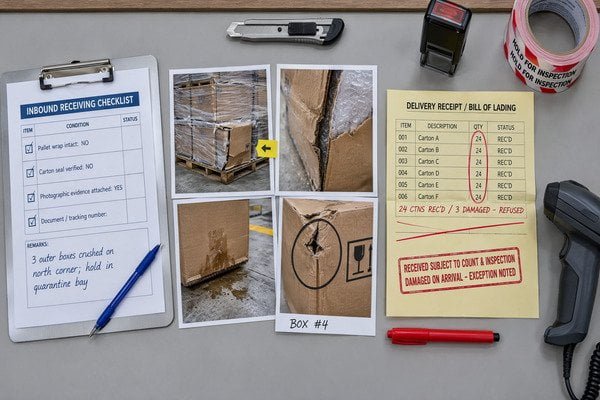
Check the container, seal, packaging and accessible goods before signing. Record specific visible exceptions: “three cartons wet on lower pallet” is more useful than “damage possible.” Photograph the overall load, affected items, labels and packaging before moving them where practicable.
If damage appears only during unpacking, record the opening sequence and identify the affected serial numbers. Preserve the original files and note who was present. Avoid describing an uncertain cause as an established fact.
Notify the relevant parties immediately
Send written notice to the relevant carrier and forwarder, and notify the insurer or broker through its required channel. Include the shipment reference, delivery and discovery dates, location, nature of damage and available photographs. State when the loss amount remains under assessment.
Do not wait for a complete repair quotation before reporting the incident. Chubb’s marine cargo claims guidance advises prompt notification, preservation of recovery rights and insurer involvement before accepting third-party settlements. Follow your own policy’s instructions.
Preserve evidence and limit further loss
Keep damaged goods and packaging available for inspection. Coordinate any survey and necessary handling with the insurer. Take reasonable steps to prevent deterioration, documenting urgent protective work and its cost. Obtain instructions before disposal, repair or settlement wherever practicable.
Create one claim folder containing the commercial invoice, packing list, bill of lading or waybill, delivery record, insurance documents, photographs, inspection findings and repair or loss estimates. Add correspondence and any available loading, temperature or handover records.
To make the financial claim reviewable, use a line-by-line schedule: item reference, quantity affected, documented condition, proposed remedy and supporting amount. Distinguish physical damage from other business costs, whose recoverability requires separate assessment.
Verify the deadline for the applicable transport regime
There is no universal international freight claims deadline. These examples illustrate why the transport mode and governing rules matter:
| Applicable framework | Damage notification example |
|---|---|
| Hague–Visby sea carriage, where applicable | Written notice generally before or at removal into the recipient’s custody; for non-apparent damage, within three days. Joint inspection provisions may affect notice requirements. |
| Montreal Convention international air carriage, where applicable | Written complaint immediately after discovery and no later than 14 days after receipt of damaged cargo. |
| CMR international road carriage, where applicable | Reservations for apparent damage at delivery; written reservations for non-apparent damage within seven days, excluding Sundays and public holidays. |
For sea carriage, Hague–Visby Article III, as enacted in UK legislation, distinguishes the evidential consequences of missing damage notice from the separate one-year suit time bar. Other sea-carriage regimes may differ.
For air cargo, Montreal Convention Articles 31 and 35 distinguish written complaints from the two-year period for bringing an action. Failure to complain on time can bar an action, subject to the Convention’s fraud exception.
The CMR Convention’s scope and damage reservations provisions concern qualifying international road carriage: generally, carriage for reward between two countries, at least one of which is a contracting country, subject to exclusions. Its rules must not be applied universally to sea, air or rail shipments.
Confirm insurance notification requirements and the deadline for commencing proceedings separately. Do not assume an acknowledgement, ongoing negotiation or an insurance claim stops a legal time bar.
5. How to Reduce Cargo Damage Before Shipment
Make damage prevention part of purchase and booking approval. Agree who prepares, checks and records the packing and loading arrangements.
Match packaging to the product and journey. Consider weight, fragility, centre of gravity, stacking and repeated handling. Obtain packaging specifications for expensive or sensitive equipment, rather than relying only on exterior photographs.
Plan securing and unloading together. Confirm lifting points, equipment capacity, access and the receiving facility’s capabilities. A machine that can be loaded at the factory still needs a workable unloading plan at destination.
Assess moisture exposure. Discuss appropriate barriers, corrosion protection and moisture-control measures with the packing specialist. Record the cargo and container condition before loading.
Review every transfer. Identify consolidation, terminal handling, storage and final delivery stages. For rail movements, Deeplinker’s guide to protecting cargo from vibration and shock explores packaging and securing considerations in more detail.
Confirm insurance before dispatch. Give the insurer accurate cargo and routing information, and resolve questions about cover before goods enter transit. For regulated products, the separate guide to lithium battery shipping, documentation and insurance addresses additional planning issues.
6. What If Cargo Is Damaged During Multimodal Transport?
Consider a hypothetical machine moving from a Chinese factory by truck to a rail terminal, then by rail and road to a European buyer. The crate arrives broken, but no operator reports an incident.
Build a custody timeline before deciding whom to blame:
- Match factory photographs to the machine’s serial number and crate markings.
- Compare collection, terminal, transfer and delivery records.
- Request available inspection reports, exception notes and handling photographs.
- Identify the first documented change in condition and any gaps in the record.
- Review who contracted for the whole movement and who performed each stage.
These records can narrow the investigation; they do not necessarily prove the precise cause. A broken crate first photographed at delivery may have been damaged earlier.
Different stages can engage different legal rules. OTIF’s explanation of the CIM rail carriage framework describes a distinct regime with its own scope. Do not assume that every China–Europe rail movement falls entirely under CIM.
Where the damage location remains unknown, examine the through-transport contract and applicable law rather than selecting whichever modal limit appears most favourable. Notify potentially relevant parties while investigating; waiting for operators to agree on responsibility can jeopardize deadlines.

FAQs
Can I claim if the outer packaging looks undamaged?
Potentially. Document unpacking, preserve the packaging and obtain a technical assessment where needed. Intact packaging alone neither proves nor disproves transit damage. Notify the relevant parties promptly and check the applicable concealed-damage requirements.
Does the carrier have to pay the full invoice value?
Not automatically. Liability, valuation, defences and applicable limits must be assessed. A commercial invoice supports the value claimed but does not determine the final compensation. Cargo insurance requires a separate review under the policy.
Should I wait for the carrier before contacting my insurer?
No. Notify the insurer or broker promptly while preserving claims against the carrier. Coordinate surveys, repairs and settlement proposals so that one process does not compromise the other.
Conclusion
Managing cargo damage starts with clear contracts, suitable preparation and useful handover records. When damage occurs, inspect promptly, preserve evidence, notify the relevant parties and verify the applicable deadlines. Keep carrier liability and cargo insurance separate throughout the assessment.
Planning a shipment from China? Explore Deeplinker’s international freight solutions and discuss your cargo characteristics, route and delivery requirements before booking.
References
Sources checked on 23 October 2026. Links appear beside the relevant discussion above.
- International Chamber of Commerce — Incoterms® 2020; CIF and CIP insurance requirements.
- European Commission, Access2Markets — Freight insurance; distinction between cargo cover and carrier liability insurance.
- Chubb — Marine Cargo Claims Guidelines; notifications, evidence and recovery rights.
- UK legislation — Carriage of Goods by Sea Act 1971, Schedule, Article III; Hague–Visby notice and suit provisions.
- EUR-Lex — Montreal Convention 1999, Articles 31 and 35; complaint and action deadlines.
- UNIDROIT — CMR Convention 1956, Articles 1, 2 and 30; scope and damage reservations.
- OTIF — CIM Uniform Rules Explanatory Report; rail-carriage scope and framework.